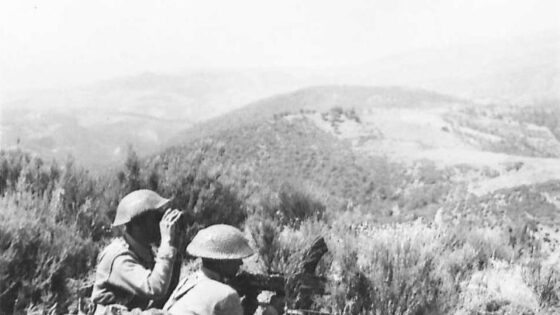
The battle of Poggio Grillo. The 11th Indian Brigade on the ridge above Bibbiano, 4–9 August 1944
A ridge above Bibbiano
On the evening of 4 August 1944 a company of Scottish soldiers climbed towards Poggio Grillo, a bare height with two summits above Bibbiano [1]. They belonged to the 2nd Battalion of the Queen’s Own Cameron Highlanders, in the 11th Brigade of the 4th Indian Division. Ten days earlier the brigade had attacked Campriano [2]. In the days that followed, the Nepalese Gurkhas of the 2/7th and the Indian soldiers of the 3/12th Frontier Force also fought on the ridge. Facing them were German Panzergrenadiers [3].
Between 4 and 10 August 43 soldiers of those units died. They are recorded by the Commonwealth War Graves Commission (CWGC), the body that cares for the graves of the Commonwealth war dead [4]. Of the German dead we know neither the names nor the number [5]. This page tells the story of those days and of what remains of them today.
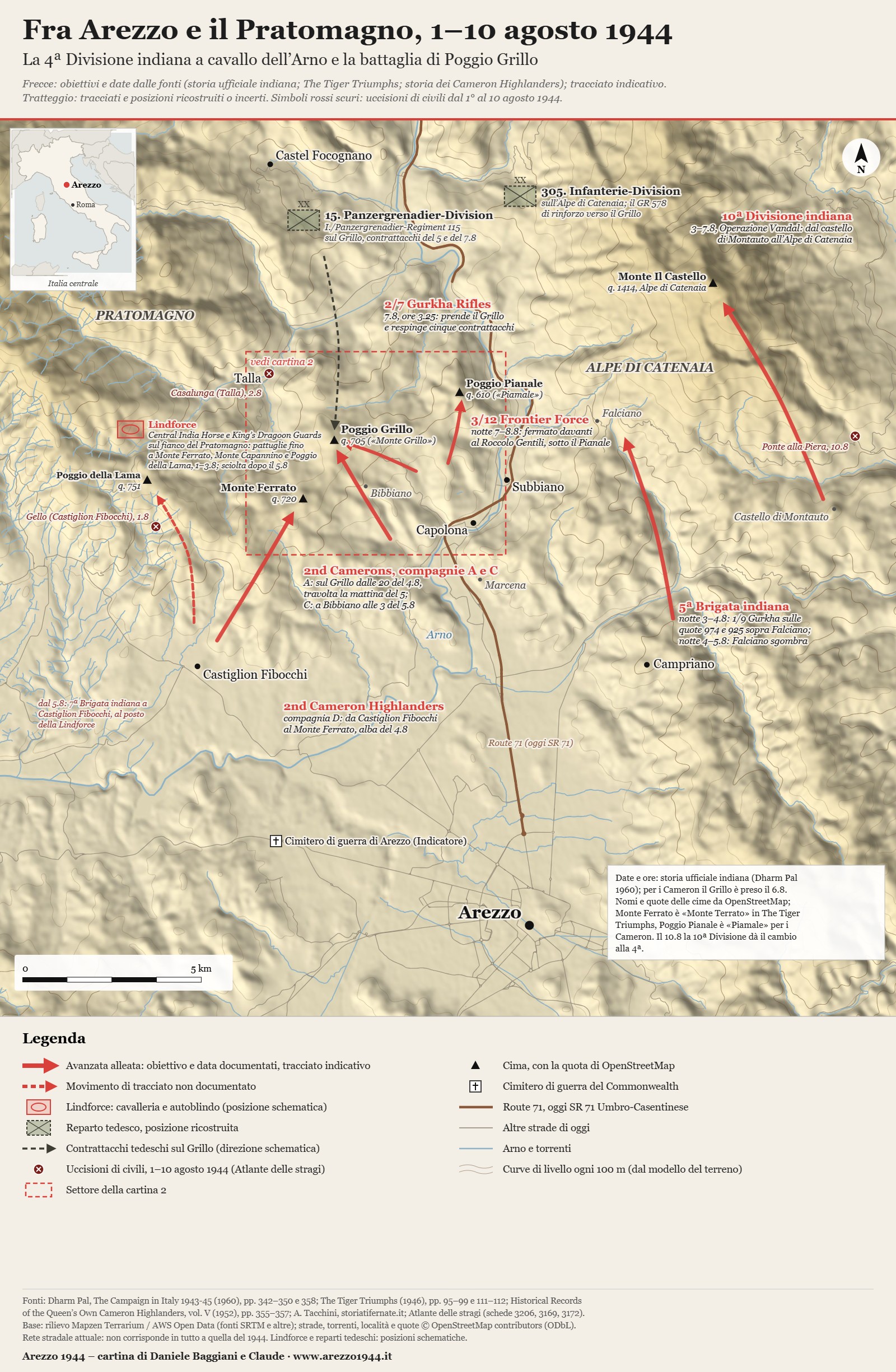
Open the full-size map ↗
They were soldiers of the Indian Army, the army of British India: volunteers from present-day India, Pakistan and Nepal, with officers who were mostly British. In every Indian brigade one British battalion served alongside two Indian or Gurkha battalions. The 11th Brigade was still commanded by Brigadier H.C. Partridge [2]. On 1 August the battalion was moved to the Chiassa area, east of Route 71, in reserve behind the 2/7th Gurkhas and the 3/12th. It crossed the Arno, to advance up the side west of Route 71, only between 3 and 4 August [6].
On 2 August Lieutenant-General Richard McCreery, commander of the British X Corps, ordered the attack towards Chitignano, Castel Focognano and Bibbiena. From there the attack on the Gothic Line, the great German defensive line in the Apennines, was to begin. Operation Vandal began at 9.30 p.m. on 3 August [7].
Further east the 10th Indian Division attacked the Alpe di Catenaia [8]. The 4th Indian Division of Major-General A.W.W. Holworthy, astride the Arno, was to take Falciano, Subbiano and Poggio Pianale [9]. West of the river the main task fell to the 11th Brigade. The left flank, towards the Pratomagno, was covered by a group of armoured cars and tanks, Lindforce [10].
Vandal lasted a week. On 4 August General Harold Alexander, commander of the Allied armies in Italy, decided to shift the weight of the Eighth Army to the Adriatic. From that decision came Operation Olive, which began on 25 August [11].
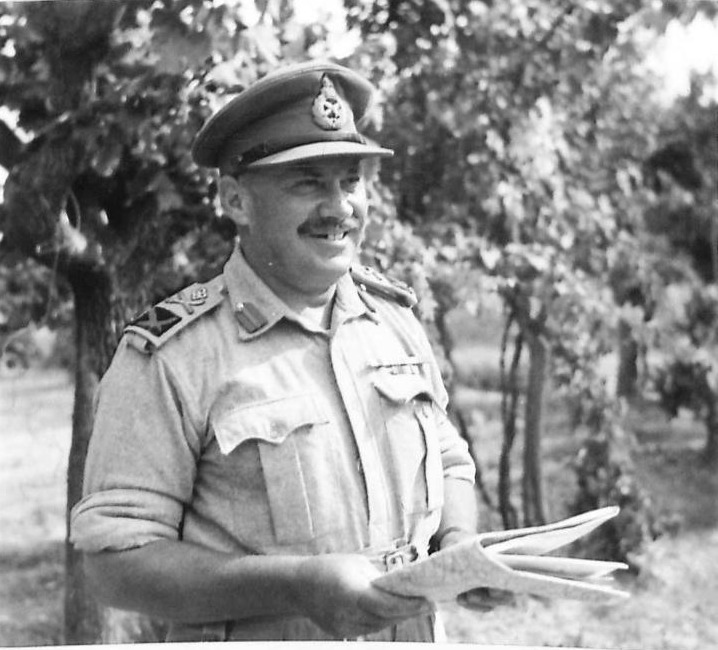
Major-General A.W.W. Holworthy, commander of the 4th Indian Division, near Arezzo, 29 July 1944. Photo: Sergeant Geoffrey Loughlin, No. 2 Army Film and Photographic Unit, Imperial War Museums, NA 17516, IWM Non Commercial Licence.
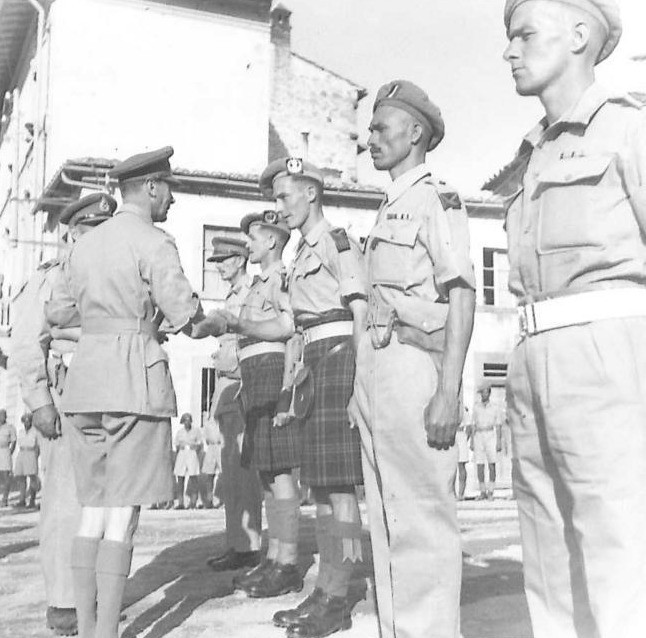
King George VI congratulates Major E.A. Cameron, of the 2nd Queen’s Own Cameron Highlanders, on 25 July 1944. Ten days later the battalion was fighting on the Grillo. The original caption reads ‘Cameronians’, which is the name of another Scottish regiment. Photo: Sergeant Geoffrey Loughlin, No. 2 Army Film and Photographic Unit, Imperial War Museums, NA 17171, IWM Non Commercial Licence. The identification of Lieutenant-Colonel Hill beside Major Cameron is still to be confirmed.
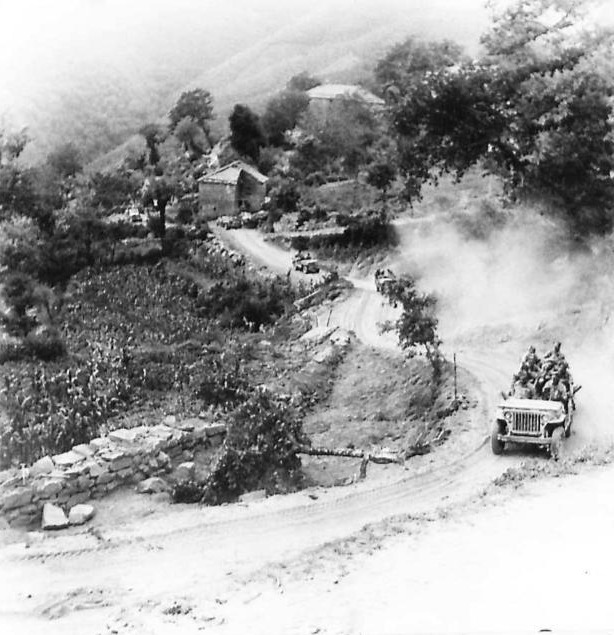
Infantry of the Gurkha and Frontier Force regiments, the two Indian regiments of the 11th Brigade, move up to the front on a mountain track, July 1944. Photo: Sergeant Geoffrey Loughlin, No. 2 Army Film and Photographic Unit, Imperial War Museums, NA 17042, IWM Non Commercial Licence.
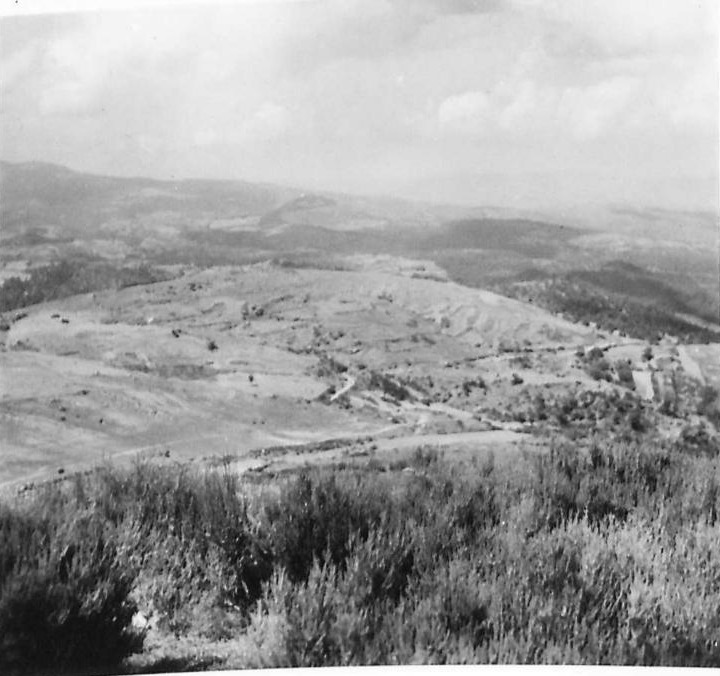
Panorama from Monte Castiglione towards Giovi and the German-held Arno valley, with the Gurkha positions on the slope in the foreground, 29 July 1944: first frame. Photo: Sergeant Geoffrey Loughlin, No. 2 Army Film and Photographic Unit, Imperial War Museums, NA 17492, IWM Non Commercial Licence.
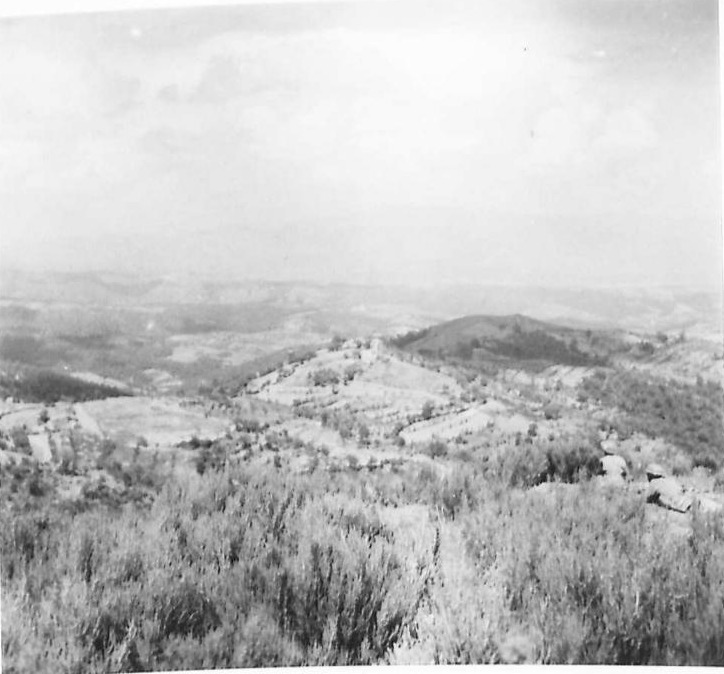
Panorama from Monte Castiglione, 29 July 1944: second frame of the same sequence. Photo: Sergeant Geoffrey Loughlin, No. 2 Army Film and Photographic Unit, Imperial War Museums, NA 17493, IWM Non Commercial Licence.
Who held the ridge
The history of the Cameron Highlanders, published in 1952, describes a ridge five miles long, about eight kilometres, on the right bank of the Arno. It is an estimate: as the crow flies it is little more than five kilometres [12]. To the west, Monte Ferrato, 720 metres. In the centre the Grillo, 705 metres, ‘the great barren twin-pimpled feature’. Then the ruined tower of Belfiore. To the east a wooded slope that the Camerons called ‘Piamale’: in all probability Poggio Pianale, 610 metres [12][13].
At its foot runs the Casentino road, the Route 71 of the Allied sources, today the SR 71 Umbro-Casentinese. The official Indian history, written in 1960 from the units’ records, lists four German positions: Monte Ferrato, Poggio del Grillo, Torri di Belfiore, Poggio Pianale [14].
Below the ridge lies Bibbiano. The summit of the Grillo is about a kilometre and a half north-west of the village. The Ferrato is almost two kilometres to the west, Poggio Pianale almost four to the north-east. According to OpenStreetMap the summits of the Ferrato and the Grillo are in the municipality of Talla, Bibbiano and Poggio Pianale in that of Capolona [13].
The Grillo mattered because of a road. It dominated a secondary road that crossed the Pratomagno to the north-east, from Laterina to Rassina, on the Casentino road. Along it supplies reached the German garrisons in the mountains. In all probability it is the road that passes through Talla, today partly the SP 59 [15].
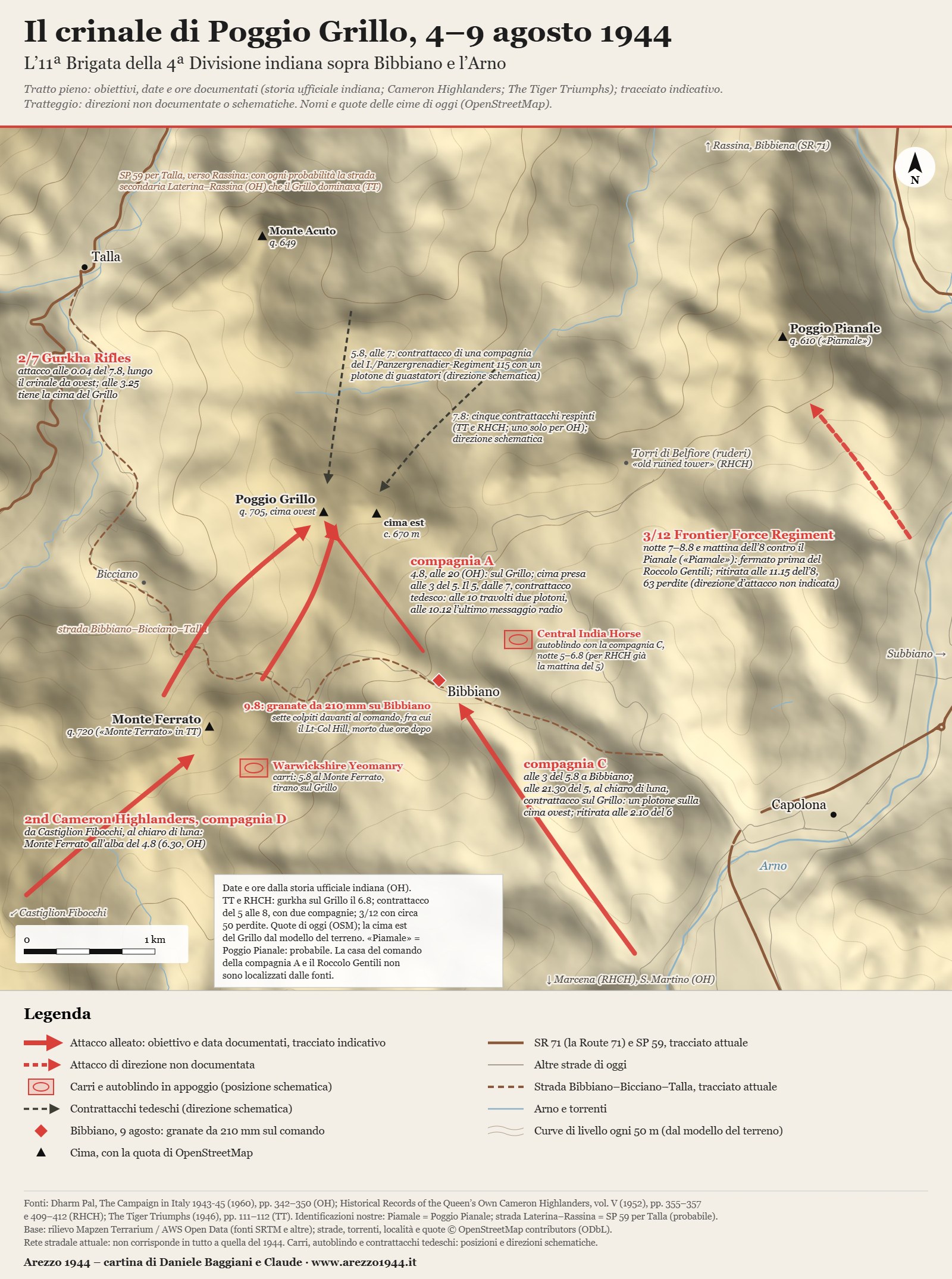
Open the full-size map ↗
On the Pratomagno stood the German 15th Panzergrenadier Division (15. Panzergrenadier-Division) of Generalleutnant Eberhard Rodt. It came under the LXXVI Panzer Corps (LXXVI. Panzerkorps) of General der Panzertruppe Traugott Herr, in the 10th Army [16]. Its Panzergrenadier-Regiment 115 held the eastern spurs of the massif, covering Subbiano and Talla. In 1944, according to the Lexikon der Wehrmacht, it was commanded by Oberst Wolfgang Maucke [16][17].
On the Grillo, according to the intelligence staff of the 4th Indian Division, was the I Battalion of the 115th. The other two were on the Talla road and around Faltona [17]. During the attack two battalions of Grenadier-Regiment 578, of the 305th Infantry Division, arrived as reinforcements: the division that had defended Campriano [17].
The 15th Division knew this area. Between 3 and 11 July, writes the historian Carlo Gentile, on the Pratomagno alone German soldiers killed at least fifty men [18]. The Atlas of Nazi and Fascist Massacres in Italy also attributes to the division the massacre of La Fontaccia, near Castiglion Fibocchi: fifteen dead, on 10 and 11 July. In the days of the Grillo, from 4 to 9 August, the Atlas records no killings of civilians at Bibbiano, Capolona or Castiglion Fibocchi. On 4 August, however, some civilians died at Vezza under German artillery fire [18][22].
Alvaro Tacchini, historian of the upper Tiber valley, places Poggio Pianale on the Lydia Line, a German line on the southernmost heights of the massif. Whether the Grillo was also part of it, the sources do not say [19].
Day by day
Monte Ferrato (4 August)
The Camerons’ plan, decided on 3 August, committed all four companies and had Poggio Pianale as its objective, on the night of 4–5 August [20]. D Company, from Castiglion Fibocchi, was to take Monte Ferrato at dawn on the 4th. A Company was to occupy a house that the maps call ‘C. Vecchia’. C Company was to enter Bibbiano, coming from San Martino; B Company protected the sappers. The Grillo was given to A Company only on the morning of the 4th, after a meeting between the battalion commander and the brigade commander: the order reached the company at 10 a.m. [20]. With the battalion were tanks of the Warwickshire Yeomanry, a British regiment that began as volunteer cavalry. There were two troops according to the official history, four according to the battalion’s operation order: two of A Squadron and two of C Squadron. The order also allotted a squadron of armoured cars of the Central India Horse [20].
D Company attacked the Ferrato at first light, from Pod. Spedale: at 5.20 a.m. according to the battalion’s report. By 6.30 a.m. it was on the summit, according to the official history and the war diary. A German machine gun wounded the company commander, Captain J. Stirling, in the face and leg, and one soldier. Then, after slight resistance, the Germans withdrew, with one killed and four taken prisoner. The company then occupied Vezza, which one of its patrols had found clear [21].
That day three men of the Camerons died: Thomas Bainbridge, aged 22, Hector Beattie, 23, and George Tanton, 19 [4]. The battalion war diary records three dead that day. Two were from C Company: they fell at 7.50 p.m. in the capture of a height that the diary calls ‘Capolona feature’, between Vezza and Bibbiano, where there were also five wounded. The third was one of the battalion’s pioneers, with B Company: a shell killed him while he was sweeping the Bibbiano road for mines. Which name belongs to which man, the diary does not say [22].
On the afternoon of the 4th, at about 4 p.m., Vezza came under heavy German artillery fire. The civilians were leaving the village, and some of them were killed. So writes the commander of A Company, who had gone up to Vezza to study the attack on the Grillo. How many they were, and who, his report does not say [22].
On 5 August C Company of the 1st Royal Sussex, a British battalion of the 7th Indian Brigade, relieved the Camerons on the Ferrato. The battalion stayed in that sector until the relief of 10–11 August [21].
A Company on the Grillo (night of 4–5 and 5 August)
A Company, under Major J.M. Underwood, was ready at 7.40 p.m., in heavy rain, in the forming-up area near Vezza. At 8 p.m. it crossed the start line, a bend in the road: this is the time given by the official history and the war diary. According to Underwood’s report the artillery began to shell the Grillo at about 8.30 p.m., with the company some 800 metres from the summit. At 9.40 p.m. the fire lifted, and the company went in. Lieutenant W. Jack, who according to his letter commanded No. 8 Platoon, recalls the fire from 7.30 to 8.45 p.m. and the last rounds at 9.15 p.m. [23][24].
It met little resistance. Jack’s platoon occupied one of the two summits. Lieutenant George Macpherson Poe, aged 20, may have killed some Germans in the buildings of a farm, which became company headquarters: so Jack believes [23]. By 11.55 p.m. on the 4th, writes the battalion war diary, the attack was complete and the company was spread over the whole feature. The official history gives the summit as taken at 3 a.m. on the 5th. At dawn five Germans surrendered [23][24].
By 9 p.m. C Company had surrounded Bibbiano, and at 2.20 a.m. on the 5th it occupied the village, with one or two Germans still inside. The battalion’s report gives 3.20 a.m., the official history 3 a.m. According to the official history the Camerons took all their objectives without much opposition. The regimental history speaks of a fierce little fire-fight [24][25]. In the house chosen as C Company headquarters the soldiers found a copy of Lord Jim, the novel by Joseph Conrad. It bore the inscription of a German soldier: ‘Bibbiano, Tuscany, 5/8/44.’ [25].
On the morning of the 5th the German Panzergrenadiers counter-attacked the Grillo with a platoon of assault pioneers, engineers trained to attack with explosives. Shortly after stand-down at dawn the German mortars shelled the company for about twenty minutes; then two German platoons attacked No. 7 Platoon. At 7.50 a.m. the company called for defensive artillery fire [26]. On the time and strength of the attack the sources disagree [26]. Underwood reported: ‘Situation desperate. House mined.’ [23]
After an hour and a half of defensive fire the company reported that two platoons had been overrun, and that the fighting was too close for the artillery to help. At 10.12 a.m. the company’s wireless sent out its last appeal, then fell silent [27]. At 1.30 p.m. a Royal Sussex patrol, heading for the Grillo from the Ferrato, saw seven Germans between itself and the summit: A Company had been cut off [27]. The pioneers blew in the door with explosive charges, and the fighting went from room to room. Underwood, the last man still on his feet, was taken among fifteen dead and wounded [27]. The report that Underwood wrote for the battalion war diary tells the end differently. The Germans blew in the door of a separate room, where four men were put out of action, and then the door of the house. Left with three men and the wounded, Underwood burned the documents. When the Germans shouted that the house was mined, and a stretcher-bearer confirmed it, ‘after over 4 hours we went out’ [27].
Poe, who held the small room at the entrance with two men, took the blast of two grenades full in the face. According to Underwood he was killed after leaving the house, still dazed: he got into the line of fire of two German machine guns behind the house [27]. As the prisoners came out, a platoon of the company that was still intact counter-attacked. The column of prisoners and wounded was taken back over the hill. After about a mile, a British tank of the Warwickshire Yeomanry opened fire on it. The column kept stopping to give water to the wounded. The second shot hit the head of the column: it killed the German captain and, Underwood writes, some of his own men too. At the next shot Underwood ran. He lay hidden all day and set off between 9 and 9.30 p.m. At 4.30 a.m. on the 6th he reached the British lines at Pod. Ierna; by 8.25 a.m. he was at battalion tactical headquarters [27]. Jack was taken prisoner. In his letter, published in the regimental history, he wrote: ‘Ours was not a glorious end’ [23].
On 5 August eleven men of the Camerons died, between A Company and C Company’s night counter-attack. Among them were Poe and Privates John Quirie, aged 24, and Ronald Bonner, 19 [4][23]. Quirie was a stretcher-bearer: he was shot dead as he left the house, wearing the Red Cross armband and unarmed [4][23][27]. The other men of A Company were wounded or taken. Of the Grillo garrison, three officers and sixty men, only the commander came back. So writes The Tiger Triumphs, the book published in 1946 for the Government of India; the official history gives the same losses [28].
The counter-attack by moonlight (night of 5–6 August)
On the afternoon of the 5th C Company, together with the Central India Horse, judged a daylight attack impossible: it would attack silently, by night. The company moved to Vezza and set off from there. At 9.30 p.m. on the 5th according to the official history, at about 10.30 p.m. according to the war diary, by the light of the full moon, C Company counter-attacked the Grillo. It was followed by the armoured cars of the Central India Horse, the Division’s reconnaissance regiment [29]. Lieutenant Robin Collier’s platoon reached the left-hand summit, killed seven Germans and took one prisoner, losing one man [29]. The rest of the company ran into a whole German company. Where the track narrowed, the men of the Central India Horse dismounted their machine guns and went on foot [30].
The attack failed: the Germans held the Grillo in strength. At 1 a.m. on the 6th the company reported the failure; at 2.10 a.m., according to the official history, it was withdrawn, and by 5.15 a.m. it was back in Bibbiano. It had three dead, six wounded and eleven missing according to the official history, two dead and six wounded according to the war diary. The diary adds two men of D Company killed by a shell on their company headquarters at Vezza, and two mortarmen wounded [29]. Collier received the Military Cross, a British decoration for courage in combat [31]. The officer commanding the armoured cars disappeared in the night. In all probability he was Captain Stott of the Central India Horse, whom Jack remembers as taken prisoner on the Grillo [32].
On 6 August Private Edwin Hughes of the Camerons died, and Sowar (cavalry trooper) Bachan Singh of the Central India Horse, aged 22 [4].
The Gurkhas on the Grillo, the 3/12th below the Pianale (7–8 August)
The Grillo was still in German hands. On 6 August Brigadier Partridge gave new orders, and the task passed to the 2/7th Gurkha Rifles [33]. At 10.15 a.m. on the 7th the Camerons’ patrols found the left-hand summit of the Grillo and the tower of Belfiore still held by the Germans. The 2/7th attacked on the night of 7–8 August, from the C. Vecchia area, with full artillery support: this was Operation SATURN. The Camerons’ order and the war diary of the 1st Royal Sussex set it for midnight. The official history gives the start at 12.04 a.m. and the summit taken at 3.25 a.m.: the times fit, but the date should read 8 August. By 6.30 a.m. on the 8th the 7th Brigade knew that the attack had succeeded [33]. The Tiger Triumphs and the regimental history speak of five counter-attacks beaten off; the official history of only one [34]. At 9.35 a.m. on the 8th, according to the war diary of the 1st Royal Sussex, the Gurkhas had taken the Grillo by surprise. They were pinned down with the Germans some 270 metres away, and had already beaten off two counter-attacks [34]. The Gurkhas had seven killed and fourteen wounded. The CWGC records the seven dead on 8 August [4][33].
Poggio Pianale remained, at the eastern end of the ridge, one of the Division’s objectives [9]. On the same night the 3/12th Frontier Force attacked it, silently, with artillery on call: this was Operation SOCRATES. By dawn, according to the Camerons’ war diary, the companies had got only half way up; according to the Royal Sussex, as far as a contour line east of the summit [35]. A strong German position halted the leading companies short of the Roccolo Gentili, the spur east of the summit [35]. At dawn the companies were withdrawn. At 9 a.m. on the 8th they attacked again and were pinned down about fifty yards, some 45 metres, from the objective [35].
At 11.15 a.m. the battalion withdrew, with 63 casualties. Among the dead was a company commander, Major John Plampin Oakes, aged 22 [4][35]. That day fourteen men of the 3/12th died: Oakes, seven Sikhs and six Muslims, to judge by their names [4].
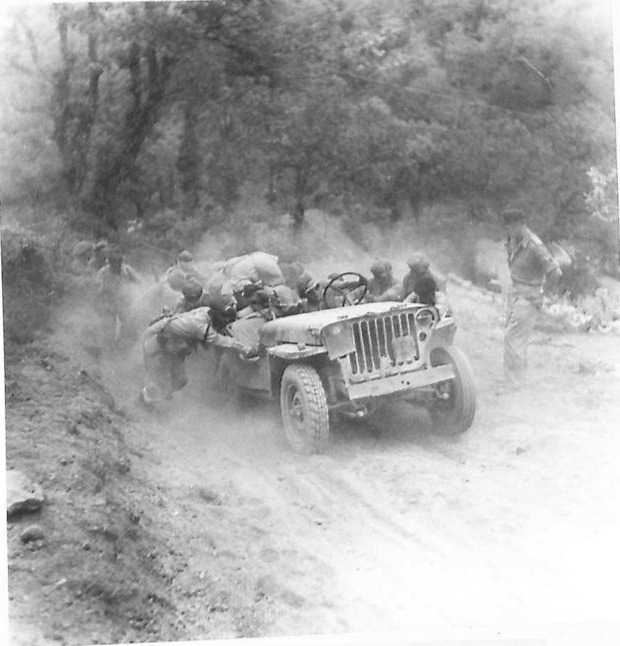
Sikh soldiers of the Frontier Force Regiment push a jeep up a mountain track of the 4th Indian Division, 20 July 1944. The caption does not give the battalion: if, as seems likely, it is the 3/12th, these are men of the battalion that attacked Poggio Pianale on 8 August. Photo: Sergeant Geoffrey Loughlin, No. 2 Army Film and Photographic Unit, Imperial War Museums, NA 17051, IWM Non Commercial Licence.
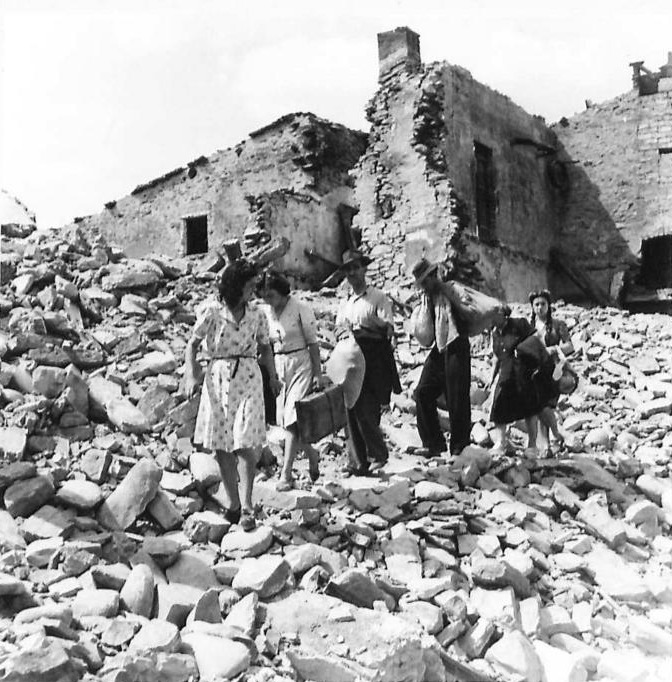
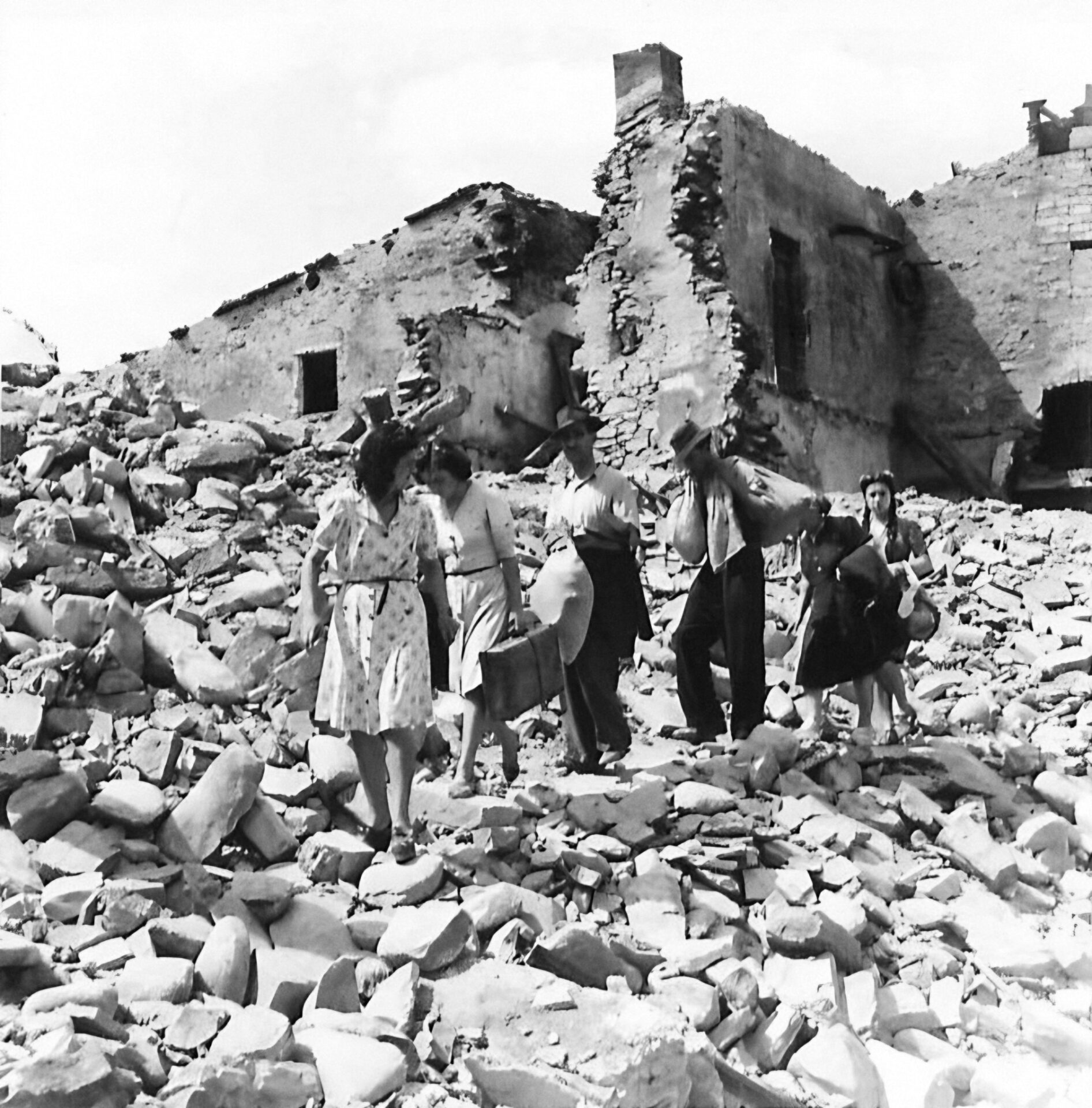
Refugees from Subbiano cross the rubble of Castelnuovo, 3–4 km south of Subbiano, towards Arezzo, 8 August 1944. The same day, at 11.15 a.m., the 3/12th Frontier Force was withdrawing from the slopes of Poggio Pianale. Photo: Sergeant Bill Wooldridge, No. 2 Army Film and Photographic Unit, Imperial War Museums, NA 17726, IWM Non Commercial Licence.
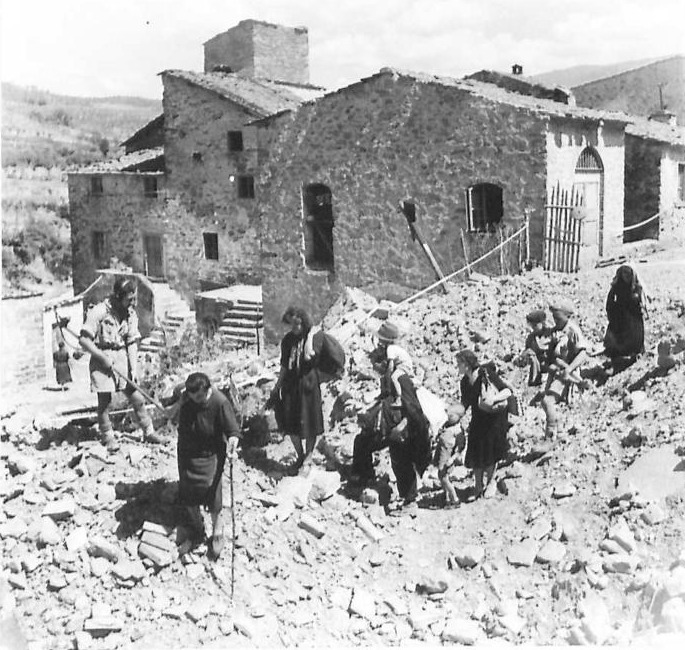
Refugees from Subbiano pass among the destroyed houses of Ponte Caliano, 8 August 1944. Photo: Sergeant Bill Wooldridge, No. 2 Army Film and Photographic Unit, Imperial War Museums, NA 17721, IWM Non Commercial Licence.
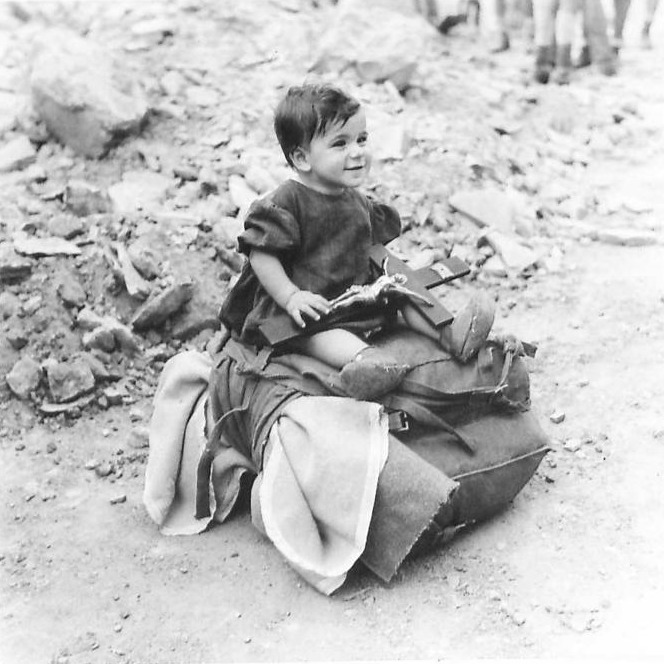
A child evacuated from Subbiano with the few things the family had saved, 8 August 1944. Photo: Sergeant Bill Wooldridge, No. 2 Army Film and Photographic Unit, Imperial War Museums, NA 17725, IWM Non Commercial Licence.
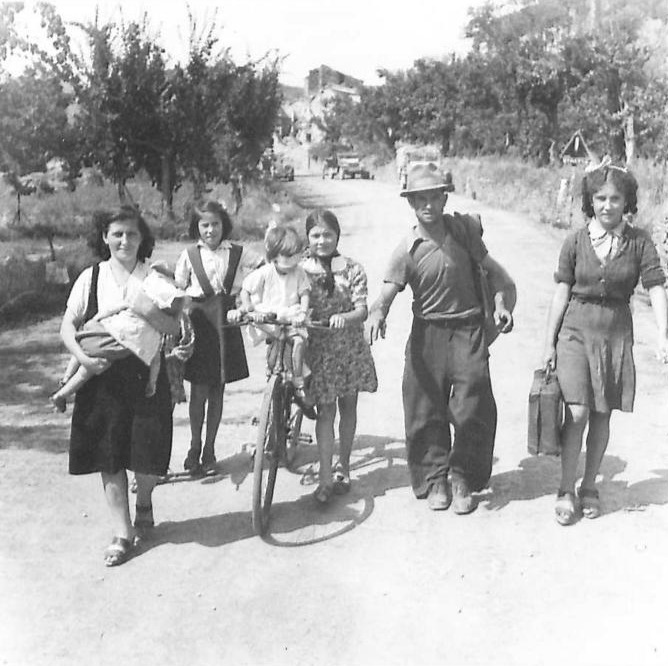
A refugee carries her wounded son through the rubble of Castelnuovo, 3–4 km south of Subbiano, towards Arezzo, 8 August 1944. Photo: Sergeant Bill Wooldridge, No. 2 Army Film and Photographic Unit, Imperial War Museums, NA 17727, IWM Non Commercial Licence.
The shells on Bibbiano (9 August)
The mopping-up south of the ridge planned for the 8th did not take place: the three night operations had only partly succeeded. On 8 August the Camerons were to attack, with tanks, the summit between the Grillo and Belfiore, and then Belfiore itself. The attack was put off to the night and then cancelled: patrols with the tanks had found that the tanks could not move freely. During the night platoons of B and D Companies occupied, without fighting, three places that the diary calls Il Botti, Cecina and Pian[elli]. The tower of Belfiore was still a mile and a half ahead [36].
On the 9th Vezza and Bibbiano were shelled all night and all morning. At 1.40 p.m. a very heavy bombardment began on Bibbiano and lasted a quarter of an hour; according to the regimental history these were German 210-millimetre shells, a heavy calibre. At about 1.55 p.m. a shell landed almost on the door of the battalion’s tactical headquarters, which had moved up to Bibbiano the night before, into C Company’s area. It hit seven men [37]. Among them was Lieutenant-Colonel Maurice George Oakley Hill, known as ‘Moggs’, who had commanded the battalion for about four months. Also badly wounded were Major L. Evans, of the British 11th Field Regiment, and two soldiers, Jones of the Intelligence Section and Duncan of the Signals. Private James Harvie, of the Signals, was killed outright. Major J.A. Cochrane, commanding C Company, was slightly wounded in the face. With Hill was also Captain Gusberti, of the Italian Army, the battalion’s interpreter [37]. The battalion’s report thought that the Germans had seen the tanks moving by the dust they raised [37].
Hill was given a transfusion and died at 3.30 p.m., at the aid post. The second-in-command arrived in time to see him. He was buried on 11 August at 5 p.m., in the cemetery of the 4th Indian Division, ‘a few miles North of AREZZO’, among the vineyards according to the regimental history. With him went the battalion’s pipe band, the divisional and brigade commanders, and the commanding officers of the 1st Royal Sussex, the 2/7th Gurkhas and the 3/12th, with small parties of their men [37]. On the afternoon of the 9th the brigade commander said of him: ‘He was too brave.’ Command passed to Major J.C. Thomson [37].
On the 9th Private James Harvie of the Camerons and Sepoy (infantry private) Mir Man of the 3/12th, aged 18, also died [4]. What the people of Bibbiano went through in those days, under fire, the military sources do not say [38].
The relief (10 August)
On 10 August Operation Vandal was abruptly suspended, and the 10th Indian Division began to relieve the 4th [39]. On the morning of the 9th the Camerons had already been warned that within two days the whole Division would come out of the line, in great secrecy. On the night of 10–11 August they were relieved by the 1st Durham Light Infantry and two companies of the 2/4th Gurkha Rifles; command passed at 1.55 a.m. on the 11th. During the relief two companies of the 2/7th Gurkhas on the Grillo were attacked, and beat off the attacks [39]. At 1.10 p.m. on 11 August the Durham Light Infantry believed that the Germans had left the line between the Pianale and Belfiore. By 5.30 p.m. one of its companies was at Belfiore; at 9.20 a.m. on the 12th it had an observation post on the Pianale [39]. Sepoy Dev Singh of the 3/12th and Rifleman Ujir Sing Rai of the 2/7th died on 10 August [4]. The Region of Tuscany dates the liberation of Capolona to 5 August, that of Subbiano to the 8th and that of Talla to the 20th. By 24 August the Pratomagno was clear [40].
Two memories from the valley
Signor Vittorio – Vittorio Emanuele, as was common at the time – was seven years old in August 1944. We do not know his surname. He lived with his father and mother, who were farmers, at the Borghetto, near Poggio Grillo. Around 2021, at Subbiano, he told his memories to Daniele Baggiani [41].
In the days before the attack, five or six German soldiers were staying in their house. They manned a machine-gun post defending the Grillo, perhaps a strongpoint with two machine guns and a mortar. Signor Vittorio remembers them as kind. He remembers two attacks and the great noise of the bombs. The first, at night, failed; the second, perhaps the next day, succeeded. When everything had calmed down he went up the hill with other children. In the positions they found the soldiers who had stayed in their house: their heads had been cut off and placed on the edge of the trench.
It is a childhood memory, told more than seventy years later. The documents consulted for this page describe several attacks on the Grillo between 4 and 8 August, and which two he remembers cannot be established. So far they offer no corroboration of what the children found.
At Bibbiano another episode is remembered. The Germans took up position coming up from the valley floor and reached the village cemetery with their guns. On a tight bend the guns could not get through, and to make room for them an old, tall cypress was cut down [42].
The fallen
Between 4 and 10 August 1944 the CWGC records 43 dead in the units of the Grillo. They were 18 Cameron Highlanders, 16 men of the 3/12th Frontier Force, 8 Gurkhas of the 2/7th and a sowar of the Central India Horse [4]. These are the dead of those units on those days: of many of them we do not know where they fell.
The Camerons were a British battalion, of a Scottish regiment. The Gurkhas came almost all from eastern Nepal. The men of the 3/12th, Sikhs and Muslims, came from villages that are today in India and Pakistan [4]. After Indian independence their units went separate ways. The Frontier Force Regiment was allotted in 1947 to the Pakistan Army, where the battalion still exists as the 5th Battalion of the regiment [43]. The 7th Gurkha Rifles passed to the British Army in 1948; in 1994 it was merged into the Royal Gurkha Rifles [44].
The Camerons lie almost all in Arezzo War Cemetery, at the Indicatore; Hill is buried beside seven of his men. The cemetery was opened in November 1944, and graves from the surrounding area were brought into it [45]. Two Camerons are in Forlì War Cemetery, then behind the German lines: Lance-Corporal Daniel Patrick McKenna and Private Robert Snedden. Jack remembers McKenna as having died of wounds. It is likely that they died as prisoners, but this is not verified [46].
Of the 3/12th, seven men are buried at Arezzo. Among them is Oakes, and there are three young men of 18 and 19. The other nine have no known grave: their names are on the Cassino Memorial, with that of Sowar Bachan Singh [4][47]. The Gurkhas of the 2/7th all lie at Arezzo. They were Rais and Limbus, and one Magar [4].
Of the German soldiers who fell on the Grillo we know neither the names nor the number. According to the Volksbund, the German body that cares for war graves, the German dead of the province of Arezzo were gathered after 1955 at Pomezia. For those of the Grillo this is not verified [5]. The names, ages, graves and home villages are in the section ‘The fallen’.
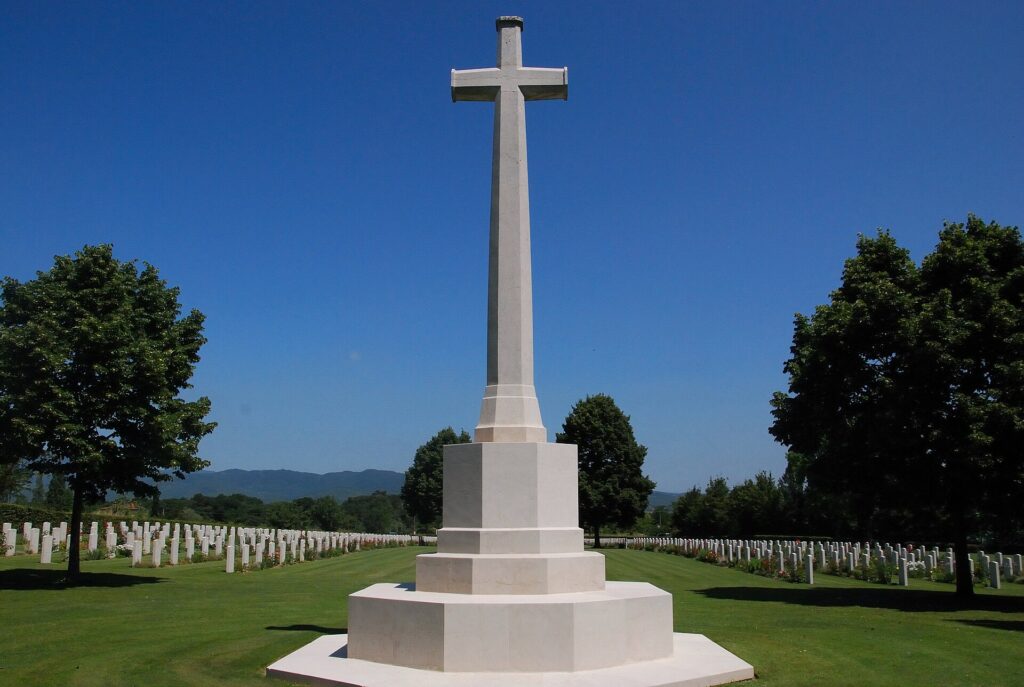
The Cross of Sacrifice in Arezzo War Cemetery, where men of the Cameron Highlanders, the 3/12th Frontier Force and the 2/7th Gurkha Rifles who died between 4 and 10 August 1944 lie. Photo: cisko66, Wikimedia Commons (from Panoramio), Arezzo,_Commonwealth_Military_Cemeteries_-_panoramio_(2).jpg, CC BY 3.0.
Remembrance today
On 29 August 2019 the municipalities of Talla and Capolona and the Unione dei Comuni montani del Casentino (the union of the Casentino mountain municipalities) signed a memorandum of understanding for Poggio Grillo. On 1 September 2019 a memorial stone made by the students of the ‘Piero della Francesca’ art school in Arezzo was placed on the Grillo. A British and an Indian delegation were present [48].
In 2020 a Cor-ten steel stele, the work of the blacksmith Caporali of Santa Mama, was placed on the ridge. It stands at 691 metres, on the boundary between Talla and Capolona. It was set up by the two municipalities with the association ‘Quelli della Karin’ of Subbiano, and unveiled on 13 September 2020 [49]. The inscription names the two municipalities, the ‘Gurkha Brigade’, ‘Quelli della Karin’ and a ‘Brigadier Jackman’, whom we have not identified [49].
Since then the two municipalities have held a commemoration at the stele every year, in early September, meeting at the Carra junction [50]. In 2021 the President of the Region of Tuscany took part. In 2022 a delegation from the Gurkha Museum in Winchester was welcomed. In 2023 those present included ‘Quelli della Karin’ and the ANPI [50].
On 3 September 2024 the Mayor of Arezzo and representatives of the Region and the ANPI were present. Young serving Gurkhas also climbed to the Grillo, there with the help of ‘Quelli della Karin’ [50]. On 7 September 2025 the commemoration ended with a lunch in the square of Bibbiano church. In 2026, on the first Sunday of September, the vice-president of ‘Quelli della Karin’ described the course of the battle before the two mayors and the ANPI [50].
At Bibbiano, beside the church, the war memorial remembers the village’s dead of the two wars, the partisans and the civilians [51]. Every 16 July, from 2024 to 2026, the programme of the Comune di Arezzo includes a wreath at the war cemetery [52]. At Subbiano the ‘Quelli della Karin’ museum displays finds from the 1944 front; its description names the Sikh and Gurkha soldiers of the Indian divisions [53].
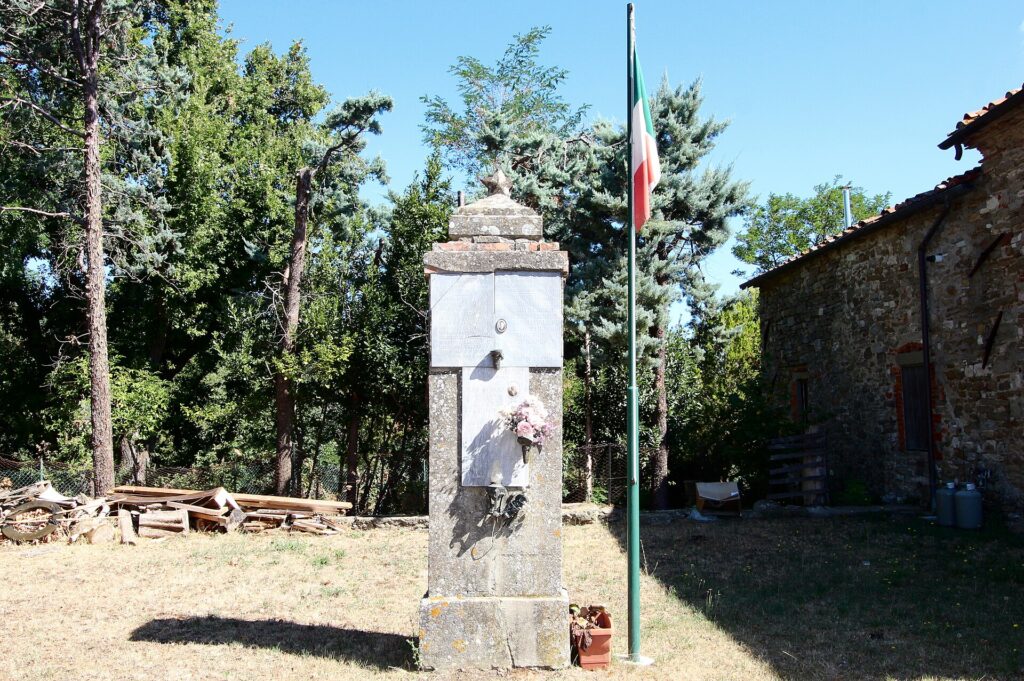
The war memorial at Bibbiano. Photo: LigaDue, Wikimedia Commons, BibbianoCapolonaMonumentoAiCaduti1.jpg, CC BY-SA 4.0.
In October 2023 two members of ‘Quelli della Karin’ found the remains of a soldier of the Indian Army on the Alpe di Catenaia. On 20 November 2025 a Gurkha bearer party accompanied him to his burial in Arezzo War Cemetery. He was not one of the Grillo dead, but in all probability a soldier of the 10th Indian Division [54]. In September 2025 a stele for the Allied dead and for the partisans, promoted by ‘Quelli della Karin’, was unveiled on the Alpe di Catenaia. Present were the colonel serving as Defence Attaché at the Embassy of India in Rome and several mayors, including those of Capolona and Talla [54].
The names of the Grillo dead are written at Arezzo, at Forlì and at Cassino; on the ridge where they fell there is now the stele. Of the German soldiers we do not know the names. Of the people of Bibbiano, in the days of the shells, the military sources say nothing.
In brief
- Poggio Grillo is a bare ridge with two summits above Bibbiano (Capolona), between Monte Ferrato and Poggio Pianale, on the eastern spurs of the Pratomagno. According to OpenStreetMap the summits are in the municipality of Talla.
- From 4 to 10 August 1944, in Operation Vandal, the 11th Brigade of the 4th Indian Division fought for the ridge against the German Panzergrenadier-Regiment 115.
- 4 August: D Company of the 2nd Cameron Highlanders takes Monte Ferrato. In the evening A Company climbs the Grillo and holds it by 11.55 p.m.; at 2.20 a.m. on the 5th C Company occupies Bibbiano.
- 5 August: a German counter-attack overruns A Company on the summit. In the evening C Company’s counter-attack fails.
- Night of 7–8 August: the 2/7th Gurkhas take the summit of the Grillo (Operation SATURN). On the same night the 3/12th Frontier Force is halted below Poggio Pianale (Operation SOCRATES).
- 9 August: in the early afternoon a German shell mortally wounds Lieutenant-Colonel Hill, commanding the Camerons, at Bibbiano. On the 10th the 10th Indian Division begins the relief.
- Between 4 and 10 August the CWGC records 43 dead in the Allied units: soldiers of the Scottish regiment of the Cameron Highlanders, Nepalese Gurkhas, Sikhs and Muslims of the army of British India (their faith is inferred from their names). Of the Germans neither the names nor the number are known.
- Since 2020 the municipalities of Talla and Capolona have remembered the battle every year, in early September, at the Poggio Grillo stele.
Who’s who
Allies
- Harold Alexander, General, commander of the Allied armies in Italy. On 4 August 1944 he decided to shift the weight of the Eighth Army to the Adriatic [11].
- Oliver Leese, Lieutenant-General, commander of the British Eighth Army. On 4 August, at Orvieto airfield, he set out to Alexander his doubts about the attack in the centre [11].
- Richard McCreery, Lieutenant-General, commander of the British X Corps. On 2 August he ordered Operation Vandal [7].
- A.W.W. Holworthy, Major-General, commander of the 4th Indian Division from March 1944 [9].
- H.C. Partridge, Brigadier, commander of the 11th Indian Brigade from May to October 1944. On 6 August he gave the orders for the Gurkha attack [2][33].
- Maurice George Oakley Hill, ‘Moggs’, Lieutenant-Colonel, commanding the 2nd Cameron Highlanders. Wounded at Bibbiano on 9 August at about 1.55 p.m., he died at 3.30 p.m. [37].
- J.C. Thomson, Major, later Lieutenant-Colonel: took command of the battalion after Hill [37].
- J.M. Underwood, Major, commanding A Company. Taken on 5 August, he escaped and reached the British lines at 4.30 a.m. on the 6th. His report is in the battalion war diary [27].
- W. Jack, Lieutenant, commanding No. 8 Platoon according to his letter; the reserve platoon according to the battalion’s report. Taken prisoner on 5 August, he wrote to the battalion the letter published in the regimental history [23].
- George Macpherson Poe, Lieutenant, aged 20, of A Company. Died on 5 August. He commanded No. 9 Platoon according to a memorial web page, No. 8 according to the battalion’s report [23].
- Robin Cameron Herne Collier, Lieutenant, of C Company. Military Cross for the counter-attack on the night of 5–6 August [31].
- J. Stirling, Captain, commanding D Company, wounded on the Ferrato on 4 August [21].
- Stott, Captain of the Central India Horse, taken prisoner on the Grillo; in all probability the armoured-car officer who disappeared on the night of 5–6 August [32].
- John Plampin Oakes, Major of the 3/12th Frontier Force, aged 22, company commander. Killed in the attack on the ‘Roccolo’ of 7–8 August [35].
- L. Evans, Major, commanding D Battery of the 11th Field Regiment, badly wounded at Bibbiano on 9 August [37].
- Gusberti, Captain in the Italian Army, interpreter to the Cameron battalion; he was with Hill when he was wounded, and at his funeral [37].
- J.A. Cochrane, Major, commanding C Company, slightly wounded at Bibbiano on 9 August [37].
Germans
- Albert Kesselring, Generalfeldmarschall, commander of Army Group C (Heeresgruppe C) [16].
- Heinrich von Vietinghoff gen. von Scheel, Generaloberst, commander of the 10th Army [16].
- Traugott Herr, General der Panzertruppe, commander of the LXXVI Panzer Corps from 15 April 1944 [16].
- Eberhard Rodt, Generalleutnant, commander of the 15th Panzergrenadier Division until 9 October 1944 [16].
- Wolfgang Maucke, Oberst, commander of Panzergrenadier-Regiment 115 in 1944 [16].
- Friedrich-Wilhelm Hauck, General der Artillerie, commander of the 305th Infantry Division from 5 March 1943 [17].
The historians and the sources
- Dharm Pal and B. Prasad: the official Indian history, The Campaign in Italy 1943-45 (1960), written from the units’ records and intelligence reports.
- The Tiger Triumphs (1946): a popular account published for the Government of India on the three Indian divisions in Italy.
- The regimental history: Historical Records of the Queen’s Own Cameron Highlanders, vol. V (1952). It contains, as an appendix, Lieutenant Jack’s letter.
- Alvaro Tacchini: historian of the upper Tiber valley, author of the articles on Operation Vandal on storiatifernate.it.
- Carlo Gentile: historian, author of the entry on the 15th Panzergrenadier Division in the NS-Täter in Italien project.
- W.E.H. Condon: author of the history of the Frontier Force Regiment (1962), which recounts the 3/12th’s attack on the ‘Roccolo’ and the death of Major Oakes.
Indian Army ranks
- sepoy: infantry private; sowar: cavalry private; rifleman: private in the Gurkha regiments;
- lance naik, naik, havildar: lance-corporal, corporal, sergeant;
- jemadar, subedar: Indian or Gurkha officers commissioned by the Viceroy, between the non-commissioned officers and the British officers; they commanded platoons.
British and German ranks
- brigadier: British rank between colonel and major-general, held by the commander of a brigade; it is not the ‘brigadiere’ of the Italian Carabinieri.
- Generalleutnant: major-general. General der Panzertruppe, General der Artillerie: lieutenant-general (corps commander). Oberst: colonel.
Chronology
The liberation dates given by the Region of Tuscany do not necessarily coincide with the arrival of the Allied units.
- 28 July: D Company of the Camerons crosses the Arno [6].
- 1 August: the Camerons go into reserve in the Chiassa area, east of Route 71. The Central India Horse clashes with the Germans at Pieve San Giovanni [6][10].
- 2 August: McCreery orders the attack. A Lindforce patrol reaches Monte Ferrato [7][10].
- 3 August: another clash on the Ferrato; the King’s Dragoon Guards reach Monte Capannino and Poggio della Lama. At 9.30 p.m. Operation Vandal begins [7][10]. The Camerons receive orders for Poggio Pianale; D Company goes to Castiglion Fibocchi. In the evening the commanding officer and two platoons of the 1st Royal Sussex, of the 7th Brigade, arrive there [10][20].
- 4 August: at Orvieto Leese sets out his doubts to Alexander; Alexander shifts the weight of the Eighth Army to the Adriatic [11]. At dawn D Company takes the Ferrato (attack at 5.20 a.m., summit at 6.30 a.m.) [21]. At 10 a.m. A Company receives its orders for the Grillo [20]. At about 4 p.m. civilians killed at Vezza by German fire [22]. At 7.50 p.m. C Company takes the ‘Capolona feature’ [22]. At 8 p.m. A Company crosses the start line; at 9.40 p.m. it goes in; by 11.55 p.m. the attack is complete [23][24]. The 1/2nd Gurkhas, of the 7th Brigade, advance along the Talla road [10].
- Night of 4–5 August: the 5th Brigade finds Falciano clear [8].
- 5 August: at 2.20 a.m. C Company occupies Bibbiano [24]. In the morning the German counter-attack: at 7.50 a.m. A Company calls for defensive fire [26]. At 10.12 a.m. the last wireless appeal [27]. C Company of the 1st Royal Sussex relieves the Camerons on the Ferrato; Lindforce is dissolved [10][21]. At 9.30 p.m., or about 10.30 p.m., C Company counter-attacks [29].
- 6 August: at 2.10 a.m. C Company is withdrawn; by 5.15 a.m. it is in Bibbiano [29]. At 4.30 a.m. Underwood reaches the British lines [27]. Partridge gives the orders for the Gurkha attack [33].
- 7 August: at 10.15 a.m. the Grillo and Belfiore are still held by the Germans. At midnight the 2/7th Gurkhas attack the Grillo (SATURN) and the 3/12th Frontier Force the Pianale (SOCRATES) [33][35].
- 8 August: at 12.04 a.m. (OH) the 2/7th is on the move; by 3.25 a.m. it holds the summit; by 9.35 a.m. it has beaten off two counter-attacks [33][34]. At dawn the 3/12th withdraws; at 9 a.m. it attacks again; at 11.15 a.m. it withdraws [35]. Liberation of Subbiano according to the Region [40].
- 9 August: from 1.40 to 1.55 p.m. a heavy bombardment on Bibbiano; Hill, wounded, dies at 3.30 p.m. [37].
- 10 August: Vandal is suspended; the relief by the 10th Indian Division begins; on the night of 10–11 August the 1st Durham Light Infantry and the 2/4th Gurkhas relieve the Camerons; the 2/7th Gurkhas beat off an attack on the Grillo [39].
- 11 August: at 1.55 a.m. command passes to the Durham Light Infantry; at 5 p.m. Hill’s funeral; at 5.30 p.m. the DLI is at Belfiore [37][39].
- 11 August: according to Tacchini, the 10th Division begins to deploy from the Alpe di Catenaia to the Pratomagno [39].
- 12 August: the Camerons are at Lake Trasimeno; DLI observation post on the Pianale [39].
- 14 August: the 10th Division holds fifteen miles of front, as far as ‘Monte Grillo’ [39].
- 20 August: liberation of Talla according to the Region [40].
- 24 August: the Pratomagno is clear [40].
- 25 August: Operation Olive begins [11].
Units
In the abbreviations, ‘3/12th’ means 3rd Battalion of the 12th Regiment; ‘2/7th’, 2nd Battalion of the 7th Gurkha Rifles.
Allies
- British Eighth Army → X Corps → 4th Indian Division (Major-General Holworthy) → 11th Indian Infantry Brigade (Brigadier Partridge):
- 2nd Battalion, The Queen’s Own Cameron Highlanders (Lieutenant-Colonel Hill, then Major Thomson): A (Underwood), B, C and D (Stirling) Companies;
- 2nd Battalion, 7th Gurkha Rifles: the commanding officer is not named in the sources consulted; the battalion’s war diary, at Kew, has not yet been consulted;
- 3rd (Royal) Battalion (Sikhs), 12th Frontier Force Regiment: the commanding officer is not named in the sources consulted; the battalion’s war diary, at Kew, has not yet been consulted. Despite its title, in 1944 the battalion was of mixed composition: according to W.E.H. Condon’s history of the Frontier Force Regiment (1962), after 19 May 1944 the Sikhs were in only two platoons of A Company; the other companies were of Pathans, Punjabi Muslims and Dogras [55].
- In support of the Camerons, according to the operation order of 3 August: two troops of A Squadron and two of C Squadron of the Warwickshire Yeomanry; B Squadron of the Central India Horse; a machine-gun platoon of the Rajputana Rifles; a platoon of the 21st Field Company, Royal Engineers [20]. On 7 August: two troops of A Squadron of the Warwickshire Yeomanry. Artillery: the 11th Field Regiment, Royal Artillery; with the Division also the 5th Medium and the 32nd Heavy Regiment, the 1st Royal Horse Artillery and the 2nd Army Group Royal Artillery (2 AGRA) [7].
- 21st King George V’s Own Horse (Central India Horse): the Division’s reconnaissance regiment, in armoured cars [10][29].
- Lindforce: Central India Horse and King’s Dragoon Guards, with tanks and self-propelled guns. It was to follow the Germans along the road between Castiglion Fibocchi and Talla; it was dissolved after 5 August. The name appears in the Camerons’ operation order of 3 August; the commander is not verified [10].
- Neighbours: the 5th Indian Brigade east of the Arno, towards Falciano. The 7th Indian Brigade at Castiglion Fibocchi from the evening of 3 August, then towards Talla: the 1st Royal Sussex on Monte Ferrato from 5 August, the 1/2nd Gurkhas on the Talla road, the 2/11th Sikhs in their place from the 6th. The 10th Indian Division on the Alpe di Catenaia [8][10].
Germans
- Army Group C → 10th Army → LXXVI Panzer Corps [16]:
- 15. Panzergrenadier-Division: Panzergrenadier-Regiment 104 on the western slopes of the Pratomagno; Panzergrenadier-Regiment 115 on the eastern spurs. Of the 115th, the I. Bataillon (I./Pz.Gren.Rgt. 115) on the Grillo, one battalion on the Talla road, one around Faltona [17];
- 305. Infanterie-Division: Grenadier-Regiment 578 sent the I. and II. Bataillon as reinforcements. The regimental staff and the I. Bataillon had arrived from Ravenna on 4 August, according to the Lexikon der Wehrmacht. The commander of the 578th has not been found [17].
- Lieutenant Jack, as a prisoner, was taken to the headquarters of a Panzergrenadier division that he believed was the ‘114’: in 1944 the 114th was a light infantry division (Jäger-Division) [23].
Where the sources disagree
Where the sources differ, the unit’s war diary, written at the time, is generally followed; where there is no war diary, the official Indian history, written from the units’ records.
- The plan. Four companies according to the official history; two for the whole feature, according to the regimental history [20]. The battalion’s operation order of 3 August commits four companies, but its objective is Poggio Pianale; the Grillo was given to A Company on the morning of the 4th [20].
- The time of A Company’s attack. 8 p.m. on the 4th according to the official history. Jack remembers the artillery fire from 7.30 to 8.45 p.m., with rounds until 9.15 p.m., and then the attack [23][24]. The war diary and Underwood’s report reconcile the two versions: the company set off at 8 p.m. and went in at 9.40 p.m., when the fire lifted. The diary gives the attack as complete by 11.55 p.m.; the official history, the summit taken at 3 a.m. on the 5th [23][24].
- Bibbiano. According to the official history, by 3 a.m. on the 5th all objectives had been taken without much opposition; according to the regimental history, at Bibbiano there was a fierce little fire-fight [24][25]. The war diary gives Bibbiano surrounded at 9 p.m. on the 4th and occupied at 2.20 a.m. on the 5th; the battalion’s report, at 3.20 a.m., with the enemy ‘in considerable numbers’ in the village [24][25].
- The time of the counter-attack on the 5th. 7 a.m. according to the official history; 8 a.m., when the shelling began, according to the regimental history; about an hour after daybreak according to Jack. The difference may depend on the reference time used [26]. 7.50 a.m. according to the war diary, when the company called for defensive fire; 6 a.m. according to the battalion’s report; ‘shortly after Stand down’ according to Underwood [26].
- The strength of the counter-attack. One company of the I./115 with a platoon of assault pioneers according to the official history; two companies according to The Tiger Triumphs and the regimental history [26]. About two companies, ‘presumably come up from TALLA’, according to the battalion’s report; according to Underwood, two platoons against No. 7 Platoon, with a smaller group behind, and another force that infiltrated between Nos. 8 and 9 [26].
- Underwood’s surrender. According to The Tiger Triumphs and the regimental history he was taken, the last man on his feet, among fifteen dead and wounded. According to the official history he agreed to surrender when the Germans threatened to blow up the house [27]. Underwood’s report, in the battalion war diary, agrees with the official history: the Germans shouted that the house was mined, a stretcher-bearer confirmed it, and the four men left went out ‘after over 4 hours’ [27].
- Underwood’s return. Twenty-four hours later according to the regimental history and the battalion’s report. According to his own report he reached the British lines at Pod. Ierna at 4.30 a.m. on the 6th, some twenty hours after the surrender; according to the war diary he reached tactical headquarters at 8.25 a.m. [27].
- A Company’s losses. Three officers and sixty men according to The Tiger Triumphs and the official history. The CWGC records eleven Camerons dead on 5 August, between A Company and C Company: the others were wounded or taken. The number of prisoners is not known [28]. The war diary gives no total. The battalion’s report counts about ten wounded in the house and some eighteen wounded taken away under the Red Cross flag; for the whole period from 15 July to 11 August it gives the battalion’s losses as 4 officers and 119 other ranks [28].
- Where Jack was taken. The title of the appendix in the regimental history says Bibbiano; the letter, the Grillo. The sentence about capture ‘on the night of the 6th’ concerns Captain Stott, not Jack [23][32].
- Jack’s and Poe’s platoons. According to Jack’s letter he commanded No. 8 Platoon; according to a web page Poe commanded No. 9. The battalion’s report instead gives Poe No. 8 Platoon and Jack the reserve platoon, which in Underwood’s report was No. 9 [23].
- C Company’s counter-attack. 9.30 p.m. according to the official history and the battalion’s report, about 10.30 p.m. according to the war diary. Withdrawal at 2.10 a.m. according to the official history, complete by 5.15 a.m. according to the diary. Three dead, six wounded and eleven missing according to the official history; two dead and six wounded according to the diary, which gives no missing [29].
- Collier’s platoon. Seven Germans killed and one taken according to the regimental history; eight killed and six prisoners according to the official history [29].
- The Central India Horse armoured cars. According to The Tiger Triumphs the crews evaded an ambush; according to the official history they fell into one: the five Indians were taken and later escaped, and of the officer nothing more was heard [30][32].
- When the Gurkhas took the Grillo. The Tiger Triumphs (‘Next morning’) and the regimental history (‘The following day’) point to 6 August. The official history gives the attack at 12.04 a.m. on the 7th and the summit at 3.25 a.m. Two war diaries give instead the night of 7–8 August. The Camerons’ order of 7 August gives the 2/7th the Grillo ‘night 7/8 AUG’ (Operation SATURN). At 9.30 p.m. on the 7th the 1st Royal Sussex notes that the 2/7th will attack at midnight, and at 6.30 a.m. on the 8th that the attack has succeeded. The CWGC has no 2/7th dead on the 6th and 7th, and seven on the 8th. The official history’s times should therefore in all probability be read as 8 August [33].
- The regimental history against itself. The same page says that the Gurkhas took the Grillo on the 6th, and that on 7 August a whole brigade had still failed to capture the ridge [33]. The war diaries bear out the second statement: on the 7th the Grillo was still in German hands [33].
- The counter-attacks on the Grillo. Five according to The Tiger Triumphs and the regimental history; only one, beaten off, according to the official history [34]. Two by 9.35 a.m. on the 8th according to the war diary of the 1st Royal Sussex. On the night of 10–11 August, during the relief, two companies of the 2/7th were attacked again (Camerons’ report) [34][39].
- The 3/12th at the Pianale. According to the regimental history it attacked together with the Gurkhas. According to the official history and undyingmemory.net, on the night of 7–8 August, with a new attack on the 8th. With the corrected date of the Gurkha attack (night of 7–8 August), the two versions agree: the Camerons’ order sets SATURN and SOCRATES on the same night, and the Camerons’ war diary writes ‘At the same time’. The second attack, at 9 a.m. on the 8th, is found only in the official history and undyingmemory.net [35].
- The fifty yards. The official history places them in the second attack, at 9 a.m. on the 8th; undyingmemory.net and Condon’s history of the Frontier Force Regiment in the attack on the night of the 7th [35].
- The losses of the 3/12th. 63 according to the official history; about fifty according to the history of the Cameron Highlanders, Condon and undyingmemory.net [35].
- The dead of 4 August. The regimental history, for the Ferrato, speaks only of two wounded; the CWGC has three Camerons dead that day [21][22]. The war diary gives three: two of C Company at the ‘Capolona feature’ and a pioneer on the Bibbiano road [22].
- The Pratomagno road. The Tiger Triumphs: a secondary road to the north-east across the Pratomagno. The official history: the road from Laterina to Rassina. In all probability it is the same road, through Talla; to be checked on the 1944 maps [15].
- The municipality. The military sources name only Bibbiano, a hamlet of Capolona. According to OpenStreetMap the summits of the Ferrato and the Grillo are in the municipality of Talla. The boundary needs to be checked on the Carta tecnica regionale, the regional technical map [13].
- The SS. They are mentioned only by The Wartime Memories Project page on Lieutenant Poe, without a source. The official history, The Tiger Triumphs, the regimental history and Jack’s letter name no SS units [3]. Nor do the war diaries of the Camerons and the 1st Royal Sussex: the order of 7 August mentions only assault engineers [3].
- The 210 mm unit and the unit on Poggio Pianale. No source consulted names them [37][35]. Nor do the war diaries; the 210 mm calibre appears only in the regimental history [37].
- The time of the shell at Bibbiano. The morning of the 9th according to the regimental history. According to the war diary the morning brought only persistent shelling; the heavy bombardment fell from 1.40 to 1.55 p.m., and Hill died at 3.30 p.m. [37].
- The departure of the 15th Division for France. The Lexikon der Wehrmacht takes it out of the line at the end of July; Gentile gives the transfer in August; the Lexikon has Panzergrenadier-Regiment 115 leave in September. The Tiger Triumphs places a ‘115th German Reconnaissance Regiment’ on the Pratomagno as late as 23 August. Perhaps it left in echelons: this is not verified [16].
- The relief. The regimental history and the official history have it begin on 10 August; Tacchini on the 11th [39]. According to the war diaries the Camerons were relieved on the night of 10–11 August, with command passing at 1.55 a.m. on the 11th; two companies of the Royal Sussex were relieved on the 10th, one at 11.30 a.m. [39].
- The 2023 commemoration. The sources give different dates: the announcement points to the first Sunday of September, the 3rd; one report says ‘ieri mattina’ (yesterday morning), that is the 4th; the Unione dei Comuni ‘domenica 6 settembre’ (Sunday 6 September), which in 2023 was a Wednesday [50].
- The burial of the Catenaia soldier. 20 November 2025 according to the CWGC, the Gurkha Welfare Trust and the British Ministry of Defence; Friday the 21st according to the Corriere di Arezzo [54].
Figures
| Date 1944 | 2nd Cameron Highlanders | 3/12th Frontier Force | 2/7th Gurkha Rifles | Central India Horse |
|---|---|---|---|---|
| 4 August | 3 | – | – | – |
| 5 August | 11 (including McKenna, date uncertain) | – | – | – |
| 6 August | 1 | – | – | 1 |
| 7 August | 1 | – | – | – |
| 8 August | – | 14 | 7 | – |
| 9 August | 2 | 1 | – | – |
| 10 August | – | 1 | 1 | – |
| Total | 18 | 16 | 8 | 1 |
Deaths by unit and date of death according to the CWGC, not casualties by action [4]. Separately, two gunners of the 11th Field Regiment, on 6 and 7 August.
- The Camerons’ front on 1 August: six miles, almost ten kilometres [6].
- The ridge: five miles according to the regimental history; 5.3 kilometres as the crow flies between the Ferrato and the Pianale [12][13].
- OpenStreetMap heights: Monte Ferrato 720 m, Poggio Grillo 705 m, Poggio Pianale 610 m [13].
- From Bibbiano: Grillo 1.5 km to the north-west; Ferrato 1.8 km to the west; Pianale 3.7 km to the north-east [13].
- A Company: three officers and sixty men lost; eleven Camerons dead on 5 August; fifteen dead and wounded in the house [27][28]; some eighteen wounded taken away as prisoners under the Red Cross flag (battalion’s report) [28].
- C Company, night of 5–6 August: three dead, six wounded, eleven missing (OH), or two dead and six wounded (war diary); plus two dead of D Company at Vezza; seven Germans killed and one taken, or eight killed and six taken [29].
- 2/7th Gurkhas: seven dead and fourteen wounded; five counter-attacks, or one; two by 9.35 a.m. on the 8th according to the 1st Royal Sussex [33][34].
- 3/12th Frontier Force: 63 casualties, or about fifty; fourteen dead on 8 August [4][35].
- Bibbiano, 9 August: seven men hit by one shell [37].
- German dead: not known [5].
- Civilians: at least fifty men killed on the Pratomagno between 3 and 11 July (Gentile); fifteen at La Fontaccia; no killings recorded at Bibbiano, Capolona or Castiglion Fibocchi from 4 to 9 August [18]; some civilians killed at Vezza by German artillery fire on 4 August, number unknown [22].
The fallen
CWGC data, taken from this site’s database; British ranks in English, Indian ranks in the original [4]. The home villages are those given by the CWGC, which uses the state names in use after 1947.
2nd Battalion, The Queen’s Own Cameron Highlanders (Arezzo War Cemetery, unless otherwise stated)
- 4 August: Private Thomas Wilfred Bainbridge, 22, V. C. 25.; Private Hector Towns Beattie, 23, II. A. 21.; Private George James Tanton, 19, II. A. 20.
- 5 August: Private Ronald Frederick Bonner, 19, II. A. 23.; Private William Grant, 21, VI. B. 19.; Private Thomas Lapsley, 28, VI. B. 20.; Private William Allan Lundie, 21, III. E. 27.; Lance-Corporal Daniel Patrick McKenna, 26, Forlì War Cemetery, II, D, 4. (died between 5 and 17 August); Lance-Corporal Charles Orr, II. A. 24.; Lieutenant George Macpherson Poe, 20, VI. B. 21.; Private John Quirie, 24, II. A. 22.; Private Ernest William Shearman, 36, VI. B. 18.; Private James Thomson, 21, VI. B. 17.; Corporal Frederick Vickery, 25, VI. B. 22.
- 6 August: Private Edwin Hughes, 26, III. D. 18.
- 7 August: Private Robert Snedden, 22, Forlì War Cemetery, II, D, 7.
- 9 August: Lieutenant-Colonel Maurice George Oakley Hill, VI. B. 16.; Private James Harvie, 27, VI. B. 15.
3rd (Royal) Battalion (Sikhs), 12th Frontier Force Regiment
- 8 August: Major John Plampin Oakes, 22, Arezzo, II. A. 27.; Havildar Sarwar Khan, 19, Karak (Kohat), Arezzo, VIII. B. 9.; Naik Charan Singh, 23, Marar (Gurdaspur), Cassino Memorial, Panel 19; Naik Fateh Khan, Uchhali (Shahpur), Arezzo, VIII. D. 1.; Sepoy Bachan Singh, 29, Lyallpur, Cassino, Panel 19; Sepoy Fazl Rahman, 26, Mardan, Cassino, Panel 19; Sepoy Jagir Singh, 21, Fatteh Garh (Ambala), Cassino, Panel 19; Sepoy Mal Singh, 36, Manki (Ludhiana), Cassino, Panel 19; Sepoy Murad Khan, 22, Peshawar, Arezzo, VIII. H. 7.; Sepoy Pritam Singh, 23, Lyallpur, Cassino, Panel 19; Sepoy Sadhu Singh, 27, Mohan Bhandarian (Amritsar), Cassino, Panel 19; Sepoy Shingara Singh, 29, Mattu (Gujranwala), Cassino, Panel 19; Sepoy Zamin Shah, 18, Kohat, Arezzo, IX. B. 10.; Sepoy Zuran Shah, 24, Kohat, Arezzo, VIII. H. 8.
- 9 August: Sepoy Mir Man, 18, Hangu (Kohat), Arezzo, VIII. C. 8.
- 10 August: Sepoy Dev Singh, 29, Almora, Cassino, Panel 19.
2nd Battalion, 7th Gurkha Rifles (all in Arezzo War Cemetery)
- 8 August: Rifleman Asa Bahadur Rai, 20, IX. F. 2., Phospu, Chaurasi, No. 3 East; Naik Bir Bahadur Rai, 29, IX. F. 3., Tikanpur, Chisankhu, Okhaldhunga; Lance Naik Chandar Bahadur Limbu, 36, VII. B. 2., Kusuwa (Sibring), Chainpur, Dhankuta; Rifleman Gaj Bahadur Magar, 21, IX. F. 5., Tanki, Siktel, Bhojpur; Rifleman Khabar Bahadur Rai, 21, VII. E. 1., Chesmi, Okhaldhunga, No. 3 East; Rifleman Ran Dhoj Limbu, 21, VII. D. 1., Sartap, Panchthar, No. 5 East; Rifleman Shankar Bahadur Rai, 22, IX. F. 4., Santank, Okhaldhunga, No. 3 East.
- 10 August: Rifleman Ujir Sing Rai, 21, VII. H. 9., Khartamchha, Phalikot, No. 4 East.
‘No. 3 East’, ‘No. 4 East’ and ‘No. 5 East’ were the districts of eastern Nepal at the time.
21st King George V’s Own Horse (Central India Horse)
- 6 August: Sowar Bachan Singh, 22, Hoshiarpur, Cassino Memorial, Panel 16.
11th Field Regiment, Royal Artillery (we do not know whether they fell at the Grillo)
- 6 August: Gunner Lionel Edward Lock, 28, Arezzo, VI. D. 30.
- 7 August: Gunner Frederick Albert Crossman, 20, Arezzo, III. D. 24.
The German dead: we know neither their names nor their number [5].
Places to visit today
Routes, access and traces of the war still visible need to be checked on the ground.
- Bibbiano (Capolona): the village of C Company headquarters and of the Camerons’ tactical headquarters, hit by the shells on 9 August.
- Monte Ferrato and Poggio Grillo (Talla, according to OpenStreetMap). The municipal road from Bibbiano to Bicciano and Talla runs through the saddle between the two summits [13].
- The Torri di Belfiore (ruins, Capolona) and Poggio Pianale. The Roccolo Gentili has not yet been identified on the map.
- Vezza, below Monte Ferrato, base of the Camerons’ D and C Companies, shelled by the Germans on 4 August.
- The view of the whole ridge from the fortress of Castelnuovo (Subbiano) or from the valley floor at Ponte Caliano.
- The Poggio Grillo stele, at 691 metres, on the boundary between Talla and Capolona: 43.5853 N 11.8102 E. It is reached on foot from the Carra junction: from Capolona head towards Bibbiano and, after the turning for Cenina, follow the signs for Carra. The site is always open, not accessible by wheelchair [49].
- The Bibbiano war memorial, in the green area beside the church: 43.5730 N 11.8219 E [51].
- The ‘Quelli della Karin’ museum, Subbiano, via Roma 8. Opening hours to be checked [53].
- The Alpe di Catenaia stele (Subbiano), of 2025, in a lay-by at about 1,000 metres along the road to Fonte del Baregno [54].
- Arezzo War Cemetery, località Indicatore, always open. The Grillo graves: for the Camerons rows II. A and VI. B, and graves III. D. 18, III. E. 27 and V. C. 25; for the 3/12th rows VIII and IX. B; for the Gurkhas row IX. F and graves VII. B. 2, VII. D. 1, VII. E. 1 and VII. H. 9 [45].
- Forlì War Cemetery: II, D, 4 (McKenna) and II, D, 7 (Snedden) [46].
- The Cassino Memorial, in Cassino War Cemetery: Panel 16 (Central India Horse) and Panel 19 (12th Frontier Force Regiment) [47].
- The German war cemetery at Pomezia, via Pontina km 31.4, where the German dead of the province of Arezzo were gathered [5].
Related pages
- The battle of Campriano. The 11th Indian Brigade on the hills north of Arezzo, 24–25 July 1944
- Operation Vandal. British X Corps towards Bibbiena
- The battle of the Alpe di Catenaia. The 10th Indian Division and Operation Vandal, August 1944
- The battle of the Alpe di Poti. The 4th Indian Division on the mountain east of Arezzo, July 1944
- From Cassino to San Marino. The 4th Indian Division in Italy, 1944
- The King at the front. George VI at Arezzo and in Tuscany (July 1944)
- The sacrifice of Casa Tocci. Two George Crosses in July 1944
- Chronology and All articles by theme
- On storiatifernate.it, by Alvaro Tacchini: Operazione Vandal: battaglie di Monte Filetto e Monte Altuccia and Operazione Vandal: la battaglia di Monte Castello
- On goticatoscana.eu: Subbiano (AR), Museo ‘Quelli della Karin’
Glossary
- armoured car: wheeled armoured vehicle, armed with machine guns or a small gun.
- battalion, company, platoon: a battalion had a few hundred men, in four companies (A, B, C, D), each with three platoons numbered in series across the whole battalion: this is why A Company has Nos. 8 and 9 Platoons. Three battalions made up a brigade.
- tactical headquarters: the battalion’s small forward headquarters, close to the companies.
- war diary: the daily record kept by every unit; those of the British and Indian battalions are at Kew, in the British National Archives.
- grenadiers; Panzergrenadiers: in 1944 ‘grenadiers’ was the name of ordinary German infantry; the Panzergrenadiers were the motorised infantry of the armoured divisions.
- assault pioneers: engineers trained to attack buildings and positions with explosives.
- Gurkhas: Nepalese soldiers of the Gurkha regiments. Those of the 2/7th were mostly Rais and Limbus, peoples of eastern Nepal.
- kukri: the curved knife of the Gurkhas.
- Gothic Line: the great German defensive line in the Apennines, from the Tyrrhenian to the Adriatic.
- Lydia Line: a German line on the southernmost heights of the massif between the Arno and the Tiber, with Poggio Pianale, Falciano and the Colle Santa Margherita (Tacchini).
- Lindforce: a temporary group of armoured cars and tanks on the left flank of the 4th Indian Division, dissolved after 5 August.
- Military Cross: British decoration for courage in combat.
- Operation Olive: the Allied offensive against the Gothic Line on the Adriatic side, which began on 25 August 1944.
- Operation Vandal: the attack by the British X Corps, from 3 to 10 August 1944, towards Bibbiena and the Casentino.
- pioneers: the platoon in every infantry battalion that swept the roads for mines and did small engineering jobs; they were soldiers of the battalion, not Royal Engineers sappers.
- aid post: the first point of treatment for the wounded, behind the line.
- roccolo: an installation for netting migrating birds, with trees planted in a circle; it has given its name to many places in the Tuscan hills.
- self-propelled guns: guns mounted on a tracked hull.
- intelligence staff: the headquarters office that gathered information on the enemy (prisoners, documents, observation).
- Sikhs: followers of the Sikh religion, which arose in the Punjab.
- Casentino road: the road from Arezzo to Bibbiena along the Arno, the Route 71 of the Allied sources, today the SR 71 Umbro-Casentinese.
- troop: a unit of three or four tanks; it has nothing to do with the Italian word ‘truppa’, meaning the rank and file.
Notes
Abbreviations: OH = Dharm Pal, The Campaign in Italy 1943-45, ed. B. Prasad, Combined Inter-Services Historical Section (India & Pakistan), 1960 (the official Indian history), read in the digitised text on archive.org: the page numbers are those of the running heads, to be checked against the scan; TT = [Anon.], The Tiger Triumphs, HMSO for the Government of India, 1946; RHCH = Historical Records of the Queen’s Own Cameron Highlanders, vol. V, 1932–1948, Blackwood, 1952 (the regimental history); Jack = letter of Lieutenant W. Jack, RHCH, Appendix 16, pp. 409–412; UM = undyingmemory.net, page on Major J.P. Oakes (battalion account with no stated source); TWMP = The Wartime Memories Project, page on Lieutenant Poe (with no author or sources); LdW = Lexikon der Wehrmacht; ATL = Atlante delle stragi naziste e fasciste in Italia (Atlas of Nazi and Fascist Massacres in Italy), with the record number; CWGC = Commonwealth War Graves Commission; DB = this site’s database of the fallen, derived from the CWGC; OSM = OpenStreetMap; WD Camerons = The National Archives, Kew, WO 170/1371, War Diary of the 2nd Bn The Queen’s Own Cameron Highlanders, August 1944: diary (cited by folio, f.) and appendices (App.); App. 2 = Major Underwood’s report on A Company, 4–6 August; App. 6 = the battalion’s report ‘Operations from 15 JUL – 10/11 AUG 44’, written on 12 August; WD Royal Sussex = The National Archives, Kew, War Diary of the 1st Bn The Royal Sussex Regiment, August 1944 (reference to be completed); WD DLI = The National Archives, Kew, War Diary of the 1st Bn The Durham Light Infantry, August 1944 (reference to be completed). The war diaries are read from photographs taken by the site’s editors. The web pages were consulted on 21 November 2026. Measurements in miles and yards are converted into rounded metres.
[1] RHCH, p. 355 (the Grillo ‘twin-pimpled’); OH, p. 346 (A Company attacking at 8 p.m. on the 4th); Jack, p. 409. Bibbiano is a hamlet of Capolona (OSM).
[2] OH, pp. 340–341 (to be checked against the scan: ‘Brigadier H. C. Partridge, D.S.O., Commander 11th Indian Infantry Brigade’), 344 and 347; Wikipedia, ‘11th Indian Infantry Brigade’, and generals.dk, ‘Henry Cuthbert Partridge’ (in command from May to October 1944). The digitised text of RHCH, p. 348, reads ‘H. G. Partridge’: a misprint or an error in the digitised text, to be checked against the page image. British Military History, ‘4 Indian Division 1944’, p. 5, notes 7–8 (the Camerons in the brigade from 27 March 1944, the 3/12th from April). On the Indian Army and the composition of the brigades see the article on Campriano.
[3] TT, pp. 111–112; OH, pp. 346–348. On the SS: TWMP (https://www.wartimememoriesproject.com/ww2/view.php?uid=218374) writes ‘supported by some SS troopers’, without a source; TT, RHCH, OH and Jack name only Panzergrenadiers and grenadiers of the 305th Division. In the ATL records for the area ‘SS’ often appears as a generic name, with the unit ‘non precisato’ (not specified) (ATL 3176, https://www.straginazifasciste.it/?page_id=38&id_strage=3176; ATL 3291, https://www.straginazifasciste.it/?page_id=38&id_strage=3291).
[4] CWGC, Find War Dead, searches by regiment and date: Queen’s Own Cameron Highlanders, 4 and 5 August 1944 (https://www.cwgc.org/find-records/find-war-dead/search-results/?Regiment=Queen%27s+Own+Cameron+Highlanders&RegimentExact=true&DateOfDeath=05-08-1944&ServedWith=United+Kingdom&War=2&Size=100&Tab=all, with DateOfDeath=04-08-1944 for the 4th); 7th Gurkha Rifles, 6, 7 and 8 August 1944 (https://www.cwgc.org/find-records/find-war-dead/search-results/?Regiment=7th+Gurkha+Rifles&RegimentExact=true&DateOfDeath=08-08-1944&War=2&Size=100&Tab=all). The other dead come from the DB, which gives the data and the addresses of the CWGC records; the totals have been rechecked against the DB. These are deaths by unit and date of death, not casualties by action. McKenna, who died between 5 and 17 August, is counted among the eleven of the 5th. Whether a soldier was a Sikh or a Muslim is inferred from his name: the CWGC does not give religion. The home villages are those given by the CWGC.
[5] Volksbund, ‘Futa-Pass’, https://kriegsgraeberstaetten.volksbund.de/en/military-cemetery/futa-pass (the Futa holds the dead of ten provinces, not that of Arezzo), and ‘Pomezia’, https://kriegsgraeberstaetten.volksbund.de/en/military-cemetery/pomezia. That the Grillo dead are at Pomezia is our own inference. The article on Monte Lignano refers, for the German dead, to the Futa: it needs to be revised. The war diary of Panzergrenadier-Regiment 115, March–August 1944, is in the Bundesarchiv, RH 82/128 (cited by Gentile), and is not online.
[6] RHCH, pp. 354 (D Company across the Arno on 28 July) and 355 (on 1 August, a six-mile front; D Company at Castiglion Fibocchi, C Company at ‘Marcena’). WD Camerons, f. 1 (1 August: the battalion east of Route 71, towards the Chiassa and Puglia) and ff. 3–4 (on 3 August D Company at Castiglion Fibocchi; on the night of 3–4 August the crossing of the Arno); App. 6, f. 2 (‘The rest of the Bn was to advance across the ARNO and then up the left side of the river ARNO, West of Route 7I’).
[7] OH, pp. 342–344 (the objective Chitignano – Castel Focognano – Bibbiena; the order of 2 August; the 4th Division’s artillery); TT, p. 111 (‘At 2130 hours on August 3rd, “Operation Vandal” was launched’).
[8] OH, pp. 349–357 (the 5th Brigade at Falciano, p. 350; the 10th Division on the Alpe di Catenaia from 3 to 7 August); TT, pp. 96–99; Tacchini, ‘Operazione Vandal: battaglie di Monte Filetto e Monte Altuccia’, storiatifernate.it.
[9] OH, p. 343 (X Corps plan; the main task west of Route 71 given to the 11th Brigade); TT, p. 111 (the start line ‘south of Subbiano’, on both banks of the Arno); British Military History, ‘4 Indian Division 1944’, p. 4, note 1 (Holworthy in command from March 1944).
[10] TT, p. 111 (Central India Horse and King’s Dragoon Guards, with tanks and self-propelled guns); OH, pp. 343–344 (the Castiglion Fibocchi – Talla road; the patrols of 1–3 August), 346 and 348 (the 7th Brigade ‘in area Castiglione’ on 5 August; ‘Lindforce was dissolved’). WD Royal Sussex, 3 August, 5–9.30 p.m. (the commander and two platoons of C Company at Castiglion; the intelligence officer at the tactical headquarters of the K.D.G.), 4 August, 4 a.m. (the 1/2nd Gurkhas on the Talla road), 6 August, 6.40 p.m. (the 2/11th Sikhs in place of the 1/2nd Gurkhas); WD Camerons, App. 1, part 2 (‘LINDFORCE, 7 Bde are both advancing on axis rd junc 1642 TALLA 2148’; ‘K.D.G. have been on MONTE FERATA and turned off twice’); f. 1 (the C.I.H. patrol near S. Giovanni, 1 August).
[11] OH, pp. 359 (the Orvieto conference, 4 August) and 360 (Alexander’s new instructions, 4 August); Tacchini, ‘Operazione Vandal: la battaglia di Monte Castello’, storiatifernate.it (Olive from 25 August). Names and appointments of Alexander, Leese and McCreery as in the article on Campriano.
[12] RHCH, p. 355 (‘a 2000-foot ridge—five miles long’; ‘the great barren twin-pimpled feature of Monte Grillo’; ‘the old ruined tower of Belfiore’; ‘Piamale, a wooded slope overlooking Route 71 and the River Arno’). TT, p. 111, writes ‘Monte Terrato’ and, a few lines later, ‘Monte Ferrato’: ‘Terrato’ is a misprint. TT, p. 111, and OH, p. 346, describe a V-shaped ridge, with the Ferrato and the Grillo on the eastern arm.
[13] OSM and Nominatim, 21 November 2026: Poggio Grillo (node 1976998351, 43.5847 N 11.8106 E, height 705) and Monte Ferrato (node 560390588, 43.5700 N 11.7998 E, height 720) in the municipality of Talla; Poggio Pianale (‘poggio il pianale’, node 1985643190, 43.5967 N 11.8540 E, height 610), Bibbiano (43.5732 N 11.8215 E) and Torri di Belfiore in the municipality of Capolona. The second summit of the Grillo, about half a kilometre away, is derived from the terrain model (map 2). Distances and directions are our own measurements on the coordinates. The identification of the Piamale with Poggio Pianale is probable. The municipal boundary needs to be checked on the Carta tecnica regionale.
[14] OH, p. 342 (the ‘chief German positions’ west of Route 71).
[15] TT, p. 111 (‘a secondary road which crossed Prato Magno to the north-east’; the supplies: ‘over which supplies reached the enemy garrisons in the mountains’); OH, p. 346 (‘the important secondary road running north-east from Laterina’, as far as Rassina on Route 71, seven miles north of Subbiano; a battalion of the 115th ‘astride the Talla road’). The identification with the Talla road and with the SP 59 is ours, on OSM (map 2); the 1944 route needs to be checked on maps of the period.
[16] LdW, ‘LXXVI. Panzerkorps’, https://www.lexikon-der-wehrmacht.de/Gliederungen/KorpsPz/LXXVIPzKorps-R.htm; ‘10. Armee’, https://www.lexikon-der-wehrmacht.de/Gliederungen/Armeen/10Armee-R.htm; ‘15. Panzergrenadier-Division’, https://www.lexikon-der-wehrmacht.de/Gliederungen/Panzergrenadierdivisionen/15PGD-R.htm; ‘Panzergrenadier-Regiment 115’ (Oberst Wolfgang Maucke, ‘1944 u. 1945’), https://www.lexikon-der-wehrmacht.de/Gliederungen/Panzergrenadierregimenter/PGR115-R.htm; C. Gentile, ‘15th Panzer Grenadier Division’, NS-Täter in Italien, 2025 (Rodt), https://www.ns-taeter-italien.org/en/perpetrators/15th-panzer-grenadier-division; Tacchini, ‘Operazione Vandal: battaglie di Monte Filetto e Monte Altuccia’ (Kesselring). Hauck’s 1975 map, fig. 52, reproduced by Tacchini, places the units under the LXXVI Corps; ATL records 3234 and 3473 give the XIV Corps for July. On the division’s departure for France: LdW (‘Ende Juli 1944’), Gentile (August), LdW, PGR 115 (September); TT, p. 100 (the ‘115th German Reconnaissance Regiment’ on the Pratomagno on 23 August).
[17] OH, pp. 342–343 (the 104th on the western slopes, the 115th on the eastern spurs), 346 (the I./115 on the Grillo; the other two battalions on the Talla road and at Faltona; the I. and II./GR 578 ‘were hurried up as reinforcements’; the counter-attack), 350 (GR 578 moved from the 10th Division’s front to that of the 4th). OH cites the 4th Indian Division’s Intelligence Summaries nos. 136 and 137 (5–7 August 1944). LdW, ‘305. Infanterie-Division’ (Hauck; the Stab and I./GR 578 from Ravenna on 4 August), https://www.lexikon-der-wehrmacht.de/Gliederungen/Infanteriedivisionen/305ID-R.htm: the LdW chronology for this division contains errors and should be used with corroboration. For Grenadier-Regiment 577 at Campriano see the article on Campriano.
[18] Gentile, ‘15th Panzer Grenadier Division’ (note 16): ‘German soldiers killed at least 50 men between 3 and 11 July’; the passage is in the section on the killing of civilians, but the sentence says ‘men’. ATL 3234, La Fontaccia, Castiglion Fibocchi, 10–11 July 1944, https://www.straginazifasciste.it/?page_id=38&id_strage=3234 (the record attributes the explosion of the German vehicle to sabotage by the Long Range Desert Group). For the days from 4 to 9 August: ATL and this site’s survey of massacres. For the civilians killed by artillery fire at Vezza on 4 August see note 22.
[19] Tacchini, ‘Operazione Vandal: battaglie di Monte Filetto e Monte Altuccia’, https://www.storiatifernate.it/id/operazione-vandal-battaglie-di-monte-filetto-e-monte-altuccia/ (Lydia ‘sulle alture più meridionali del massiccio (Poggio Pianale, Falciano, Colle Santa Margherita)’, that is, on the southernmost heights of the massif), with Hauck’s 1975 map, fig. 52.
[20] OH, p. 344 (the four-company plan; ‘C. Vecchia’ and ‘S. Martino’, not yet identified on the map; two troops of A Squadron, the Warwickshire Yeomanry, and a machine-gun platoon of the Rajputana Rifles). RHCH, p. 355, gives a different plan: ‘two companies for the whole feature’. WD Camerons, App. 1, part 1 (Warning Order of 3 August: ‘2/Camerons will seize and capture POGGIO PIANALE (2647) on night 4/5 AUG 44’) and part 2 (Operation Order No. 1 of 3 August: the companies’ tasks; ‘2 tps C Sqdn Warwickshire Yeomanry. 2 tps A Sqd Warwickshire Yeomanry. B Sqdn C.I.H. One pl MMG. 1 Pl 2I Fd Coy RE’; in the distribution list ‘MMG Raj Rif’); f. 5 (at 9.30 a.m. on the 4th, after the meeting with the brigade commander, the order to A Company to attack and hold ‘POGGIO DEL GRILLO (2346)’); App. 2, f. 1 (‘1000 hrs – Received orders to attack and hold GRILLO 2346’). The diary gives C. Vecchia at 2242 and 226428 and S. Martino at 2543, on the military map grid, without stating the map sheet.
[21] RHCH, p. 355 (D Company ‘attacked Monte Ferrato at dawn on 4th August’; Stirling, the company commander, wounded); OH, p. 346 (the Ferrato occupied at 6.30 a.m. on the 4th, ‘slight opposition’). WD Camerons, f. 5 (‘by 0630 hrs the coy was firmly established on the feature, having met only slight opposition, killing one and taking 4 prisoners’; Stirling ‘wounded in the face and leg’); App. 6, f. 2 (attack at 5.20 a.m.). The relief on the Ferrato: WD Royal Sussex, 5 August, 1 a.m. and 8.30 a.m. (‘Pt.720 now in process of being vacated by 2nd Camerons’); WD Camerons, f. 8.
[22] WD Camerons, f. 6 (at 4.55 p.m. two casualties in A Company and one in D Company from artillery fire; a pioneer with B Company ‘killed by a shell whilst sweeping the BIBBIANO road’; at 7.50 p.m. ‘the capture of the CAPOLONA feature (2344) for the loss of 2 killed and 5 wounded’); App. 2, f. 2 (on the evening of the 4th, in A Company, only one sergeant wounded and one man suffering from shock). Civilians at Vezza: App. 2, f. 1 (‘VEZZA was being very heavily shelled by the enemy, all the civilians were leaving a number of whom were killed’), at about 4 p.m. on 4 August. DB and CWGC: Tanton and Beattie are in II. A. 20–21, beside Quirie, Bonner and Orr, who died on the 5th.
[23] Jack, pp. 409 (the fire planned from 7.30 to 8.45 p.m., rounds until 9.15 p.m., then ‘We then attacked’; Jack’s platoon on one summit; ‘Lieutenant Poe, I believe, killed some Germans’), 410 (the five Germans in the house at dawn; the falling back of ‘No. 9 Platoon’; ‘about one hour after daybreak’; ‘Situation desperate. House mined.’; Bonner), 411 (‘Ours was not a glorious end’; the house beyond the Grillo, ‘German H.Q. of some sort’; the headquarters ‘(114 I think the number was)’; Captain Stott), 412 (McKenna, A Company signaller, ‘died of wounds’; the attack expected from the 5th Brigade; ‘Major Underwood fought to the end’). The idea that the Germans had let the Grillo be taken ‘as part of the enemy plans’ is in the same letter. That Poe commanded No. 9 Platoon is stated only by TWMP (‘George was in charge of No.9 Platoon’). The title of Appendix 16 says that Jack was taken ‘at Bibbiano on 5th August 1944’. In 1944 the 114th was a Jäger-Division (LdW). The battalion’s report (WD Camerons, App. 6, f. 2) writes ‘Lieut. G.M. Poe OC 8 Pl’ and gives Jack ‘The reserve Pl’; in Underwood’s report (App. 2, f. 2) the reserve was ‘9 Pl’.
[24] OH, p. 346 (at 6.17 p.m. A Company moves from C. Vecchia to Vezza; the attack at 8 p.m.; the summit taken at 3 a.m. on the 5th; Bibbiano ‘at the same time’; ‘The Cameron thus secured the objectives without much opposition’). WD Camerons, f. 6 (A Company’s attack at 8 p.m., ‘completed successfully by 2355 hrs’; Bibbiano surrounded at 9 p.m.), f. 7 (Bibbiano occupied at 2.20 a.m. on the 5th); App. 2, f. 2 (forming-up area at 7.40 p.m., start line at [2]000, artillery from [2]030, at 9.40 p.m. ‘Arty lifted and we went in’; the first figures of two times are hidden by the fold); App. 6, f. 2 (Bibbiano at 3.20 a.m.).
[25] RHCH, p. 355 (‘a fierce little fire-fight’; on the morning of the 5th, in the house chosen for company headquarters, the Lord Jim with the inscription and a propaganda leaflet).
[26] OH, p. 346 (at 7 a.m., a company of the I./115 not yet committed, with a platoon of assault pioneers); RHCH, p. 356 (at 8 a.m. ‘enemy shells began to crash’; two companies and a platoon of pioneers); TT, pp. 111–112 (two companies of the 15. Panzergrenadier-Division); Jack, p. 410. WD Camerons, f. 8 (‘At 0750 hrs a tragedy began. “A” Coy reported the start of an enemy counter attack in strength and asked for immediate D.F.’); App. 2, f. 2 (mortar fire for about 20 minutes after ‘Stand down’, then the attack on No. 7 Platoon); App. 6, f. 2 (at 6 a.m., ‘in approx 2 coy strength … presumably come up from TALLA’).
[27] RHCH, p. 356 (at 10 a.m. two platoons overrun; at ‘twelve past ten’ A Company’s last wireless appeal; ‘The fighting had gone from room to room’; Underwood taken among ‘fifteen wounded and dying’; the escape; the return ‘Twenty-four hours afterwards’); TT, p. 112 (the door blown in with pole charges; ‘From room to room’; ‘Major Underwood, the last man on his feet, was pulled down’; ‘fifteen dead and dying’); Jack, p. 412; OH, p. 347 (Underwood ‘agreed to surrender’ when the Germans threatened to blow up the house). WD Camerons, ff. 8–9 (defensive fire for an hour and a half; two platoons overrun; the last appeal at 10.12 a.m.); App. 2, ff. 3–4 (the defence of the house, the surrender ‘after over 4 hours’, the column of prisoners hit by a British tank after about a mile, the escape, the arrival at Pod. Ierna at 4.30 a.m. on the 6th); f. 10 (Underwood at tactical headquarters at 8.25 a.m. on the 6th); App. 6, f. 2 (‘only surrendering when himself and three others were the only ones left unwounded’; the tank ‘of the Warwickshire Yeomanry’; ‘24 hours later’). WD Royal Sussex, 5 August, 1.30 p.m. (‘indicating that “A” Coy 2nd Camerons were cut off by the enemy’).
[28] TT, p. 112 (‘the sole survivor of three officers and sixty men of the Grillo garrison’); OH, p. 347 (‘The Cameron losses totalled 3 officers and 60 other ranks’). WD Camerons, App. 6, ff. 2–3 (about 10 wounded in the house; ‘some 18 wounded’ taken away under the Red Cross; the battalion’s losses from 15 July to 11 August: ‘4 Officers and 119 O.Rs’). The daily diary gives no total.
[29] RHCH, p. 356 (‘by the light of a full moon, “C” Company counter-attacked Grillo’; Collier’s platoon); TT, p. 112 (‘Armoured cars from Central India Horse followed in close support’); OH, p. 347 (attack at 9.30 p.m.; the ‘west Pimple’; the other two platoons halted below the ‘east Pimple’; eight Germans killed and six prisoners; withdrawal at 2.10 a.m. on the 6th; three dead, six wounded and eleven missing). WD Camerons, f. 9 (at 2.20 p.m. the attack decided for the night; C Company at Vezza; the C.I.H. at Vezza), f. 10 (attack ‘about 2230 hrs’; at 1 a.m. on the 6th the failure; Collier’s platoon on the ‘left hand “Pimple”’, with one killed; withdrawal complete at 5.15 a.m.; C Company ‘two killed and six wounded’; D Company two killed by a shell on its headquarters at Vezza; two mortarmen wounded); App. 6, f. 2 (attack at 9.30 p.m.; ‘killing some 6 of the enemy and taking 2 prisoners’). The diary, f. 10, 6 August, 1 a.m.: ‘Lieut. Collier’s Platoon, however, had reached the summit of the left hand “Pimple”, killing a number of enemy and taking 6 prisoners for the loss of one man killed.(he held on to these prisoners throughout the fighting but on his way back was forced to shoot 4 who proved recalcitrant).’
[30] TT, p. 112 (the cavalrymen on foot where the track narrowed; ‘evaded an enemy ambush’); OH, p. 347 (the ambush; the Cameron sergeant got away, the five Indians were taken and later escaped).
[31] RHCH, p. 356 (‘For his resolute leadership in this action’); London Gazette, supplement 36928, 8 February 1945, p. 797 (Military Cross to ‘Lieutenant Robin Cameron Herne Collier (251669)’), https://www.thegazette.co.uk/London/issue/36928/supplement/797/data.pdf.
[32] Jack, p. 411 (Stott ‘sent up to assist “C” Company, I believe’, taken ‘on the night of the 6th’); OH, p. 347 (the officer commanding the armoured cars went forward on foot with the crews and fell into an ambush: ‘No trace was found’). Unit, task, place and night coincide: in all probability he is the same officer, but this needs to be confirmed in the Central India Horse war diary. The Camerons’ war diary names neither Stott nor the ambush; the battalion’s report praises a detachment of the C.I.H. (App. 6, f. 2). The Central India Horse war diary has not yet been consulted.
[33] OH, pp. 347–348 (Partridge’s orders on the 6th; the attack at 12.04 a.m. ‘on the 7th’, the summit at 3.25 a.m.: in all probability to be referred to 8 August; ‘21 casualties, 7 killed and 14 wounded’); TT, p. 112 (‘Next morning 2/7 Gurkhas took over the task of reducing this key position’); RHCH, p. 356 (‘The following day’; ‘by 7th August a whole Brigade still failed to capture it’). WD Camerons, f. 11 (on the 7th at 10.15 a.m. ‘the left pimple of GRILLO’ and Belfiore occupied; ‘During the night the 2/7 G.R. put in an attack on GRILLO’; the date of the folio read as 8, with one figure typed over); App. 3, Op Order No. 2 of 7 August (‘2/7 GR have been ordered to capture GRILLO night 7/8 AUG, op to be known as SATURN. Axis of advance C. VECCHIA 2242 – objective. Full arty sp’; exploitation as far as pt 541, ‘TROJAN’); WD Royal Sussex, 7 August, 9.30 p.m. (‘2/7 G.R. who are attacking GRILLO 2400 hrs’), 8 August, 6.30 a.m. (‘Attack on GRILLO successful’). The war diary of the 2/7th Gurkha Rifles (The National Archives, Kew, WO 169) has not yet been consulted.
[34] TT, p. 112 (‘Five counter-attacks disputed consolidation’); RHCH, p. 356 (‘they were forced to beat off five counter-attacks’); OH, p. 347 (‘A German counter-attack developed but it was broken up’). WD Royal Sussex, 8 August, 9.35 a.m. (‘2/7 G.R. took GRILLO surprising enemy, are now pinned down with enemy 300 yds away (.) Have been counter-attacked twice’).
[35] OH, p. 348 (the objective Poggio Pianale; A and B Companies halted short of the Roccolo Gentili by ‘a strong German position’; the withdrawal at dawn; at 9 a.m. on the 8th ‘about fifty yards from their objective’; the withdrawal at 11.15 a.m. with 63 casualties; the commander of A Company killed, not named); RHCH, p. 356 (the 3/12th ‘half-way up the hill’ of the Piamale, about fifty casualties); UM, https://undyingmemory.net/NOWTON/oakes-john.html (the attack of the 7th on ‘Roccolo’ and ‘Pianle’, the fifty yards on the night of the 7th, the new attack on the 8th, the death of Oakes). W.E.H. Condon, The Frontier Force Regiment, 1962, p. 287 (digitised text, to be rechecked against the printed page): a diversionary attack by two companies against the ‘Roccolo’, halted at about fifty yards on the night of the 7th; a second attempt, by day, on the 8th; about fifty casualties, among them the company commander Major J.P. Oakes, killed. Oakes is the only officer of the 3/12th who died that day (CWGC, DB). The German unit on the Pianale is not named by any source consulted. WD Camerons, App. 3 (‘3/12 RFFR have been ordered to capture the PIANALE feature night 7/8 AUG. Op to be known as SOCRATES – Axis of advance LANARGA – objective. Silent attack. Arty on call’; ‘LANARGA’ can also be read as ‘LAMARGA’, not identified); f. 12 (‘At the same time the 3/I2 R.F.F.R. attempted to seize PIANALE but, meeting with strong opposition were able to reach only half way up the mountain’); WD Royal Sussex, 8 August, 6.30 a.m. (‘partially successful up to ring contour 273470’). The war diary of the 3/12th has not yet been consulted.
[36] OH, p. 348 (the tower of Belfiore ‘still a mile ahead’). The digitised text also names three places occupied without fighting: ‘Pianelh; Born and Ccnina’, probably Pianelli, Borro and Cenina. WD Camerons, f. 11 (the mopping-up planned in Op Order No. 2 ‘did not, however, take place, as SATURN, TROJAN and SOCRATES fell short of full success’), f. 12 (the attacks of B and C Companies, with the tanks, put off and then cancelled; occupied without fighting ‘IL BOTTI (246456)’, ‘CECINA (266455)’ and ‘PIAN[ELLI?] (25245I)’, uncertain reading). ‘Born’ and ‘Ccnina’ in the digitised text of OH are therefore probably Il Botti and Cenina (the diary’s ‘Cecina’, near the Pieve di Cenina).
[37] RHCH, pp. 346 and 357 (Hill, ‘Moggs’), 356–357 (‘On 9th August the Battalion suffered a cruel blow’; ‘German 210 mm. shells began to crash with vicious accuracy into Bibbiano’; the house of the tactical headquarters and C Company; Major Evans; the transfusion; death at the aid post; the burial ‘in a little cemetery among the vineyards north of Arezzo’; ‘He was too brave’; command to J.C. Thomson). The brigadier is not named: in all probability he was H.C. Partridge, whom OH names in command of the brigade on 5 and 6 August (pp. 344 and 347); to be confirmed in the war diary. CWGC, record of M.G.O. Hill, https://www.cwgc.org/find-records/find-war-dead/casualty-details/2097389/maurice-george-oakley-hill/ (9 August 1944, Arezzo War Cemetery, VI. B. 16.). The German unit firing the 210 mm guns is not named by any source consulted (TT, OH, LdW, Gentile, Tacchini). WD Camerons, f. 12 (shelling all night and all morning; one man of C Company wounded at 4.55 a.m.), f. 13 (‘Stonk’ on Bibbiano ‘from 1340 to 1355 hrs’; ‘“C” Coy HQ had had a direct hit’; wounded: the commanding officer, Major Evans, Privates Jones and Duncan; killed: Private ‘Harvey’; Major Cochrane wounded in the face; the transfusion; death at 3.30 p.m.); App. 6, f. 3 (tactical headquarters at Bibbiano from the night of 8–9 August; ‘At 1355 hrs’; ‘A shell landed practically on the door of Tac HQ’; ‘Major L. Evans’; ‘2 of the O.Rs of Tac HQ killed and 2 seriously wounded’; the dust of the tanks; the funeral ‘at 1700 hrs on II August in the Divisional Cemetery at AREZZO’); App. 4 (the funeral in the ‘Cemetery of the 4th Indian Division, a few miles North of AREZZO’; those present; Captain Gusberti ‘of the Italian Army, who had for some time been attached to the Battalion as interpreter and was with the Colonel when he was wounded’). The diaries name neither the calibre nor the brigade commander.
[38] Searched in the ATL and in this site’s survey of massacres: no civilian victims recorded at Bibbiano from 4 to 10 August. We have found no information on the victims of the shelling. For Vezza, 4 August, see note 22.
[39] OH, pp. 350 (on the 10th the 4th Division moves towards Lake Trasimeno), 357 (‘operation Vandal was abruptly suspended due to a change in the Army plan’), 358; RHCH, p. 357 (‘On 10th August the 10th Indian Division began to relieve the 4th’; the Camerons at Lake Trasimeno two days later); TT, pp. 99 (on 14 August, ‘between the Tiber and Monte Grillo’), 112 (the 1/4th Essex with the 4th Division’s badges); Tacchini, ‘Operazione Vandal: la battaglia di Monte Castello’ (the 10th Division’s deployment from 11 August). WD Camerons, f. 13 (on the morning of the 9th the warning that ‘2 days later the whole Div would be coming out of the line’); App. 6, f. 3 (the relief on the night of 10–11 August by the 1/ D.L.I. and two companies of the 2/4th Gurkha Rifles; the attack on the two companies of the 2/7th on the Grillo; command handed over at 1.55 a.m.); WD Royal Sussex, 10 August (A Company relieved by the 2/4 G.R. at 11.30 a.m.); WD DLI, 10 August, 11.55 p.m. (‘Spandau fire and red Verey light seen in area GRILLO’), 11 August, 1.10 p.m. and 5.30 p.m. (‘The enemy are thought to have evacuated the line PAMALE-TORRI DE BELFIORE’; C Company at ‘BELFOIRE’), 12 August, 9.20 a.m. (‘An OP was established on PIANALE’).
[40] Regione Toscana, ‘I giorni della Liberazione: Provincia di Arezzo’, https://www.regione.toscana.it/-/i-giorni-della-liberazione-provincia-di-arezzo; TT, p. 100 (‘Next day Prato Magno was clear’, after the evening of 23 August).
[41] Oral testimony of Signor Vittorio (Vittorio Emanuele; surname not known) to Daniele Baggiani, Subbiano, around 2021. The war diaries of the Camerons and the 1st Royal Sussex record three attacks on the Grillo: the successful night attack by the Camerons’ A Company (4–5 August), lost on the morning of the 5th; the failed night counter-attack by C Company (5–6 August); the successful attack by the 2/7th Gurkhas on the night of 7–8 August. Neither diary mentions the Borghetto or the bodies found in the positions. The war diary of the 2/7th Gurkhas has not yet been consulted.
[42] A memory handed down at Bibbiano, reported by Daniele Baggiani.
[43] en.wikipedia.org, ‘53rd Sikhs (Frontier Force)’, https://en.wikipedia.org/wiki/53rd_Sikhs_(Frontier_Force) (in 1922 ‘3rd Battalion (Sikhs)’ of the 12th Frontier Force Regiment; in 1947 the regiment ‘allotted to the Pakistan Army’; today ‘5th Battalion The Frontier Force Regiment’); FIBIS, ‘3rd Regiment of Sikh Infantry, Punjab Frontier Force’, https://wiki.fibis.org/w/3rd_Regiment_of_Sikh_Infantry,_Punjab_Frontier_Force (‘allocated to Pakistan’; later ‘known as the 5th Battalion’). The two pages date differently the merger that gave the present name: 1956 Wikipedia, 1957 FIBIS.
[44] National Army Museum, ‘7th Duke of Edinburgh’s Own Gurkha Rifles’, https://www.nam.ac.uk/explore/7th-duke-edinburghs-own-gurkha-rifles (after Indian independence, one of the four Gurkha regiments transferred to the British Army ‘the following year’, 1948; merged into the Royal Gurkha Rifles in 1994); en.wikipedia.org, ‘7th Duke of Edinburgh’s Own Gurkha Rifles’, https://en.wikipedia.org/wiki/7th_Gurkha_Rifles (transfer to British service on 1 January 1948).
[45] CWGC and DB for the graves: in row VI. B, 15–22, with Hill (16) seven Camerons are buried, Harvie (died on the 9th) and six men who died on the 5th; in row II. A, 20–24, five Camerons; three more in scattered graves. CWGC, ‘Arezzo War Cemetery’, https://www.cwgc.org/find-a-cemetery/cemetery/2008200/Arezzo%20War%20Cemetery. That the dead of 5 and 9 August were gathered together is a hypothesis, to be checked against the CWGC concentration reports.
[46] CWGC, record of D.P. McKenna, https://www.cwgc.org/find-records/find-war-dead/casualty-details/2207117/ (‘Died Between 05 August 1944 and 17 August 1944’, Forlì War Cemetery, II, D, 4), and of R. Snedden, https://www.cwgc.org/find-records/find-war-dead/casualty-details/2207312/ (7 August 1944, Forlì, II, D, 7). The two records refer to the same CWGC burial report (Graves Registration Report doc3734219), not yet read. Jack, p. 412. On 7 August the Camerons’ war diary records ‘fortunately we had no casualties’ (WD Camerons, f. 11): this is consistent with Snedden’s death in captivity.
[47] CWGC, ‘History of Cassino War Cemetery’, https://admin.cwgc.org/liberation/cassino/history-of-cassino-war-cemetery/ (about 4,000 dead with no known grave); CWGC, ‘Courage, sacrifice, honour: cemeteries and memorials commemorating Indian Army personnel’, 21 July 2025, https://admin.cwgc.org/our-work/blog/courage-sacrifice-honour-cemeteries-memorials-commemorating-indian-army-personnel (Indian soldiers cremated according to their faith are commemorated on the Sangro, Forlì and Rimini memorials). That the Sikhs of the 3/12th are on the Cassino Memorial, and not on a cremation memorial like the sepoy of Campriano, suggests that their bodies were not recovered: this is not verified.
[48] Unione dei Comuni montani del Casentino, news item of 31 August 2019, https://uc.casentino.toscana.it/novita/firmato-il-protocollo-dintesa-che-da-il-via-al-progetto-di-valorizzazione-di-poggio-grillo-in-memoria-delle-stragi-del-44-avvenute-nella-zona/ (the memorandum signed on 29 August 2019 by the Mayor of Talla, the Mayor of Capolona and the President of the Unione; the art school’s memorial stone and the delegations for 1 September), and news item of 12 February 2019, https://uc.casentino.toscana.it/novita/nasce-un-progetto-di-valorizzazione-di-poggio-grillo-le-amministrazioni-di-talla-e-capolona-unite-per-conservare-limportanza-storica-e-paesaggistica-del-luogo-un-tempo-teatro-di-una-sanguin/ (the art school’s design; the documentary film produced by ‘Quelli della Karin’); first-hand account by Daniele Baggiani, who took part.
[49] Arezzo24, 29 August 2020, https://www.arezzo24.net/notizie/attualita/una-stele-in-memoria-della-battaglia-di-poggio-grillo-talla-e-capolona-ricordano-la-strage/, and 12 September 2020, https://www.arezzo24.net/notizie/attualita/inaugurazione-delle-stele-in-memoria-della-battaglia-di-poggio-grillo-talla-e-capolona-ricordano-la-strage/ (the stele by the blacksmith Caporali of Santa Mama; the unveiling on 13 September, first planned for 30 August; the meeting point at the Carra junction); ANPI, MEMO, record ‘Monumento in ricordo della battaglia di Poggio Grillo’, L. Frittelli, 3 September 2024, https://memo.anpi.it/monumenti/3926/monumento-in-ricordo-della-battaglia-di-poggio-grillo/ (coordinates 43.5853229 N 11.8102279 E, 691 m; access; inscription, partly transcribed); first-hand account by Daniele Baggiani, who took part. Who the ‘Brigadier Jackman’ of the inscription was has not been established.
[50] 2021: Arezzo24, 6 September 2021, https://www.arezzo24.net/notizie/attualita/il-ricordo-della-strage-di-poggio-grillo-presente-anche-eugenio-giani/; Casentino Informa, 8 September 2021, https://www.casentinoinforma.it/commemorazione-per-le-vittime-della-battaglia-di-poggio-grillo/; Unione dei Comuni, https://uc.casentino.toscana.it/novita/commemorazione-per-le-vittime-della-battaglia-di-poggio-grillo-la-cerimonia-alla-presenza-di-giani/. 2022: Arezzo24, 1 September 2023 (below), which recalls the Gurkha Museum delegation; Teletruria, video ‘Poggio Grillo e i Gurka’, https://www.youtube.com/watch?v=MRr6ik7tHa0 (description read). 2023: Arezzo24, 1 September 2023, https://www.arezzo24.net/notizie/attualita/in-ricordo-della-battaglia-di-poggio-grillo-che-permise-la-liberazione-di-arezzo/, and 5 September 2023, https://www.arezzo24.net/notizie/attualita/battaglia-di-poggio-grillo-ducci-conservare-la-memoria-di-chi-e-morto-per-la-liberta/; Unione dei Comuni, 6 September 2023, https://uc.casentino.toscana.it/novita/commemorazione-per-le-vittime-della-battaglia-di-poggio-grillo-ducci-un-dovere-conservarne-la-memoria-di-chi-e-morto-per-la-liberta-del-nostro-paese/ (on the date see ‘Where the sources disagree’). 2024: Comune di Talla, notice of 28 August 2024, https://comune.talla.ar.it/novita/commemorazione-di-poggio-grillo-martedi-3-settembre-2024/; Teletruria, ‘Poggio Grillo: per la Liberazione i Gurkha’, 5 September 2024, https://www.youtube.com/watch?v=7OjBoZjJYTE (description read: for the first time since 1944 serving Gurkha soldiers at Poggio Grillo; unit and number not given). 2025: Comune di Talla, notice of 6 September 2025, https://comune.talla.ar.it/novita/loc-poggio-grillo-commemorazione-in-memoria-dei-caduti-della-battaglia-di-poggio-grillo/. 2026: Arezzo24, 8 September 2026, https://www.arezzo24.net/notizie/attualita/capolona-e-talla-ricordano-i-caduti-della-battaglia-di-poggio-grillo/; La Nazione Arezzo, 8 September 2026, https://www.lanazione.it/arezzo/cronaca/capolona-talla-la-commemorazione-dei-caduti-nella-battaglia-di-poggio-grillo-lbsqvdv4; Casentino Informa, 8 September 2026, https://www.casentinoinforma.it/capolona-commemorazione-dei-caduti-di-poggio-grillo/ (the Mayor of Talla: the commemoration has been held ‘dal 2020’, since 2020). For all the editions, and in particular for 2019, 2022 and 2025, first-hand account by Daniele Baggiani, who took part. Three articles in Arezzo Notizie on the commemorations could not be opened. The reports also speak of civilian victims of the German shelling: their numbers are not verified. The sources found do not name representatives of Nepal or Pakistan.
[51] Pietre della memoria, ‘Cippo ai Caduti di Bibbiano di Capolona’, https://www.pietredellamemoria.it/pietre/cippo-ai-caduti-di-bibbiano-di-capolona/ (43.573008 N 11.821922 E); Wikimedia Commons, File:BibbianoCapolonaMonumentoAiCaduti1.jpg (LigaDue, 25 August 2020), https://commons.wikimedia.org/wiki/File:BibbianoCapolonaMonumentoAiCaduti1.jpg: whether the photograph shows the same memorial is still to be verified.
[52] Comune di Arezzo, programmes of the July commemorations: 2024, https://www.comune.arezzo.it/sites/default/files/programma_celebrazioni_luglio_2024_1.pdf; 2025, https://www.comune.arezzo.it/sites/default/files/programma_celebrazioni_luglio_2025.pdf; 2026, https://comune.arezzo.it/sites/default/files/2026-07/Programma%20celebrazioni%20luglio%202026.pdf.
[53] Gotica Toscana, ‘Subbiano (AR) // Museo “Quelli della Karin”’, https://www.goticatoscana.eu/en/portfolio/subbiano-ar-museo-quelli-della-karin/ (via Roma 8; the Sikh and Gurkha soldiers of the 4th and 10th Indian Divisions); G.S. Fabbri, ‘Il museo “Quelli della Karin” a Subbiano’, all4shooters.com, 19 February 2022, https://www.all4shooters.com/it/tiro/cultura/museo-karin-video/ (‘il ritrovamento di un Kukri’, the finding of a kukri).
[54] F. Muzzi, Corriere di Arezzo, 22 November 2025, https://www.corrierediarezzo.it/news/cronaca/406249/arezzo-soldato-della-seconda-guerra-mondiale-ritrovato-a-catenaia-sepolto-al-cimitero-di-indicatore.html (the find of October 2023; the burial dated ‘venerdì 21 novembre’, Friday 21 November); GOV.UK, ‘Gurkhas lay to rest unknown war hero’, 21 November 2025, https://www.gov.uk/government/news/gurkhas-lay-to-rest-unknown-war-hero (present: the British Defence Attaché in Rome and the CWGC representative for Italy); CWGC, ‘WW2 hero laid to rest by Gurkha honour guard in Italy’, 21 November 2025, https://admin.cwgc.org/our-work/news/ww2-hero-laid-to-rest-by-gurkha-honour-guard-in-italy (ceremony on Thursday 20 November); Gurkha Welfare Trust, 20 November 2025, https://www.gwt.org.uk/?p=97521; The Himalayan Times, ‘Gurkhas lay to rest unknown World War II soldier in Italy’, 21 November 2025, https://thehimalayantimes.com/nepal/gurkhas-lay-to-rest-unknown-world-war-ii-soldier-in-italy. Teletruria, 22 September 2025, https://www.teletruria.it/notizie/attualita/stele-per-i-caduti-sullalpe-per-la-liberazione/, and Newsline of 13 October 2025, https://www.teletruria.it/programmi/programmi-attualita/newsline/newsline-13-10-2025/ (the Alpe di Catenaia stele, by Andrea Caporali, made from fragments of ordnance; the colonel serving as Defence Attaché at the Embassy of India in Rome; the exact day is not given).
[55] W.E.H. Condon, The Frontier Force Regiment, 1962, p. 280 (reorganisation of 19 May 1944: A Company, two Sikh platoons and one Dogra; B, Pathans; C, one Dogra platoon, one of Punjabi Muslims and one of Pathans; D, Punjabi Muslims), read in the digitised text on archive.org, https://archive.org/stream/dli.pahar.3213/1962%20The%20Frontier%20Force%20Regiment%20by%20Condon%20s_djvu.txt: reading to be rechecked against the printed page. If it is correct, the seven Sikhs who died on 8 August belonged to the platoons of A Company, whose commander, according to the official history, was killed that day. On the battalion’s name see note 43.
Bibliography
Official and regimental histories and documents
- Dharm Pal, The Campaign in Italy 1943-45, ed. B. Prasad, Combined Inter-Services Historical Section (India & Pakistan), 1960, chs. XV–XVI: https://archive.org/details/in.ernet.dli.2015.111423.
- [Anon.], The Tiger Triumphs, HMSO for the Government of India, 1946, chs. 9 and 10: https://ibiblio.org/britishraj/Tiger3/chapter09.html; https://ibiblio.org/britishraj/Tiger3/chapter10.html; digitised text: https://archive.org/download/tigertriumphsitaly/TigerTriumphsItaly_djvu.txt.
- Historical Records of the Queen’s Own Cameron Highlanders, vol. V, 1932–1948, Blackwood, 1952, pp. 341–358 and 386–428 (Appendix 16, pp. 409–413): https://archive.org/details/cameronhighlandersvol5.
- W.E.H. Condon, The Frontier Force Regiment, 1962, pp. 280 and 287, in the digitised text on archive.org (note 55).
- London Gazette, supplement 36928, 8 February 1945, pp. 795–800: https://www.thegazette.co.uk/London/issue/36928/supplement/795/data.pdf.
- The National Archives, Kew, WO 170/1371, War Diary, 2nd Bn The Queen’s Own Cameron Highlanders, August 1944, with appendices 1–4 and 6. The National Archives, Kew, War Diary, 1st Bn The Royal Sussex Regiment, August 1944, and War Diary, 1st Bn The Durham Light Infantry, August 1944 (references to be completed). Transcribed from photographs taken by the site’s editors.
Studies
- A. Tacchini, ‘Operazione Vandal: battaglie di Monte Filetto e Monte Altuccia’ and ‘Operazione Vandal: la battaglia di Monte Castello’, storiatifernate.it (notes 8, 11, 19).
- C. Gentile, ‘15th Panzer Grenadier Division’, NS-Täter in Italien, 2025, CC BY-NC-SA 4.0 (note 16).
- British Military History, ‘4 Indian Division 1944’: https://www.britishmilitaryhistory.co.uk/wp-content/uploads/sites/124/2020/06/4-Indian-Division-1944.pdf.
- National Army Museum, ‘7th Duke of Edinburgh’s Own Gurkha Rifles’ (note 44).
Databases and reference works
- Commonwealth War Graves Commission, Find War Dead and the pages in notes 4, 37, 45–47, 54.
- Atlante delle stragi naziste e fasciste in Italia, records 3176, 3234 and 3291.
- Volksbund Deutsche Kriegsgräberfürsorge, pages ‘Futa-Pass’ and ‘Pomezia’.
- Lexikon der Wehrmacht, entries in notes 16 and 17.
- FIBIS wiki and en.wikipedia.org, entries in notes 2, 43 and 44.
- OpenStreetMap and Nominatim (note 13).
- Database of the Commonwealth fallen of arezzo1944.it (version 2, 19 November 2026) and survey of massacres of arezzo1944.it.
Web pages with no stated source (used only with corroboration)
- undyingmemory.net, ‘No.EC/2795, Major, John Plampin OAKES MiD’: https://undyingmemory.net/NOWTON/oakes-john.html.
- The Wartime Memories Project, Lt George MacPherson Poe: https://www.wartimememoriesproject.com/ww2/view.php?uid=218374.
Remembrance and press
- Unione dei Comuni montani del Casentino, Comune di Talla, Arezzo24, Casentino Informa, La Nazione Arezzo, Teletruria, ANPI MEMO (notes 48–50); Pietre della memoria (note 51); Comune di Arezzo (note 52); Gotica Toscana and all4shooters.com (note 53); Corriere di Arezzo, GOV.UK, CWGC, Gurkha Welfare Trust, The Himalayan Times, Teletruria (note 54); Regione Toscana (note 40).
- Oral testimony of Signor Vittorio, collected by Daniele Baggiani at Subbiano, and a memory handed down at Bibbiano (notes 41–42).
- First-hand account by Daniele Baggiani of the Poggio Grillo commemorations (notes 48–50).
Works not consulted, to be sought
- W.G.F. Jackson and T.P. Gleave, The Mediterranean and Middle East, vol. VI, part II, HMSO, 1987 (the British official history).
- Mackay, History of 7th Duke of Edinburgh’s Own Gurkha Rifles, 1962.
- The war diaries of the 2/7th Gurkha Rifles, the 3/12th Frontier Force Regiment, the Central India Horse, the 11th Brigade and the 4th Indian Division (The National Archives, Kew), not yet photographed.
An invitation to readers
If you know of other ceremonies, a plaque or a family memory, please let us know. We are thinking of readers in Bibbiano, Capolona, Talla and Subbiano and of their local councils. We are thinking too of the communities who live in the Arezzo area today and who may find their own people among these soldiers: Nepalese, Pakistani, Indian and Sikh, British. The information on this page is available to anyone who wishes to remember the battle and all who died in it. They were Allied and German soldiers, and there were the civilians who lived through it. You can write to us through our Contact page.