


An order for Bibbiena
On 2 August 1944, north of Arezzo, the Germans held the hills above Subbiano and the first heights of the Alpe di Catenaia. That day the British Lieutenant-General Richard McCreery, commander of X Corps, ordered the attack to begin on the night of 3/4 August. A corps grouped several divisions under a single command; the sector of the attack lay between the Arno and the Tiber, some twenty kilometres from Bibbiena.
The objective was the area between Chitignano, Castel Focognano and Bibbiena, at the entrance to the Casentino. Bibbiena was, for the official Indian history, written in 1960 from the units’ records, the natural starting point for breaking into the Gothic Line, the great German defensive line in the Apennines [1].
The operation had a code name, Vandal, which already appears in the 4th Indian Division’s operation instruction of 1 August; the 10th Indian Division had issued its own on 31 July. The divisions had therefore been preparing the attack for days, on corps directives that the sources consulted do not report; on 2 August McCreery fixed the date of its start [2].
McCreery wanted a swift attack, so that an advance in one place would outflank the German defences in the others. To the east the 10th Indian Division was to take the Alpe di Catenaia and, beyond the mountain, Chitignano; to the west the 4th Indian Division was to take Falciano, Subbiano and Poggio Pianale, and then link up with the 10th [3].
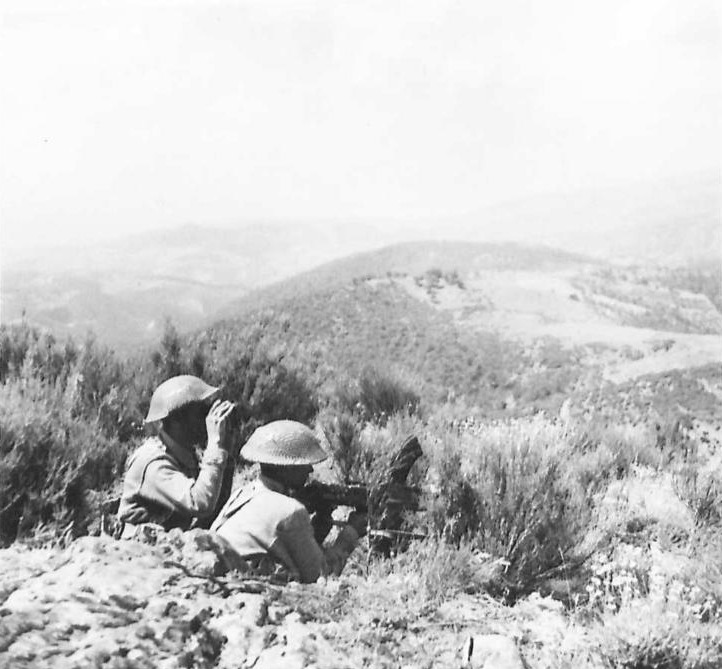
The X Corps front on 29 July 1944, five days before Vandal: two Gurkhas of the 1/9th Gurkha Rifles (4th Indian Division) in position on Monte Castiglione. According to the original caption, the view looks from the direction of Giovi and the Arno valley, still held by the Germans, towards Anghiari; the big mountain ridge in the centre is the Alpe di Catenaia. Photo Sgt Geoffrey Loughlin, No. 2 Army Film and Photographic Unit, the British Army’s photographic unit. © IWM (NA 17489), IWM Non Commercial Licence.
The ground
North of Arezzo the Arno comes down from the Casentino, the valley of Bibbiena, and passes Subbiano, followed by the road to Bibbiena, Route 71 in the Allied sources. East of the river rises the Alpe di Catenaia, which separates the Casentino from the Valtiberina, the upper Tiber valley, with Anghiari and Sansepolcro; its summit, Monte Castello, reaches 1,414 metres. To the west, between Castiglion Fibocchi and Subbiano, runs a ridge of hills of six to seven hundred metres, from Monte Ferrato to Poggio Pianale; beyond it rises the Pratomagno. Vandal was fought on the mountain and on the ridge [4].
A plan for the Gothic Line
Vandal was one piece of a larger plan. On 26 July General Harold Alexander, commander of the Allied Armies in Italy, had laid down where the Gothic Line was to be attacked: in the centre, in the mountains north of Florence, roughly between Dicomano and Pistoia, in the direction of Bologna. The two Allied armies in Italy would attack side by side: the US Fifth Army and the British Eighth Army, to which X Corps belonged [5].
X Corps was to advance on Bibbiena by the two valleys of the upper Arno and the upper Tiber, on either side of what Alexander, in his official despatch, calls ‘a great roadless massif’, the Alpe di Catenaia. It would then attack towards Bologna alongside another British corps, XIII Corps, which was advancing on Florence: so writes Eric Linklater, author in 1951 of a popular history of the campaign, written from the documents for HMSO, the British government publisher [6].
The forces engaged
X Corps had, Alexander writes, ‘two Indian infantry divisions, 4th and 10th, and an armoured brigade’. They were divisions of the Indian Army, the army of British India; in each of their brigades one British battalion served alongside two Indian or Gurkha battalions, and that is why English and Scottish soldiers also fight in this account, alongside Indians and Nepalese. The 10th was commanded by Major-General Denys Reid, the 4th by Major-General A.W.W. Holworthy [7].
To the east, beyond the Tiber, the flank was held by the British 9th Armoured Brigade, with tanks and armoured cars; two of its tank regiments supported the Indian divisions. To the west, towards the Pratomagno, a reconnaissance group, Lindforce, covered the corps as far as the British 6th Armoured Division, which was on the far side of the mountain and, according to Linklater, came under X Corps until 12 August. Working with the 10th Division’s sappers were two companies of ‘artieri’, pioneers of the Italian army, which after the armistice fought alongside the Allies [8].
Facing them was the German Tenth Army of General Heinrich von Vietinghoff. The Catenaia and the hills as far as the Arno were held by the 305th Infantry Division of General Friedrich-Wilhelm Hauck, with its three grenadier regiments, ‘grenadiers’ being by then the name for ordinary German infantry; west of the Arno, from the Pratomagno to the hills of Subbiano and Talla, was the 15th Panzer Grenadier Division, motorised infantry. Further east, towards the Tiber, stood the 44th Division, much reduced, and beyond the Tiber the 114th Jäger Division, light infantry [9]. (X Corps, with its Roman numeral, has nothing to do with the 10th Indian Division or with the German Tenth Army: the coincidence is pure chance.)
Here the Germans were not defending a fortified line but delaying lines, positions to be held for a few days to slow down the advancing enemy. Alexander, who calls them phase lines, explains that they had women’s names in alphabetical order, from south to north: Irmgard, Karin, Lydia and others. On the night of 1 August, writes the historian Alvaro Tacchini, who also publishes a German map of them, the 305th left the Karin line, which ran through Subbiano, and fell back to the Lydia line, a little further north: on Poggio Pianale, at Falciano and on the first heights of the Catenaia [10].
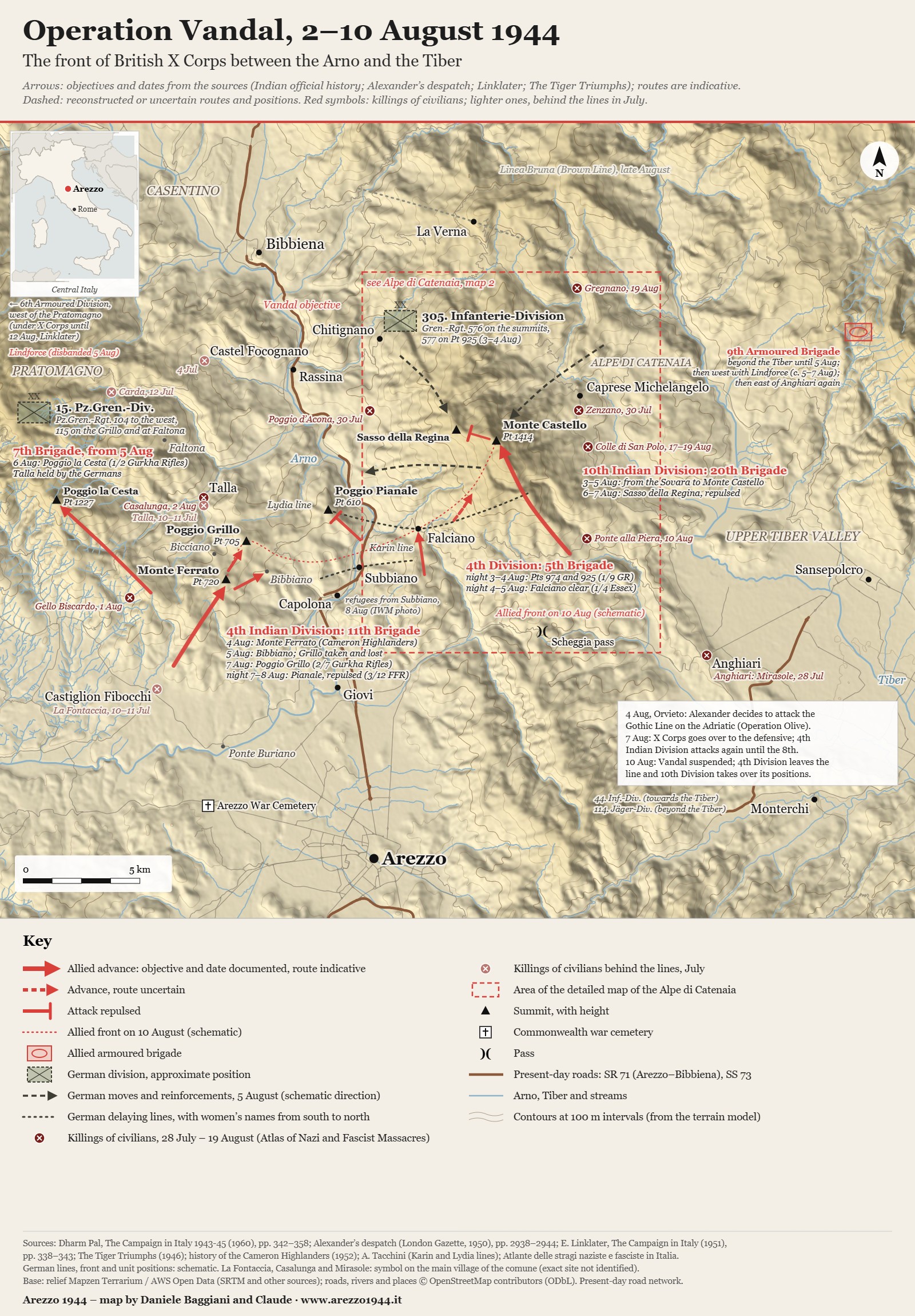
Operation Vandal, 2–10 August 1944: the front of British X Corps between the Arno valley and the upper Tiber valley. West of the Arno, the 4th Indian Division in the hills between Castiglion Fibocchi, Subbiano and Falciano; in the centre, the 10th Indian Division on the Alpe di Catenaia; the objective lay between Chitignano, Castel Focognano and Bibbiena. German delaying lines Karin and Lydia shown schematically; red symbols: killings of civilians. Compiled by arezzo1944.it from the official Indian history (Dharm Pal, 1960), Alexander’s despatch (1950), Linklater (1951), The Tiger Triumphs (1946), the history of the Cameron Highlanders (1952), Tacchini and the Atlante delle stragi; base © OpenStreetMap contributors, relief Mapzen Terrarium. Map by Daniele Baggiani and Claude.
The night of 3/4 August
‘At 2130 hours on August 3rd,’ writes The Tiger Triumphs, the 1946 book on the Indian divisions in Italy, ‘“Operation Vandal” was launched.’ At that hour, on the eastern wing of the 4th Division, a battalion of Gurkhas, Nepalese soldiers, set off towards the western slopes of the Catenaia; a quarter of an hour later, further east, the Marathas of the 10th Division, soldiers from western India, set off from Montauto, north of Anghiari, and crossed the Sovara stream [11].
The 10th Division’s climb is told in the page on the battle of the Alpe di Catenaia. The 20th Brigade’s order, issued at 10.05 p.m. on 1 August, called for Monte Altuccia and Il Castello to be taken by 4 August; its intentions of 3 August provided, if resistance was weak, for an advance as far as the Sasso della Regina and Monte La Caspa and an attack on Chitignano on the 5th or on the night of 5/6 August. During the night the 3/5th Mahrattas took Point 941 and, at 2 a.m. on 4 August, Point 1201; then Monte Filetto, with the bayonet, after two attempts at a silent attack had failed, and at 8 p.m., after a day’s fighting, Monte Altuccia; at 11.30 a.m. on the 5th another battalion of their brigade, 2/3rd Gurkha Rifles (2nd Battalion, 3rd Gurkha Rifles), took the summit, Monte Castello, and on the 6th beat off a German counter-attack there: at dawn three German companies, drawn from two different divisions, attacked between Il Castello and the Regina and were driven off after hand-to-hand fighting that lasted until about 11 a.m. On the night of 6/7 August the 3/5th Mahrattas attacked the Sasso della Regina, a little to the north-west, along the knife-edge ridge that joins it to Il Castello: at about 3 a.m. two companies were on the objective, but, almost out of ammunition, they could not hold against the German counter-attack and at about 3.45 a.m. fell back on Il Castello, with 19 killed, 38 wounded and 5 missing. The Sasso della Regina remained in German hands until 20 August [12]. Behind the two battalions came the 8th Manchesters, the brigade’s British battalion, in reserve, and then the 1st King’s Own and the 4/10th Baluch, who took over the summits: from 9 August Il Castello was held by the Manchesters, under shelling that could come from every side.
Below the Catenaia: the heights above Falciano
The 4th Division was attacking on both banks of the Arno. East of the river its 5th Indian Infantry Brigade had a secondary task, in support of the 10th Division: to take Falciano and the slopes of the Catenaia, where in the preceding days the British 1/4th Essex and the Indian 3/10th Baluch had already occupied the first heights [13].
On the night of 3/4 August 1/9th Gurkha Rifles (1st Battalion, 9th Gurkha Rifles) set off from the place called C. Orzale towards two heights above Falciano, which the military maps mark with their height in metres as ‘Points’: Point 974 and Point 925. Two companies occupied Point 974 without a fight. A third, A Company, found on Point 925 about sixty grenadiers of the 577th Regiment, with heavy machine guns, and drove them off in hand-to-hand fighting, under mortar and artillery fire from the direction of Monte Filetto: by 3 a.m. on 4 August the Point had been taken. The Commonwealth War Graves Commission (CWGC), the body that cares for the memory of the Commonwealth war dead, records seven men of the battalion who died with the date of 4 August [14].
On the night of 4/5 August patrols of the 1/4th Essex found Falciano clear of Germans [15].
On the hills west of the Arno: Poggio Grillo and Poggio Pianale
The main task fell to another brigade of the 4th Division, the 11th Indian Infantry Brigade of Brigadier H.C. Partridge (in the British Army a brigadier commanded a brigade), west of the road to Bibbiena, on the ridge between Monte Ferrato and Poggio Pianale. The first to go in was the brigade’s Scottish battalion, the 2nd Bn The Queen’s Own Cameron Highlanders (the Camerons), with few men for a ridge eight kilometres long: according to its history, at first only two companies were planned [16].
On Subbiano the sources do not agree: in McCreery’s plan the village was still an objective, and The Tiger Triumphs places the brigade’s start line on 3 August ‘south of Subbiano’, while for Linklater patrols of the brigade had entered it on the 2nd, after some skirmishing, without opposition. The Atlante delle stragi naziste e fasciste in Italia (Atlas of Nazi and Fascist Massacres in Italy), the national database of killings of civilians, places the liberation of the village ‘around 8 August’; which day the municipality commemorates, the sources consulted do not say [17].
At dawn on 4 August a Scottish company occupied Monte Ferrato, 720 metres; the following night another climbed Poggio Grillo, 705 metres, and a third entered Bibbiano. On the morning of the 5th the Germans counter-attacked the Grillo with the panzer grenadiers of the 115th Regiment, of the 15th Division: the Scottish company was overrun, with losses of three officers and sixty men, and the CWGC records ten men of the battalion who died with the date of the 5th. That night the Camerons counter-attacked in their turn, without retaking the summit. It was taken by 2/7th Gurkha Rifles (2nd Battalion, 7th Gurkha Rifles) on the night of 7/8 August, with twenty-one killed and wounded according to the official Indian history, which gives the attack at 12.04 a.m. and the summit taken at 3.25 a.m. ‘On 4th August,’ writes the history of the Camerons, ‘two companies of Jocks had set out to capture a ridge five miles long; by 7th August a whole Brigade still failed to capture it.’ A page on the battle will be published shortly [18].
On the night of 7/8 August it was the turn of Poggio Pianale, 610 metres, on the Lydia line. It was attacked silently, without the usual artillery bombardment, by the brigade’s Indian battalion, the 3/12th Frontier Force Regiment (3rd Royal Battalion, 12th Frontier Force Regiment), from the area of La Marga, on the floor of the Arno valley at the northern end of Subbiano. At 4 a.m. the leading companies fell back so that the Allied artillery could shell Roccolo Gentili; at 9 a.m. two companies were pinned down some fifty yards, about 45 metres, from the objective; at 11.15 a.m. the battalion withdrew, with sixty-three casualties. Among the fourteen dead whom the CWGC records on 8 August is Major John Plampin Oakes, aged twenty-two, whom we identify, in all probability, with the commander of A Company who was killed in the attack according to the official history [19].
Further west, from 5 August, the division’s third brigade, the 7th, climbed towards the Pratomagno: on the 6th 1/2nd Gurkha Rifles took Poggio la Cesta, at 1,227 metres, while the 2/11th Sikhs found Talla strongly held. By the 9th the Camerons had occupied Pianelli, Botti and Cenina without a fight. On the morning of the 9th German heavy artillery hit Bibbiano and mortally wounded their commanding officer, Lieutenant-Colonel Maurice Hill, who died two hours later at the aid post [20].
On the German side
Of the week of Vandal seen from the German side we know little: the German war diaries, the history of the 305th written in 1975 by its commander, Hauck, and Tacchini’s 2016 book have not yet been studied for this page [21].
According to Linklater, Vandal caught the 305th while it was thinning out its troops in the line east of the Arno. The 578th Grenadier Regiment was moved from the sector facing the 10th Indian Division to the one facing the 4th, towards the Grillo; on 5 August reinforcements from the 114th and the 15th Divisions arrived on the Catenaia. Linklater then counts twelve German battalions in the line, with the weight of the defence by now west of the Arno [22].
4 August: the new plan decided at Orvieto
Let us go back to 4 August. That day, while the Camerons were on Monte Ferrato and the Marathas on Monte Filetto, the Allies were entering the southern part of Florence, and on Orvieto airfield the plan changed. ‘There were only three of us present,’ writes Alexander: he himself, Lieutenant-General Oliver Leese, commander of the Eighth Army, to which X Corps belonged, and Lieutenant-General John Harding, Alexander’s Chief of Staff; ‘we sheltered from the sun under the wing of a Dakota’, a transport aircraft [23].
The proposal, Alexander writes, was ‘largely his idea’: Leese’s. The French Expeditionary Corps, with what Alexander calls his best mountain troops, had left for the landings in Provence; the Eighth Army had no mountain divisions and in the mountains would not be able to exploit its superiority in tanks and artillery, while the Adriatic coast offered better ground and surprise. Leese, Linklater adds, did not want to attack alongside the US Fifth Army towards objectives close to each other; and Alexander admits that it was ‘anything but certain’ that a heavy blow in the centre would break through [24].
The new plan was called Olive. The Eighth Army would move in secret to the Adriatic to attack the Gothic Line along the coast on 25 August, aiming first at the river Marecchia, then at Bologna and Ferrara. X Corps’ task was now to hold the front, not to break through it [25].
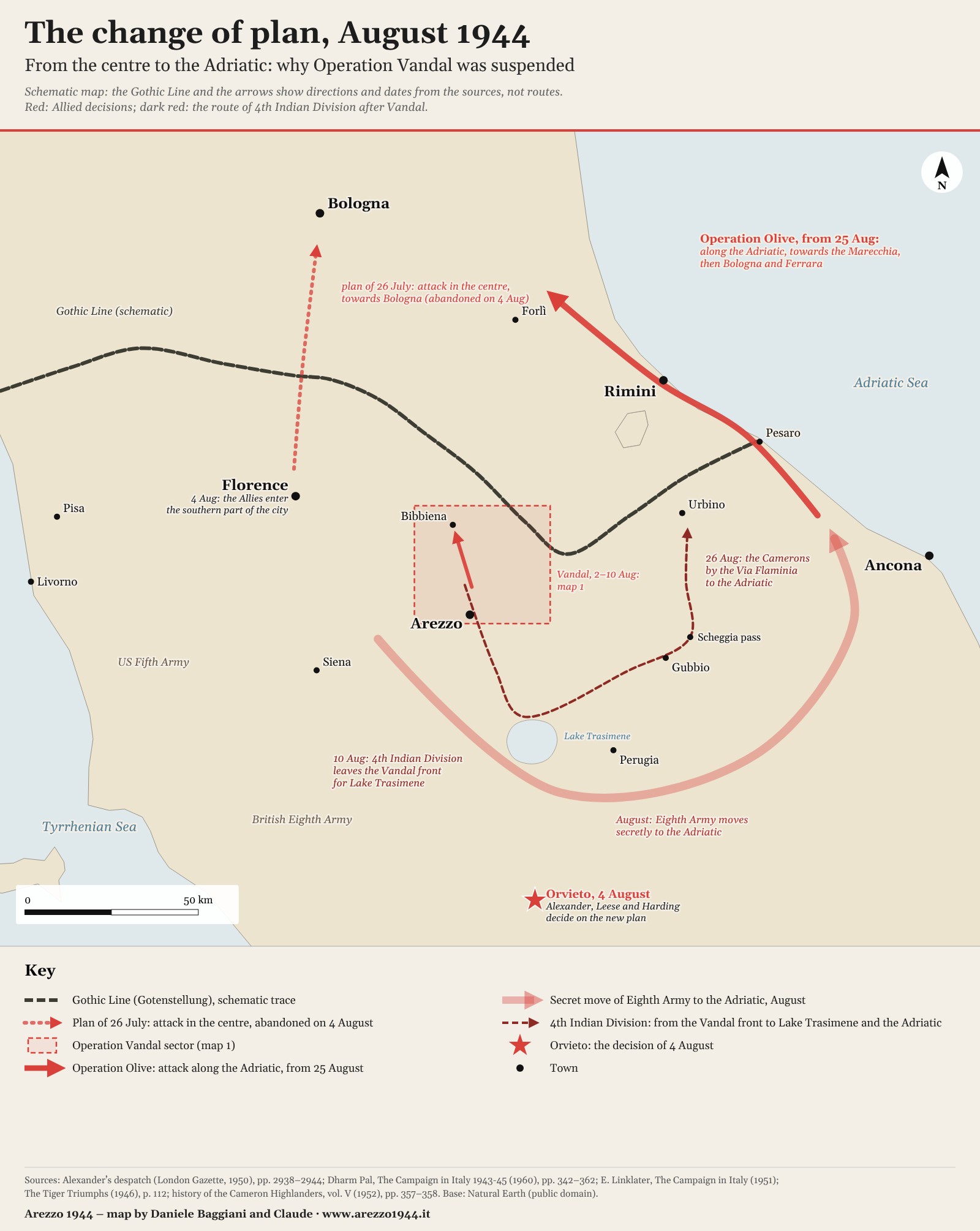
The Allied change of plan of August 1944. The plan of 26 July provided for attacking the Gothic Line in the centre, in the mountains north of Florence, in the direction of Bologna: Vandal was to open the road to Bibbiena for X Corps. On 4 August, at Orvieto, Alexander decided instead to attack along the Adriatic (Operation Olive, from 25 August): the Eighth Army moved in secret to the coast, and the 4th Indian Division, having left the Vandal front on 10 August, passed through Lake Trasimene before reaching it. Gothic Line and arrows are schematic. Drawn by arezzo1944.it from Alexander’s despatch (1950), the official Indian history (Dharm Pal, 1960), Linklater (1951), The Tiger Triumphs (1946) and the history of the Cameron Highlanders (1952); base Natural Earth, public domain. Map by Daniele Baggiani and Claude.
One more week, 5–10 August
On 5 August, with the capture of Monte Castello, X Corps reached what Alexander calls its high-water-mark: the furthest limit of its advance. On the 6th Alexander issued the written order for the new plan, warning that the scope and object of Olive were not yet to appear in any document. The same day Partridge ordered the attacks on the Grillo and the Pianale [26].
On 7 August, Alexander writes, the corps, ‘reduced in strength to 10 Indian Division only’, went over to the defensive, and according to Linklater the 4th Division was taken away from it; on the ground, however, the division stayed in the line and went on attacking until the 8th. On the 10th, the official Indian history writes, Vandal was ‘abruptly suspended’: the 10th Division took over the positions of the 4th, which left for Lake Trasimene. We read these dates as different stages (decision on the 4th, written order on the 6th, change to the defensive on the 7th, relief on the ground on the 10th): this is our own reading, which the corps’ war diaries may confirm or correct [27].
Why the attacks of the night of 7/8 August, ordered the day before the change to the defensive, went ahead all the same, the sources consulted do not explain, and none says that they were meant to deceive the Germans. What they do say is that the change of plan was kept secret, so that the enemy would believe the main blow was coming in the centre: on X Corps’ front, Linklater writes, active patrolling covered the departure of the 4th Division, and the 1/4th Essex stayed with the 10th still wearing the 4th’s insignia, ‘for the information of enemy agents’ [28]. On the Catenaia, the notes on the operation by the commander of the 20th Brigade, written after 12 August, say that the attack had not got as far as planned, but had drawn ‘strong enemy reinforcements’ to the area, ‘which was what was required’; they do not say since when this had been the aim. According to the Allied sources, the Germans did not notice: the Eighth Army’s move to the coast, Linklater writes, was not observed by the enemy. In August the 15th Panzer Grenadier Division, the division of the Grillo, left for France [29].
The 10th Division alone
From 10 August the 10th Division held alone the front on which two divisions and an armoured brigade had stood before. On 14 August it was spread over about 24 kilometres, from the Tiber to Poggio Grillo [30].
The 4th Division removed its insignia and went to Lake Trasimene. On 25 August Operation Olive began; on the 26th the Camerons were marching towards the Adriatic by the Scheggia pass, on the Via Flaminia near Gubbio, not to be confused with the Valico della Scheggia between Arezzo and Anghiari. What followed is told in the page From Cassino to San Marino [31].
On the Catenaia the 3/1st Punjabis put a standing patrol on the Sasso della Regina on 19 August and occupied it on the 20th. On the 27th a patrol of the 1st Durham Light Infantry found the Germans at Bibbiena station; by the evening of the 28th the town was clear. The Germans were falling back to the Brown Line, along the ridge of La Verna: the last of their delaying lines before the Gothic Line [32].
Civilians on the X Corps front
In the municipalities on Vandal’s front the worst violence against civilians and partisans came before the fighting, in the anti-partisan sweeps and the reprisals of June and July. On 4 July at Castel Focognano four partisans were hanged in the square; on 10 and 11 July at Talla three men were killed; on the 12th at Carda, a hamlet of Castel Focognano, three civilians taken for partisans were shot [33].
On 10 and 11 July, at La Fontaccia, near Castiglion Fibocchi, fifteen civilians were killed. It was a reprisal for the blowing up of a German vehicle, which the Atlante record devoted to the massacre attributes not to the partisans but to a British patrol; the responsibility remains with those who killed. The record attributes the massacre to the 15th Panzer Grenadier Division, the same division that three weeks later defended the Grillo; between the massacre and the fighting of August there is no connection [34].
As the front drew closer, German soldiers went on killing individuals: Vittorio Martelli at Poggio d’Ancona (Subbiano) on 30 July, Maria Fini, aged twenty-two, at Gello di Castiglion Fibocchi on 1 August, Natale Santini at Casalunga (Talla) on the 2nd. During the days of Vandal, from 3 to 10 August, the Atlante records only one intentional killing in the municipalities of the front: Dina Primitivi, aged eighteen, taken into the woods with her sister and killed on the 10th at Ponte alla Piera, in the municipality of Anghiari [35].
Other civilians suffered from the fighting. On 8 August a British Army photographer, Bill Wooldridge, photographed the refugees from Subbiano at Ponte Caliano and at Castelnuovo, with the few belongings they had saved; in one photograph a woman carries her wounded child in her arms. How many civilians died from artillery fire, bombs and mines in the municipalities of Vandal, the sources consulted do not say [36].
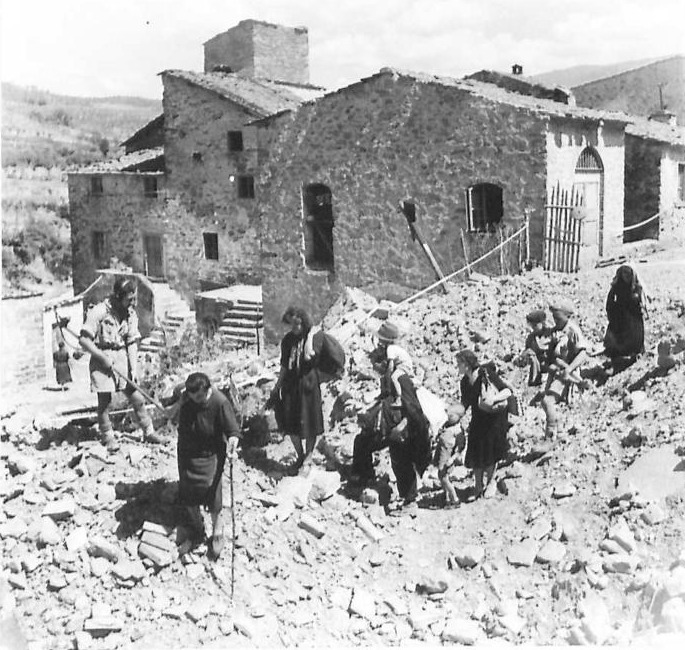
Refugees from Subbiano pass through the rubble at Ponte Caliano, 8 August 1944, during the days of Operation Vandal. Photo Sgt Bill Wooldridge, No. 2 Army Film and Photographic Unit, the British Army’s photographic unit. © IWM (NA 17721), IWM Non Commercial Licence.
What remains of Vandal
The sources judge Vandal in different ways. For the official Indian history it ‘had started well’: half the distance to Castel Focognano had been covered, and X Corps ‘was well on the road to success’. For Linklater, on the other hand, after thirty-six encouraging hours the German reaction had already brought about deadlock along the whole line, before the change of plan put a stop to everything; and Bibbiena still lay ‘beyond the stubborn hills’ [37].
X Corps took Falciano, Monte Ferrato, Bibbiano, Poggio Grillo and the southern summits of the Catenaia as far as Monte Castello; it did not take Poggio Pianale or the Sasso della Regina, reached and lost on the night of 6/7 August (on the Pianale the 1st Durham Light Infantry set up an observation post, without a fight, on 12 August; the Sasso della Regina was occupied by the 3/1st Punjabis on the 20th), and Chitignano, Castel Focognano and Bibbiena remained beyond the German lines. Between 4 and 10 August the CWGC records at least fifty-nine dead in the units that belonged to the 4th Division at the start of Vandal and, on the Catenaia, between 4 and 7 August, forty-eight men of the 3/5th Mahrattas and seventeen of 2/3rd Gurkha Rifles, of the 20th Brigade: these are the identified dead, not all the losses. For the Germans the sources consulted give figures for individual actions and, for the Catenaia, the 20th Brigade war diary’s estimate: some 250 killed and 70–80 prisoners between 3/4 and 9 August [38].
Many of the Allied dead lie in Arezzo War Cemetery, the Commonwealth war cemetery at Indicatore; those with no known grave, among them the Sikhs and Hindus cremated in accordance with their faith, are commemorated on the Cassino Memorial. The German dead of those days have not been identified; many German soldiers who died in Tuscany lie in the German war cemetery at the Futa Pass. At Subbiano the ‘Quelli della Karin’ museum (‘Those of the Karin’), which takes its name from the German line, collects the material found on these hills [39].
The men who climbed the Grillo and the Pianale on 7 and 8 August were fighting for a plan that, a few days earlier at Orvieto, had already been changed. Whether they knew it, the sources do not say.
In brief
-
Operation Vandal was the attack by the British X Corps (Lieutenant-General Richard McCreery), north of Arezzo, towards Chitignano, Castel Focognano and Bibbiena, the entrance to the Casentino and the starting point for the Gothic Line. The divisions had issued their operation instructions on 31 July and 1 August; on 2 August 1944 McCreery fixed the start of the attack.
-
It was part of the Allied plan of late July, which provided for attacking the Gothic Line in the centre, between Dicomano and Pistoia, towards Bologna.
-
For Vandal X Corps committed the 4th and 10th Indian Divisions and the British 9th Armoured Brigade. Facing them were the German 305th Infantry Division (305. Infanterie-Division) on the Alpe di Catenaia and on the hills as far as the Arno, the 15th Panzer Grenadier Division (15. Panzergrenadier-Division) from the Pratomagno to Poggio Grillo, and the 44. Reichsgrenadier-Division and the 114. Jäger-Division towards the Tiber. The Germans were falling back on delaying lines with women’s names: Karin, Lydia and the others.
-
The attack began at 9.30 p.m. on 3 August for the 4th Division and at 9.45 p.m. for the 10th. On the Catenaia the 20th Brigade took the summits as far as Monte Castello (5 August); on the night of 6/7 August it reached the Sasso della Regina, but lost it to the German counter-attack. To the west the 4th Division took Falciano, Monte Ferrato (4 August), Bibbiano and Poggio Grillo (5 August, lost the same day, retaken on the night of 7/8 August); it failed on Poggio Pianale (7–8 August, 63 casualties).
-
On 4 August, at Orvieto, Alexander, Leese and Harding decided to attack the Gothic Line on the Adriatic side: this was Operation Olive, which began on 25 August.
-
On 7 August X Corps went over to the defensive and the 4th Division was taken away from it, but it stayed in the line and attacked until the 8th. On 10 August Vandal was suspended and the 10th Division was left alone on the corps front, which on 14 August measured about 24 km. The change was kept hidden from the Germans.
-
Vandal did not reach its objective. On 27 August a patrol of the 1st Durham Light Infantry, a British battalion of the 10th Indian Division, found the Germans at Bibbiena station; by the evening of the 28th the town was clear. The Germans were falling back to the Brown Line.
-
In the municipalities of the front the worst killings of civilians and partisans came before the fighting: sweeps and reprisals in June and July, among them the massacre of La Fontaccia (Castiglion Fibocchi, 10–11 July, 15 victims). During Vandal the Atlante records only one intentional killing (Ponte alla Piera, 10 August). On 8 August the refugees from Subbiano were photographed on the road.
Who’s who
Ranks. The British brigadier is the officer who commands a brigade, between colonel and major-general: the rank has nothing to do with the brigadiere of the Italian Carabinieri. British ranks under ‘The fallen’: private, lance corporal, corporal. Indian Army ranks: sepoy, infantry private; rifleman, private, in the Gurkha regiments; sowar, cavalry trooper; lance naik, lance corporal; naik, corporal; havildar, sergeant. German ranks: Generalfeldmarschall, field marshal; Generaloberst, colonel general (equivalent to a full general); Generalleutnant, equivalent to major-general; Oberst, colonel.
Allies: the commanders
-
Harold Alexander, British general, commander of the Allied Armies in Italy. On 26 July 1944 he laid down the attack on the centre of the Gothic Line; on 4 August, at Orvieto, he decided on the new Adriatic plan (Olive). His official despatch on the campaign was published in the London Gazette in 1950 [5][23].
-
Oliver Leese, British lieutenant-general, commander of the Eighth Army, to which X Corps belonged. He proposed the change of plan of 4 August [24].
-
John Harding, British lieutenant-general, Alexander’s Chief of Staff; the third man present at Orvieto on 4 August [23].
-
Richard McCreery, British lieutenant-general, commander of X Corps. On 2 August he fixed the start of Vandal [1].
-
A.W.W. Holworthy, British major-general, DSO, MC, commander of the 4th Indian Division [7].
-
Denys W. Reid, British major-general, commander of the 10th Indian Division [7].
-
H.C. Partridge, brigadier, DSO, commander of the 11th Indian Infantry Brigade; on 6 August he ordered the attacks on Poggio Grillo and Poggio Pianale [16][26].
-
J.B. Macdonald (also McDonald in the war diary), brigadier, OBE, commander of the 20th Indian Infantry Brigade on the Catenaia.
-
R.N. Anderson, lieutenant-colonel, commander of the 1st King’s Own and, from 9–10 August, of Centre Force [30].
-
The commanders of the 9th Armoured Brigade, of the 5th and 7th Indian Brigades and of Lindforce are not named in the sources consulted.
Allies: officers named in the text and in the sources
-
Maurice George Oakley Hill, lieutenant-colonel, commanding officer of the 2nd Cameron Highlanders; mortally wounded by German heavy artillery on 9 August 1944 at Bibbiano, he died two hours later; buried in Arezzo War Cemetery, VI. B. 16. [20].
-
John Plampin Oakes, major, aged 22, of the 3/12th Frontier Force Regiment, in all probability the commander of A Company (our identification); killed on 8 August 1944 in the attack on Poggio Pianale, buried at Arezzo, II. A. 27. [19].
-
Stott, captain, of the Central India Horse. According to the letter of a Cameron officer taken prisoner, he was captured on the Grillo on the night of the 6th (‘I believe’, he writes); the official Indian history writes of the armoured-car officer that ‘no trace was found’ (see ‘Where the sources disagree’).
Germans
-
Albert Kesselring, Generalfeldmarschall, commander of the German forces in Italy (Heeresgruppe C).
-
Heinrich von Vietinghoff called Scheel (in German ‘genannt Scheel’), Generaloberst, commander of the Tenth Army (Armeeoberkommando 10). According to Tacchini he ordered the Sasso della Regina to be held [9].
-
Friedrich-Wilhelm Hauck, Generalleutnant, commander of the 305. Infanterie-Division; in 1975 he wrote its history, which we have not consulted [9][21].
-
Eberhard Rodt, Generalleutnant, commander of the 15. Panzergrenadier-Division (Gentile) [9].
-
Wolfgang Maucke, Oberst, commander of Panzergrenadier-Regiment 115 from March 1944 (Gentile): the regiment that defended Poggio Grillo.
-
Hans-Günther von Rost, Generalleutnant, commander of the 44. Reichsgrenadier-Division ‘Hoch- und Deutschmeister’ from 26 June 1944 (Gentile); Hans-Joachim Ehlert, commander of the 114. Jäger-Division after 19 July 1944 (Tacchini; his rank is not given in the sources consulted).
-
The commanders of the two German corps in the sector (LXXVI. Panzerkorps and LI. Gebirgs-Armeekorps) are not named in the sources consulted.
Civilians
-
Maria Fini, aged 22, killed on 1 August 1944 at Gello (Castiglion Fibocchi); Natale Santini, aged about 39, killed on 2 August at Casalunga (Talla); Vittorio Martelli, aged 43, killed on 30 July at Poggio d’Ancona (Subbiano); Dina Primitivi, aged 18, killed on 10 August at Ponte alla Piera (Anghiari) [35].
-
The fifteen victims of La Fontaccia (Castiglion Fibocchi, 10–11 July 1944): their names are in Atlante record 3234 [34].
The historians and the sources
-
Dharm Pal, author of The Campaign in Italy 1943-45 (1960), the volume of the official history of the Indian armed forces devoted to Italy, edited by Bisheshwar Prasad. Written from the units’ war diaries and the intelligence reports, with footnotes: chapter XVI is entitled ‘Operation Vandal’.
-
The Tiger Triumphs (1946): the book on the three Indian divisions in Italy, published for the Government of India; anonymous, attributed by some catalogues to G.R. Stevens. A work of official popular history, written soon after the events, without notes.
-
Alexander’s despatch (‘The Allied Armies in Italy from 3rd September, 1943, to 12th December, 1944’), published in the supplement to the London Gazette of 12 June 1950: it is the first-hand source on the decision at Orvieto, but it summarises the detail of events.
-
Eric Linklater, writer, author of The Campaign in Italy (1951), a popular history of the campaign published by His Majesty’s Stationery Office (HMSO); written from the documents, without notes. It is not the British official history proper, which is that of Jackson and Gleave (see below).
-
Historical Records of the Queen’s Own Cameron Highlanders, vol. V (1952): the history of the Camerons’ regiment, with the letter of Lieutenant W. Jack, taken prisoner on the Grillo.
-
Alvaro Tacchini, historian of Città di Castello, author of the articles on storiatifernate.it on Operation Vandal and the upper Tiber valley: our main route to the German side. His online articles do not give their German sources; data reported only by him are attributed to him.
-
Carlo Gentile, historian, author of studies on German war crimes in Italy and of the ‘NS-Täter in Italien’ entries on German units.
-
W.G.F. Jackson and T.P. Gleave, authors of the volume of the British official history on the summer of 1944 (1987): not consulted.
Chronology
The dates on which Allied units arrived do not necessarily coincide with those that the municipalities commemorate as their day of liberation. Times are those given by the sources; where the sources diverge, see ‘Where the sources disagree’.
The high command
-
3 July 1944: a deception plan of Alexander’s seeks to make the Germans believe in an attack on the Adriatic.
-
17 July: the Eighth Army proposes attacking the Gothic Line in the centre with two corps, on the Florence–Firenzuola and Florence–Bologna axes.
-
18–19 July: the X Corps boundary moves west to the northern edge of Arezzo; the 11th Indian Brigade takes over the sector north of the city.
-
26 July: Alexander lays down the attack on the centre of the Gothic Line, between Dicomano and Pistoia.
-
31 July – 1 August: operation instructions of the 10th Division (31 July) and of the 4th Division (1 August); 20th Brigade Operation Order No. 5 (1 August, 10.05 p.m.); the name Vandal appears in that of the 4th Division.
-
2 August: McCreery fixes the start of the attack for the night of 3/4 August.
-
4 August: the Allies enter the southern part of Florence. Conference at Orvieto: Alexander, Leese and Harding decide on the Olive plan.
-
6 August: Alexander’s written order; the British 46th and 56th Divisions are warned of their move.
-
7 August: the 4th Indian Division, the King’s Dragoon Guards and the 1st/60th Rifles are taken away from X Corps, which goes over to the defensive; on the ground the 4th Division stays in the line until the 10th.
-
10 August: Vandal is suspended.
-
12 August: the British 6th Armoured Division, west of the Pratomagno, returns from X to XIII Corps (Linklater).
-
13 August: orders for the attack on the Adriatic.
-
15–22 August: large movements of troops towards the Adriatic.
-
25 August: Operation Olive begins.
The X Corps front
-
1 August: the Camerons are all north of the Arno, with one company at Castiglion Fibocchi. A Central India Horse patrol from Ponte Buriano towards Pieve San Giovanni. 9.30 p.m.: the 1/4th Essex on the Scille spur without opposition. Night: the German 305th Division falls back from the Karin line to the Lydia line (Tacchini). Killing of Maria Fini at Gello.
-
2 August, 5–6.40 a.m.: the 3/10th Baluch take Point 636 and Monte Alto; their battalion headquarters remains under fire for about three hours. After some skirmishing, patrols of the 11th Brigade enter Subbiano without opposition (Linklater). A Central India Horse patrol reaches Monte Ferrato: three Germans killed, two taken prisoner. Killing of Natale Santini at Casalunga (Talla). Night: the 1/9th Gurkhas move to C. Orzale.
-
3 August: patrols of the King’s Dragoon Guards and tanks of the Warwickshire Yeomanry at Monte Capannino and Poggio della Lama. 8 p.m.: a Cameron company assembles at Castiglion Fibocchi. 9.30 p.m.: Vandal begins for the 4th Division; the 1/9th Gurkhas set off from C. Orzale. 9.45 p.m.: the 3/5th Mahrattas, of the 20th Brigade, cross the start line east of Montauto; at 11.30 p.m. they are on Point 941 (see the page on the Catenaia).
-
4 August, 3 a.m.: the 1/9th Gurkhas take Point 925 after hand-to-hand fighting; Point 974 had been occupied without a fight. Dawn, 6.30 a.m.: the Camerons on Monte Ferrato. On the Catenaia the 3/5th Mahrattas take Point 1201 (2 a.m.), Monte Filetto (by 6.30 a.m.) and, at 8 p.m., Monte Altuccia. Allied fighter-bombers strike the German communications. 8 p.m.: one Cameron company moves against Poggio Grillo, another against Bibbiano; the assault on the Grillo begins at 9.15 p.m., according to Lieutenant Jack’s letter.
-
night of 4/5 August: patrols of the 1/4th Essex find Falciano clear.
-
5 August, 3 a.m.: the Camerons on Poggio Grillo and at Bibbiano. Between 7 and 10.12 a.m.: German counter-attack on the Grillo; the Cameron company is overrun. Lindforce is disbanded; the 9th Armoured Brigade leaves the eastern flank and moves into its sector, to the west; the 7th Indian Brigade assembles at Castiglion Fibocchi. 11.30 a.m.: 2/3rd Gurkha Rifles take Monte Castello (official history; the 20th Brigade war diary gives no time: the two companies sent off in the night had lost their way in the woods and waited for daylight). During the morning the 3/5th Mahrattas, south of Il Castello, capture a German officer and five machine guns. German reinforcements arrive on the Catenaia and the 578th Grenadier Regiment moves towards the Grillo. 9.30 p.m.: night counter-attack by the Camerons on the Grillo.
-
6 August, 2.10 a.m.: the Cameron company is recalled from the Grillo. New orders from Brigadier Partridge. At dawn 2/3rd Gurkha Rifles are counter-attacked between Il Castello and the Regina by three German companies; the fighting lasts until about 11 a.m. Allied aircraft strike German reinforcements arriving by lorry (17 destroyed out of 20, according to the war diary of the 8th Manchesters). The 1/2nd Gurkhas take Poggio la Cesta; the 2/11th Sikhs find Talla strongly held.
-
night of 6/7 August: the 3/5th Mahrattas attack the Sasso della Regina from spur 332506; at about 3 a.m. they are on the objective; at about 3.45 a.m., out of ammunition, they fall back on Il Castello (19 killed, 38 wounded, 5 missing). 7 August, midnight: the 2/7th Gurkhas attack Poggio Grillo (Operation SATURN); according to the official history, by 3.25 a.m. on the 8th they hold the summit.
-
night of 7/8 August: the 3/12th Frontier Force Regiment attacks Poggio Pianale. 8 August, 4 a.m.: the leading companies fall back south of Roccolo Gentili, because the Allied artillery is to shell that point; 9 a.m.: two companies pinned down near the objective; 11.15 a.m.: withdrawal. Refugees from Subbiano photographed at Ponte Caliano and at Castelnuovo. At Sansepolcro, according to the captions of two British photographs (IWM, NA 17729 and 17730), only armoured patrols have entered. On the Catenaia, at Pozza, two platoons of the 8th Manchesters and one of the 1st King’s Own drive off a platoon of the German 114th Division’s reconnaissance battalion and take 4 prisoners.
-
by 9 August: the Camerons at Pianelli, Botti and Cenina without a fight.
-
9 August, morning: German heavy artillery rounds (210 mm) on Bibbiano; Lieutenant-Colonel Hill is mortally wounded. The 10th Division begins to side-step to take over the front of the 4th. On the Catenaia the 20th Brigade consolidates in its positions: higher command has decided that a further effort in that direction would not ‘pay a good dividend’. On the 10th Division’s front Lieutenant-Colonel Anderson’s Centre Force is formed.
-
10 August: the 10th Division relieves the 4th, which leaves for Lake Trasimene. By the 25th Brigade’s Operation Order No. 6 the front of the 10th Division, extended to the 4th Division’s sector by the 13th, is divided into five sectors: 25th Brigade, 20th Brigade, Centre Force, 10th Brigade and Skinner’s Horse. Killing of Dina Primitivi at Ponte alla Piera.
-
11 August: the 1st Durham Light Infantry believe the Germans have left the line between the Pianale and Belfiore; at 5.30 p.m. one of its companies is at Belfiore.
-
12 August: the Camerons at Lake Trasimene. At 9.20 a.m. the 1st Durham Light Infantry have an observation post on Poggio Pianale.
-
14 August: the 10th Division spread over about 24 km, from the Tiber to the Grillo.
-
19–20 August: the 3/1st Punjabis put a standing patrol on the Sasso della Regina (19th) and occupy it with two companies (20th).
-
25 August: Chitignano found empty. Killing of Benedetto Cipriani at Serravalle (Bibbiena).
-
26 August: the Camerons march towards the Adriatic by the Scheggia pass, on the Via Flaminia near Gubbio, then Cantiano, Cagli and Urbino.
-
27 August, 2.30 a.m.: a company of the 1st Durham Light Infantry makes contact with the Germans at Bibbiena station. 28 August, 10.10 p.m.: a patrol of the same battalion finds Bibbiena clear (see ‘Where the sources disagree’); a local study dates the liberation of Bibbiena to 28 August.
-
end of August: the Germans on the Brown Line, from the ridge of La Verna to Monte Faggiolo.
Units
Finding one’s way. From the smallest to the largest: the battalion (a few hundred men), the brigade (three battalions), the division (three brigades, with the artillery, the engineers and the services), the corps (several divisions, identified by a Roman numeral) and the army (several corps). In abbreviations, ‘3/12th’ means 3rd Battalion, 12th Regiment. In the Indian brigades one British battalion served alongside two Indian or Gurkha battalions. A British tank, armoured-car or artillery regiment was the size of a battalion, not of an Italian or continental regiment.
Three numbers not to be confused. The British X Corps, with the Roman numeral, is the subject of this page. The 10th Indian Division was one of its two divisions. The German Tenth Army (Armeeoberkommando 10) was on the other side of the front. The coincidence of the numbers is pure chance.
Allied chain of command
-
Allied Armies in Italy, General Harold Alexander; Chief of Staff, Lieutenant-General John Harding.
-
British Eighth Army, Lieutenant-General Oliver Leese.
-
British X Corps, Lieutenant-General Richard McCreery.
Corps troops and supporting units (official Indian history, pp. 343–344; Linklater, pp. 340–343). The list is for readers looking for a particular unit. RA stands for Royal Artillery; RHA for Royal Horse Artillery, which by 1944 was motorised.
-
9th Armoured Brigade: three tank regiments and one armoured-car regiment (official Indian history, p. 326, reading of the scan text, to be checked against the page image). In the sources for these days: the Warwickshire Yeomanry, supporting the 4th Division (one squadron with the 5th Brigade, one with the 11th, one, probably, with Lindforce); the Royal Wiltshire Yeomanry, supporting the 10th; the 3rd The King’s Own Hussars, under the 10th at the end of July (official Indian history, p. 327, reading of the scan text). At the end of July the brigade was responsible for the flank east of the Tiber, with the Household Cavalry, the 12th Lancers, the 27th Lancers and the 1st/60th Rifles under its command; the 12th Lancers and the Household Cavalry covered, according to Alexander, the mountains between Gubbio and Fabriano. On 5 August the brigade took over the rest of Lindforce and its sector, to the west: the move, Linklater writes, was completed only thirty-six hours after the start of the attack. After the change of plan it ‘returned to its former ground’, east of Anghiari.
-
Lindforce: a reconnaissance group on the western flank, formed to cover the extension of the corps westwards as far as the boundary of the 6th Armoured Division, with the Central India Horse (21st King George V’s Own Horse), the King’s Dragoon Guards, tanks and self-propelled guns. Disbanded on 5 August: the Central India Horse and one squadron of the King’s Dragoon Guards passed to the 4th Division, the rest to the 9th Armoured Brigade. Its commander and the origin of its name are not known.
-
Artillery: 2nd Army Group Royal Artillery supporting the divisions (supporting the 4th ‘less 5th Medium Regiment’, that is, without the 5th Medium, which was under the division’s command); 5th Medium Regiment and 32nd Heavy Regiment RA under the 4th Division; 85th Mountain Regiment under the 10th and 7th Mountain Regiment supporting the 10th; the batteries E Battery RHA, 1st Battery 2nd RHA, B Battery 1st RHA; 225/57 Anti-Tank Battery; 17th Heavy Anti-Aircraft Battery; Y Troop, 8th Survey Regiment.
-
Air observation: A Flight (4th Division) and C Flight (10th Division) of 654 Air Observation Post Squadron.
-
Others, under the command of the 10th Division: 165th (Jeep) Regiment; 4th Canadian Drilling Section, Royal Canadian Engineers; two companies of Italian artieri, who worked on the jeep track up the Catenaia (official Indian history, pp. 343, 351, 355).
-
On the western flank of the corps, west of the Pratomagno, the British 6th Armoured Division, under X Corps until 12 August according to Linklater (see ‘Where the sources disagree’).
4th Indian Division, Major-General A.W.W. Holworthy
- 5th Indian Infantry Brigade, east of the Arno, towards Falciano and the slopes of the Catenaia:
- 1st/4th Battalion, The Essex Regiment, British: Scille (1 August), Point 616, Falciano (4–5 August); from 9 August under the 10th Division, wearing the insignia of the 4th.
- 3rd Battalion, 10th Baluch Regiment: Point 636 and Monte Alto (2 August).
- 1st Battalion, 9th Gurkha Rifles: C. Orzale, Points 974 and 925 (3–4 August).
- In support: A Company (medium machine guns) of the Rajputana Rifles; B Squadron of the Warwickshire Yeomanry.
- 7th Indian Infantry Brigade, on the western flank from 5 August:
- 1st Battalion, The Royal Sussex Regiment, British: on 5 August one company relieves a Cameron company between Monte Ferrato and Vezza; Monte Capannino – Bicciano (6 August).
- 2nd Battalion, 11th Sikh Regiment: Poggio della Lama – Bagnena; Talla ‘strongly held’ (6 August).
- 1st Battalion, 2nd King Edward VII’s Own Gurkha Rifles: Poggio la Cesta (6 August).
- 11th Indian Infantry Brigade, Brigadier H.C. Partridge, west of the Arno:
- 2nd Battalion, The Queen’s Own Cameron Highlanders, Scottish, Lieutenant-Colonel M.G.O. Hill (mortally wounded on 9 August), then Lieutenant-Colonel J.C. Thomson: Monte Ferrato, Poggio Grillo, Bibbiano (4–5 August); Pianelli, Botti, Cenina (by the 9th).
- 2nd Battalion, 7th Duke of Edinburgh’s Own Gurkha Rifles: Poggio Grillo (7 August).
- 3rd Royal Battalion, 12th Frontier Force Regiment: Poggio Pianale (7–8 August).
- In support: D Company (medium machine guns) of the Rajputana Rifles; A Squadron of the Warwickshire Yeomanry; 11th Field Regiment RA.
- Reconnaissance: Central India Horse, back with the Division from 5 August; four armoured cars with the Camerons on the Grillo, night of 5/6 August.
10th Indian Division, Major-General D.W. Reid: 10th, 20th and 25th Indian Brigades, as in the page on the Alpe di Catenaia. From 9–10 August also the 4/11th Sikhs, the 1/4th Essex, the Lovat Scouts and two mountain batteries; from 9–10 August a Centre Force (also ‘Central Force’ in the documents), commanded by Lieutenant-Colonel R.N. Anderson of the 1st King’s Own, with the 1st King’s Own, the 3/18th Royal Garhwal Rifles, a squadron of Skinner’s Horse and two troops of tanks of the Royal Wiltshire Yeomanry, between the Catenaia and Falciano; from 10–11 August the 10th Brigade in the area of the Grillo and Skinner’s Horse (1st Duke of York’s Own Cavalry), with two squadrons of the Lovat Scouts, on the Pratomagno flank, from Monte Lori to Poggio la Cesta and the Bagnena.
German chain of command
-
Heeresgruppe C (Army Group C), Generalfeldmarschall Albert Kesselring.
-
Armeeoberkommando 10 (Tenth Army), Generaloberst Heinrich von Vietinghoff called Scheel.
-
LXXVI. Panzerkorps (LXXVI Panzer Corps): according to Tacchini it fell back to the Lydia line on 30–31 July; the 15. Panzergrenadier-Division had come under it in June 1944 (Gentile). On 25 August it held the front from the Adriatic to Sansepolcro.
-
LI. Gebirgs-Armeekorps (LI Mountain Corps): in the upper Tiber valley with the 114. and the 44.; on 30–31 July ‘with its right wing on the Heinrich Line’ (Tacchini). On 25 August, according to the official Indian history, from Sansepolcro to Pontassieve, with the 305. among its divisions.
-
Which corps the 305. Infanterie-Division came under between 3 and 10 August, and where the boundary between the two corps ran, the sources consulted do not say.
German divisions and regiments
-
305. Infanterie-Division (305th Infantry Division), Generalleutnant Friedrich-Wilhelm Hauck; brought up to six battalions (Linklater):
- Grenadier-Regiment 576: at the end of July on Monte Castiglione and Monte Veriano; in August on the summits of the Catenaia (Tacchini); on 9 August, according to the 20th Brigade’s intelligence, its I. and II. Bataillon held the front between Ponte alla Piera and Il Castello (20th Brigade Op Inst. No. 6, 9 August).
- Grenadier-Regiment 577: at the end of July from the Bibbiena road to north of Campriano; its II. Bataillon on Point 925, on a front of about 2,300 metres, on 3–4 August.
- Grenadier-Regiment 578: at the end of July east of the 577th; from 5 August its I. and II. Bataillon were moved from the front of the 10th Indian Division to that of the 4th, towards the Grillo.
- Füsilier-Bataillon 305 and Pionier-Bataillon 305: reinforcements and road works (Tacchini).
-
15. Panzergrenadier-Division (15th Panzer Grenadier Division), Generalleutnant Eberhard Rodt; on a wide front to the west:
- Panzergrenadier-Regiment 104: on the western slopes of the Pratomagno; one of its battalions on the Catenaia from 5 August (the II. according to Tacchini, the III. according to the official Indian history and to the 20th Brigade’s intelligence, which on 9 August places the III. Bataillon, with the 305th’s fusilier battalion, in front of Il Castello and the Regina; on the 7th a prisoner taken on Il Castello belonged to the 10th company of the 104th; 20th Brigade war diary, 7–9 August).
- Panzergrenadier-Regiment 115, Oberst Wolfgang Maucke: covering Subbiano and Talla; its I. Bataillon on Poggio Grillo, the other two astride the Talla road and at Faltona. In the counter-attack of 5 August on the Grillo, with a platoon of assault pioneers.
-
114. Jäger-Division (114th Jäger Division), Jäger-Regimenter 721 and 741: east of the Tiber; its Aufklärungs-Abteilung (reconnaissance battalion) on the Catenaia from 5 August. The 20th Brigade war diary records on 8 August, at Pozza, 4 prisoners from the ‘114 Recce Bn’, and on the 9th places in reserve the 114th’s fusilier battalion, which had left Fragaiolo on the 7th heading south-west; whether these were the same unit, the diary does not say.
-
44. Reichsgrenadier-Division ‘Hoch- und Deutschmeister’, Grenadier-Regimenter 131, 132, 134, Generalleutnant Hans-Günther von Rost: west of the Tiber (Tacchini), ‘much reduced’ (Linklater).
-
II. Bataillon of Regiment 3 ‘Brandenburg’: a reinforcement on the Catenaia (Tacchini). The same regiment, with auxiliary police and the Guardia nazionale repubblicana (the Fascist Republican National Guard), appears in the Atlante record on the killings at Talla of 10–11 July.
The German lines
| Line | What it was | Where, according to the sources | State of knowledge |
|---|---|---|---|
| Irmgard, Karin, Lydia, Maedchen, Olga, Paula | delaying lines with women’s names in alphabetical order from south to north (phase lines in Alexander’s despatch), in the German withdrawal towards the Arno | – | the system is explained by Alexander; the traces in the Vandal sector come only from a German map published by Tacchini. ‘Maedchen’ is not a proper name: in German it means ‘girl’; so in the despatch |
| Irmgard | the southernmost | on 19 July in the Arno valley south of Florence; on the German map in front of the 305. | trace in the sector not described |
| Karin | delaying line | Subbiano – Campalla; abandoned on the night of 1 August | Campalla not found on present-day maps |
| Lydia | delaying line | Poggio Pianale – Falciano – Colle Santa Margherita (305.); in front of Florence, Monte Scalari and Monte Moggio | the name is the same in the two sectors |
| Heinrich | line of the LI. Gebirgskorps, 30–31 July | not located | whether it belongs to the same alphabetical series (H comes before I), the sources consulted do not say |
| Brown Line (‘Brown line’ in the official Indian history) | last delaying line before the Gothic Line | ridge of La Verna, Monte Faggiolo, Monte della Modina, then beyond the Tiber | end of August; the German name is not attested in the sources consulted |
Places in the 4th Division’s sector. Coordinates and heights from OpenStreetMap, to be checked against the Carta tecnica regionale (the Tuscan regional technical map); the forms used by the sources are in quotation marks.
| Place (forms in the sources) | Height | Municipality | What happened there |
|---|---|---|---|
| Monte Ferrato (‘Monte Terrato’ once in The Tiger Triumphs) | 720 m | Talla | Camerons, 6.30 a.m. on 4 August |
| Poggio Grillo (‘Poggio del Grillo’, ‘Monte Grillo’) | 705 m | Talla | Camerons, 3 a.m. on 5 August; German counter-attack; 2/7th Gurkhas, 7 August |
| Bibbiano | – | Capolona | Camerons, 5 August; German heavy artillery on 9 August |
| Poggio Pianale (‘Piamale’ in the history of the Camerons) | 610 m | Capolona | 3/12th Frontier Force Regiment, 7–8 August, repulsed |
| Roccolo Gentili, Pianelli | – | not found | near the Pianale; Pianelli taken by 9 August |
| La Marga | – | Subbiano | start point of the attack on the Pianale; on the floor of the Arno valley at the northern end of Subbiano; the bank to be confirmed on the regional technical map |
| Torri di Belfiore | – | Capolona | ‘still a mile ahead’ on 9 August |
| Botti, Cenina | – | Capolona | Camerons, by 9 August |
| Poggio la Cesta | 1,227 m | Talla | 1/2nd Gurkhas, 6 August |
| Monte Lori | 1,365 m | Talla | 7th Brigade (Linklater) |
| Falciano | – | Subbiano | 1/4th Essex, night of 4/5 August |
| C. Orzale; Scille | – | Subbiano; Anghiari | bases of the 5th Brigade; the expansion of ‘C.’ has not been verified |
| Point 974: reference R 323485 in the war diary of the 3/18th Royal Garhwal Rifles, who relieved the 1/9th Gurkhas there on 9 August (to be checked on the map); Points 925, 636, 631, 616 and Monte Alto | – | not found | 1/9th Gurkhas; 3/10th Baluch; 1/4th Essex |
| ‘Monte Fonda’ (Linklater) | – | not found | objective of the 10th Division near Chitignano |
Where the sources disagree
This section is for readers who want to know why, in the account, we have chosen one date, number or name rather than another: the sources, written by different people in different years, do not always say the same thing.
Where the sources diverge, the official Indian history is as a rule followed: it was written from the units’ war diaries and the intelligence reports, and for the decisive pages it has been checked against the image of the scan. Alexander’s despatch is first-hand for command decisions, but it summarises the detail of events; Linklater writes from the documents, but without notes; The Tiger Triumphs is contemporary popular history; the history of the Camerons tells the story of its own battalion and compresses what happened to the others. Of the units’ war diaries, those of the 20th and 25th Indian Brigades, of seven units of the 10th Division, of the Camerons and of the 1st Royal Sussex have been read (list in the Bibliography); those of the 4th and 10th Divisions, of X Corps and of the other battalions of the 4th Division have not yet been read.
-
The end of Vandal: 7 or 10 August? Alexander’s despatch (London Gazette, p. 2939) writes that on 7 August X Corps, ‘reduced in strength to 10 Indian Division only’, went over to the defensive; Linklater (p. 342) that on the 7th the 4th Division was taken away from the corps. The official Indian history (pp. 350, 357) and the history of the Camerons (p. 357) give the 10th, when Vandal was ‘abruptly suspended’ and the 10th Division relieved the 4th. In the account the dates are read as different stages: decision on the 4th, written order on the 6th, change to the defensive and assignment of the 4th Division to another task on the 7th, relief on the ground on the 10th. This is our own reading, not a statement in the sources. The attacks of the 7th and 8th on the Grillo and the Pianale, ordered on the 6th, came after the change to the defensive: the sources consulted do not explain why they went ahead all the same, and none links them to the deception. The page on the Alpe di Catenaia gives the 10th, following the official history. The war diary of the 20th Brigade, in its summary for 9–15 August, writes that higher command had decided that a further effort in that direction was not likely to ‘pay a good dividend’, and that the brigade consolidated in its positions while ‘planning on a high level’ was carried out.
-
X Corps after 7 August. Alexander’s despatch (p. 2939) writes that on 7 August the corps was ‘reduced in strength to 10 Indian Division only’; Linklater (p. 343) writes that the British 6th Armoured Division, west of the Pratomagno, returned from X to XIII Corps on 12 August. Either Alexander did not count the 6th Armoured among the forces of the advance on Bibbiena, or the two sources refer to different moments; since when the division had been under X Corps, the sources consulted do not say. The corps’ war diaries (WO 170/307) may clarify this.
-
Who took Monte Castello. Alexander’s despatch (p. 2939): ‘3/5 Mahrattas captured the summit of Monte Il Castello’ on 5 August. The official Indian history (p. 354), The Tiger Triumphs and Tacchini: 2/3rd Gurkha Rifles, at 11.30 a.m. on the 5th. Valour Enshrined, the history of the Maratha regiment, places a company of the 3/5th on the slopes of Il Castello on the evening of the 4th. The war diary of the 20th Brigade says that the two companies of 2/3rd Gurkha Rifles sent to take Il Castello by first light on the 5th lost their way in the woods, waited for daylight and then reached the objective, without giving the time; on the morning of the 5th the 3/5th Mahrattas were fighting south of Il Castello, and the brigade commander’s notes cite ‘the exploitation by 3 Mahrattas to M. CASTELLO’ as an example to follow. The Marathas’ part may explain Alexander’s sentence. The despatch, which in that passage does not even name the 10th Division, seems to confuse the two battalions; the text follows the official history.
-
‘4 Indian Division on the Alpe di Catenaia’. Alexander’s despatch (pp. 2938–2939), immediately after the capture of Città di Castello, writes that ‘4 Indian Division now took up the running on the heights of the Alpe di Catenaia’, and that the weight of X Corps shifted to its left. All the other sources place the 10th Division on the Catenaia in August. The sentence probably refers to the 4th Division’s fighting at the end of July on the south-western slopes (Monte Castiglione), or simplifies; it is not used in the text.
-
When Poggio Grillo was taken. Official Indian history (p. 348, checked against the image): 2/7th Gurkha Rifles attacked at 12.04 a.m. on 7 August and secured the objective at 3.25 a.m., with 7 killed and 14 wounded. History of the Camerons (p. 356): the day after the night counter-attack of 5/6 August, that is, 6 August. The Tiger Triumphs (p. 112): ‘next morning’. The CWGC records seven men of the 2/7th Gurkhas who died with the date of 8 August, the same number as the dead in the official history, and none on the 6th or the 7th. The 6th must therefore be ruled out. Two war diaries give the night of 7/8 August: the Camerons’ order of 7 August assigns the Grillo to the 2/7th ‘night 7/8 AUG’ (Operation SATURN), and the 1st Royal Sussex notes at 9.30 p.m. on the 7th that the 2/7th will attack at midnight and at 6.30 a.m. on the 8th that the attack has succeeded. The official history’s times should therefore in all probability be read as 8 August, and they fit the seven dead recorded by the CWGC. In the text: the night of 7/8 August.
-
When Poggio Pianale was attacked. Official Indian history (p. 348): night of 7/8 August, 63 casualties. History of the Camerons (p. 356): ‘at the same time’ as the Gurkha attack on the Grillo, which it places on the day after the night counter-attack of 5/6 August, and so on 6 August; ‘fifty casualties’. The CWGC gives fourteen dead of the 3/12th Frontier Force Regiment with the date of 8 August, among them Major Oakes, whom we identify in all probability with the company commander killed in the official history: the official history is followed. ‘Piamale’ (history of the Camerons) and Poggio Pianale (official history, Tacchini, OpenStreetMap) are in all probability the same hill. With the corrected date of the Gurkha attack, the two versions agree: the Camerons’ order of 7 August sets the attack on the Grillo (SATURN) and that on the Pianale (Operation SOCRATES) on the same night of 7/8 August.
-
Who defended Poggio Pianale. Tacchini places the Lydia line of the 305. Infanterie-Division on Poggio Pianale. The official Indian history gives the 15. Panzergrenadier-Division the task of covering Subbiano and Talla (p. 342) and places I./Panzergrenadier-Regiment 115 on the Grillo (p. 346); from 5 August battalions of Grenadier-Regiment 578 of the 305th were moved towards the Grillo (p. 346), and according to Linklater (p. 342) one of them reinforced the 115th at Bibbiano. Which German unit repulsed the 3/12th Frontier Force Regiment on 8 August, the sources consulted do not say.
-
The start time. 9.30 p.m. on 3 August for the 4th Division (The Tiger Triumphs, p. 111; official history, p. 349, for the 1/9th Gurkhas); 9.45 p.m. for the 20th Brigade (official history, Valour Enshrined, Tacchini and the brigade war diary: at that time the 3/5th Mahrattas crossed the start line east of Montauto), 9 p.m. according to The Tiger Triumphs, p. 96. The two times for the two divisions are not a mistake. For the Camerons the real attack began at dawn on the 4th (history of the Camerons, p. 355).
-
The German counter-attack of 5 August on the Grillo. Strength: one company of I./Panzergrenadier-Regiment 115 with a platoon of assault pioneers (official history, p. 346); two companies and a platoon (history of the Camerons, p. 356; The Tiger Triumphs). Time: 7 a.m. (official history); bombardment at 8 a.m. and the company’s last wireless message at 10.12 a.m. (history of the Camerons); ‘one hour after daybreak’ (Lieutenant Jack’s letter). The times are compatible. The Wartime Memories Project, a website that collects memories, speaks of SS troops: no source confirms this.
-
The Camerons’ night counter-attack. The platoon that reached the western summit of the Grillo killed eight Germans and took six prisoners according to the official history (p. 347), seven and one according to the history of the Camerons (p. 356). The company was recalled at 2.10 a.m. on 6 August with 2 killed, 6 wounded and 11 missing (official history, p. 347, from the image; a reading of the scan text gave ‘3 killed’). The CWGC records one man of the Camerons who died on 6 August.
-
The Central India Horse officer. On the night of 5/6 August four armoured cars of the regiment supported the Camerons; their officer went on on foot and was ambushed: ‘No trace was found’ of him (official history, p. 347). Lieutenant W. Jack of the Camerons, a prisoner, writes after his liberation that ‘A Captain Stott (of the Central India Horse)’, sent up to assist C Company, was taken prisoner on the Grillo, ‘I believe’, ‘on the night of the 6th’ (history of the Camerons, App. 16, p. 411). The CWGC records no Central India Horse officers who died in those days.
-
The 578th Grenadier Regiment. Tacchini places it from the outset to the west, facing the 4th Division; the official Indian history (pp. 339, 346, 350) east of the 577th at the end of July, then moved from the front of the 10th Division to that of the 4th. The official history is followed: at p. 339 (checked against the image) it cites the 4th Division’s intelligence summaries nos. 121 and 124: ‘the 578th Grenadier Regiment operated further to the east’.
-
The 15. Panzergrenadier-Division. In the line on the Pratomagno and covering Subbiano and Talla according to the official history (p. 342), in reserve according to The Tiger Triumphs (p. 96). German Wikipedia states that it left for the Western Front at the end of July; Gentile writes that it moved to France in August, and the Allied sources find units of it on the Grillo and on the Catenaia until 7 August.
-
The German corps. Gentile places the 15. Panzergrenadier-Division under the LXXVI. Panzerkorps from June 1944, without mentioning July and August; the Atlante record on La Fontaccia (July) assigns it to the ‘XIV. Panzerkorps’; the goticatoscana.eu page on the Subbiano museum names the XIV. Panzerkorps and the LI. Gebirgs-Armeekorps. The XIV. Panzerkorps was further west, in the German Fourteenth Army; Gentile is followed. For the 305th, the corps it came under during the days of Vandal remains to be established.
-
Subbiano. On 2 August, ‘after some skirmishing’, patrols of the 11th Brigade entered it without opposition (Linklater, p. 341); on the 3rd the brigade’s start line was ‘south of Subbiano, on both sides of the Arno’ (The Tiger Triumphs, p. 111), and in McCreery’s plan the village was still an objective (official history, p. 343); the Atlante (record 3438) places the liberation ‘around 8 August’; on 8 August the village’s refugees were on the road (IWM photographs). Patrols on the 2nd and a village still contested on the 3rd are not mutually exclusive, but no source says so. The arrival of the first patrols and the liberation commemorated by the municipality may not coincide: the municipality’s date has not been found.
-
Who proposed the change of plan. Leese, according to Linklater (p. 348: ‘General Leese suggested the change of plan’) and to Alexander himself (‘largely his idea’, p. 2943); the official Indian history (p. 359) writes that Leese confided his misgivings to Alexander, who issued the new instructions. The sources are compatible.
-
How long Vandal lasted for the 4th Division. From 3 to 10 August according to the official Indian history; from 3 to 9 August, with the move to the Adriatic at the end of August, according to the goticatoscana.eu page ‘September 1944: The Slow Advance in the Apennines’. According to the official history and The Tiger Triumphs the division left the front on the 10th for Lake Trasimene, and from there went to the Adriatic at the end of August.
-
The Lydia line in two sectors. The name appears both in front of X Corps (Tacchini) and in front of XIII Corps, in the mountains south of Florence (Alexander’s despatch, p. 2939). The despatch presents the delaying lines as a single programme of German withdrawal towards the Arno and names the Lydia line in front of XIII Corps as well: it is in all probability the same line.
-
Monte Ferrato or Monte Terrato. ‘Ferrato’ in the official history, in the history of the Camerons and on present-day maps; The Tiger Triumphs (p. 111) writes ‘Terrato’ once and ‘Ferrato’ elsewhere. Monte Ferrato is used here.
-
Who reached Bibbiena. According to The Tiger Triumphs (p. 101), on 27 August ‘a patrol of 25th Brigade’; according to the official Indian history (p. 446, reading of the scan text) a patrol of the 1st Durham Light Infantry, the British battalion of the 10th Brigade, found a German platoon at the station, and only on the 29th did the patrols enter without contact. The war diary of the 1st Durham Light Infantry confirms the official history: at 2.30 a.m. on 27 August one of its companies made contact with the Germans at the station, and at 10.10 p.m. on the 28th one of its patrols found the town clear; the war diary of the 8th Manchesters says that one of its companies entered Bibbiena on the night of 29/30 August, after a Durham patrol had found it empty. None of the diaries read mentions a 25th Brigade patrol. In the text: the patrol of the 1st Durham Light Infantry.
Figures
The number of identified dead is not the number of casualties, which also include the wounded, the missing and prisoners. The sources’ measurements in yards, feet and miles are given in rounded metres and kilometres.
-
About 19 km (12 miles): the distance of X Corps from Bibbiena at the end of July (official Indian history) [1].
-
2 Indian infantry divisions and 1 armoured brigade: X Corps according to Alexander; 3 tank regiments and 1 armoured-car regiment: the 9th Armoured Brigade (official Indian history, reading of the scan text) [7][8].
-
6 battalions: the 305. Infanterie-Division at the beginning of August; 12 German battalions in the line after the reaction to Vandal (Linklater) [9][22].
-
About 60 German grenadiers, with heavy machine guns, on Point 925, on a front of about 2,300 metres (2,500 yards) held by their battalion [14].
-
3 officers and 60 men: the losses of the Cameron company on the Grillo on 5 August (official history; The Tiger Triumphs) [18].
-
2 killed, 6 wounded, 11 missing: the Cameron company in the night counter-attack of 5/6 August (official history) [18].
-
8 Germans killed and 6 taken prisoner (official history) or 7 and 1 (history of the Camerons) in the same counter-attack.
-
21 casualties, 7 killed and 14 wounded: the 2/7th Gurkhas on Poggio Grillo (official history) [18].
-
63 casualties (official history) or about 50 (history of the Camerons): the 3/12th Frontier Force Regiment on Poggio Pianale [19].
-
About 45 metres (50 yards): the distance from the objective at which two companies of the 3/12th were pinned down [19].
-
115 casualties of the 3/5th Mahrattas, 66 of 2/3rd Gurkha Rifles and 2 of the 8th Manchesters on the Catenaia between 3/4 and 9 August, and some thirty more afterwards, from shelling (20th Brigade war diary); 19 killed, 38 wounded and 5 missing of the 3/5th Mahrattas in the attack on the Sasso della Regina, night of 6/7 August; about 50 estimated casualties of 2/3rd Gurkha Rifles in the German counter-attack of the 6th [12][38].
-
7 men hit, among them Lieutenant-Colonel Hill, by the 210 mm rounds on Bibbiano on 9 August (history of the Camerons) [20].
-
3: those present at the Orvieto conference of 4 August (Alexander) [23].
-
About 24 km (15 miles): the front of the 10th Indian Division on 14 August, from the Tiber to the Grillo [30].
-
Dead recorded by the CWGC, unit by unit, between 4 and 10 August 1944: 18 of the Camerons (one with a date between 5 and 17 August), 16 of the 3/12th Frontier Force Regiment, 10 of the 1/9th Gurkhas, 8 of the 2/7th Gurkhas, 2 of the 1/2nd Gurkhas, 2 of the 3/10th Baluch, 1 of the 2/11th Sikhs, 1 of the 1/4th Essex, 1 of the Central India Horse: in all at least 59 in the units that belonged to the 4th Division at the start of Vandal (the 1/4th Essex passed to the 10th on 9 August). For the 20th Brigade, 48 Marathas of the 3/5th Mahrattas and 17 Gurkhas of 2/3rd Gurkha Rifles killed between 4 and 7 August (CWGC; page on the Catenaia) [38].
-
1 intentional killing recorded by the Atlante in the municipalities of the X Corps front from 3 to 10 August (our own count) [35].
-
15 victims at La Fontaccia, Castiglion Fibocchi (10–11 July); 20 victims in 5 episodes at Castiglion Fibocchi between 1 June and 31 August (Atlante) [34].
-
52 episodes and 89 victims in the whole province of Arezzo between 25 July and 31 August 1944, mostly in the Valtiberina and on the Alpe della Luna, outside the Vandal sector (Atlante) [35].
-
No figures in the sources consulted for the overall strength of Vandal or for the total Allied losses. For the Germans on the Catenaia the 20th Brigade war diary estimates some 250 killed and 70–80 prisoners between 3/4 and 9 August; the brigade commander’s notes, between 180 and 200 dead on the slopes of Il Castello and the Regina. These are estimates from the Allied side.
The fallen
The names come from the records of the Commonwealth War Graves Commission (CWGC), searched by regiment and by date. The records do not say where each man fell: they are attributed to the fighting of Vandal by unit and by date, and for some names (marked as such) the attribution remains uncertain. For each man: rank, name, service number in brackets, age and grave or panel. ‘VIII. B. 9.’ means plot VIII, row B, grave 9 of Arezzo War Cemetery. The ranks are explained at the head of ‘Who’s who’. Every name can be searched on the CWGC website (https://www.cwgc.org/find-records/find-war-dead/).
On this page the names are given of the dead of the actions told only here: the heights above Falciano, Poggio Pianale, the Pratomagno flank and the corps troops. For Poggio Grillo and the Alpe di Catenaia the numbers are given: the names are on the pages devoted to those battles.
Arezzo War Cemetery holds those who were buried, among them Muslims and Gurkhas. The Cassino Memorial, in Cassino War Cemetery, bears the names of those who died in the Italian campaign and have no known grave: among them the Sikhs and Hindus cremated in accordance with their faith, but also men of other faiths.
10th Indian Division, Alpe di Catenaia. Forty-eight men of the 3/5th Mahrattas and seventeen of 2/3rd Gurkha Rifles killed between 4 and 7 August, as well as the dead of other units. The names are on the page on the battle of the Alpe di Catenaia.
4th Indian Division, 11th Brigade, Poggio Grillo. 2nd Cameron Highlanders: eighteen dead between 4 and 9 August 1944, among them the battalion’s commanding officer, Lieutenant-Colonel Maurice George Oakley Hill (9 August, Bibbiano; Arezzo, VI. B. 16.); ten have the date of 5 August and in all probability belonged to the company overrun on the Grillo; two are buried in Forlì War Cemetery. 2/7th Gurkha Rifles: eight dead between 8 and 10 August, seven of them with the date of the 8th, the same number as the dead that the official history gives for the attack on the Grillo; four other men of the battalion died on 2 and 3 August, before Vandal. The names will be on the page on the battle of Poggio Grillo, to be published shortly.
4th Indian Division, 11th Brigade, Poggio Pianale
3/12th Frontier Force Regiment (3rd Royal Battalion, 12th Frontier Force Regiment): sixteen dead between 8 and 10 August 1944
-
8 August (Poggio Pianale), buried in Arezzo War Cemetery: Major John Plampin Oakes (EC/2795), 22, II. A. 27.; Havildar Sarwar Khan (12689), 19, VIII. B. 9.; Naik Fateh Khan (13796), VIII. D. 1.; Sepoy Murad Khan (23346), 22, VIII. H. 7.; Sepoy Zamin Shah (18479), 18, IX. B. 10.; Sepoy Zuran Shah (22457), 24, VIII. H. 8.
-
8 August, commemorated on the Cassino Memorial, panel 19: Naik Charan Singh (15329), 23; Sepoys Bachan Singh (22216), 29; Fazl Rahman (27445/1), 26; Jagir Singh (22715), 21; Mal Singh (32169), 36; Pritam Singh (25658), 23; Sadhu Singh (30231), 27; Shingara Singh (22171), 29.
-
9 August: Sepoy Mir Man (25025), 18, Arezzo, VIII. C. 8.
-
10 August: Sepoy Dev Singh (27045), 29, Cassino Memorial, panel 19.
4th Indian Division, 5th and 7th Brigades, reconnaissance and corps troops
-
1/9th Gurkha Rifles, all in Arezzo War Cemetery. 4 August (Point 925): Lance Naik Chandar Bahadur Thapa (2770), 21, VII. O. 1.; Lance Naik Tek Bahadur Khandka (2978), 23, VII. O. 2.; Riflemen Harka Bahadur Adhikari (95502), 22, VII. N. 8.; Hira Bahadur Khattri (100774), 24, VII. O. 3.; Jagat Bahadur Khattri (97642), 24, VII. N. 10.; Min Bahadur Basnyat (95025), 21, VII. N. 9.; Om Bahadur Sen (97364), 22, VII. O. 4. 5 August: Riflemen Garul Dhoj Katwal (68406), 18, IX. G. 2.; Tek Bahadur Thapa (97634), 21, IX. G. 3. 9 August: Lance Naik Tek Bahadur Mall (2683), 25, IX. G. 4.
-
1/4th Essex Regiment: Corporal Henry William Ottley (6013859), 25, 10 August, Arezzo, V. D. 4.
-
3/10th Baluch Regiment, Arezzo: Sepoy Wali Muhammad (22671), 27, 9 August, VIII. A. 9.; Havildar Muhammad Khan (15104), 27, 10 August, VIII. B. 7.
-
3/10th Baluch Regiment, 2 August (Point 636 and Monte Alto, before Vandal): Lance Naik Ghulam Rasul (19159), aged 22, Cassino Memorial, panel 18; Sepoy Sardar Ali (26570), 28, Arezzo, VIII. B. 8.
-
1/2nd Gurkha Rifles, 6 August (Poggio la Cesta), Arezzo: Captain Clive Desmond Marley-Clarke (EC/1381), V. D. 1.; Rifleman Harka Bahadur Gurung (29435), 26, VII. B. 9.
-
2/11th Sikh Regiment: Sepoy Dara Singh (20212), 25, 6 August, Cassino Memorial, panel 19.
-
Central India Horse: Sowar Bachan Singh (10140), 22, 6 August, Cassino Memorial, panel 16 (not the sepoy of the same name of the 3/12th Frontier Force Regiment).
-
Central India Horse, 2 August, the day of the regimental patrol’s clash at Monte Ferrato (before Vandal): Sowar Allah Din (A/6921), aged 22, Arezzo, VIII. H. 6.
-
1st Royal Sussex Regiment: Lance Corporal James Richard Southard (6408016), 3 August, Arezzo, V. C. 26.: the day before the brigade’s attack; circumstances not known.
-
4/11th Sikh Regiment, under the 10th Division from 9 August: Sepoy Uttam Singh (23722), 28, 10 August, Cassino Memorial, panel 19.
Units not yet checked. The dead of the armoured regiments (Warwickshire Yeomanry, Royal Wiltshire Yeomanry, 3rd King’s Own Hussars), of the King’s Dragoon Guards, of the Lovat Scouts and of the artillery have not been found by the search by regiment: they will be added when they have been.
The German dead of the days of Vandal are not identified in the sources consulted. Their names and places of burial can be searched with the Volksbund Deutsche Kriegsgräberfürsorge, the body that cares for the graves of the German war dead; many German soldiers who died in Tuscany lie in the German war cemetery at the Futa Pass.
Civilians in the area
The records come from the Atlante delle stragi naziste e fasciste in Italia (Atlas of Nazi and Fascist Massacres in Italy), the national database of killings of civilians, cited by record number. Intentional killings, in the rear areas before the front arrived or along the front, are distinguished from deaths in the fighting. No source links these killings to the units that fought on the Grillo, on the Pianale or on the Catenaia: for La Fontaccia the record names a division that in August was on the Vandal front, but the massacre took place three weeks earlier and has nothing to do with the fighting. They are given as context, not as explanation. Earlier partisan or military actions are reported as the sources report them, without making them a cause: the responsibility remains with those who killed. The records for Caprese Michelangelo, Anghiari and the Valico della Scheggia are on the page on the Alpe di Catenaia.
La Fontaccia, Castiglion Fibocchi, 10–11 July 1944 (Atlante, record 3234, compiled by Gianluca Fulvetti; last updated 12 February 2016)
-
Victims: fifteen civilians, fourteen men and one woman; among them a boy of twelve and a woman of eighty-one. The men over fifty-five number two in the record’s summary, three according to the dates of birth in its list.
-
What happened: according to the record, after the escape of a partisan leader, a German vehicle blew up on the road at Castiglion Fibocchi on the evening of 10 July. The record attributes the attack not to the partisans but to a British patrol of the Long Range Desert Group under Captain G.F. Rowbottom, dropped by parachute by mistake on 13 June. The Germans took hostages from the nearby houses and elsewhere; two young men were hanged, ten men killed with bursts of fire, and two witnesses, an elderly woman and her grandson, shot with a pistol. The record’s account does not explain all fifteen victims on its list.
-
Type: a reprisal in the rear areas, before the front arrived; the massacre took place three weeks before Vandal and has nothing to do with its fighting.
-
After the war: the record cites a British investigation (The National Archives, WO 310/115), a German inquiry of 1973 by the Zentrale Stelle in Ludwigsburg, the German central office for the investigation of Nazi crimes, and, among the judicial documents, ‘PMT La Spezia, 2020’ (the military court of La Spezia).
-
Unit: 15. Panzergrenadier-Division, according to the record (which assigns it to the ‘XIV. Panzerkorps’: see ‘Where the sources disagree’). Carlo Gentile, after the 42 shot at San Giustino Valdarno, attributes to the division eight killed at Castiglion Fibocchi, without date or place: in all probability this is the same episode, with a figure different from the Atlante’s. In August the same division defended Poggio Grillo.
Before the front arrived: sweeps and reprisals in the rear areas, June–July 1944
| Date | Place (municipality) | Victims | Perpetrators according to the Atlante | Type | Record |
|---|---|---|---|---|---|
| 2 June | Castelluccio (Capolona) | 1: Luigi Ricciarini | ‘Italian SS’, unit not specified | punitive: believed to be a partisan or a supporter | 3175 |
| 28 June | Gello (Castiglion Fibocchi) | 1: Bruno Brenni | German unit not specified | killed while fleeing during a sweep | 3208 |
| 4 July | Castel Focognano | 4 partisans, hanged in the square | German SS unit not specified | punitive; memorial of 1971 | 3173 |
| 6 July | Poggio d’Ancona (Subbiano) | 2: Angelo and Duilio Dini | German SS unit not specified | captured as partisans and shot | 3436 |
| 8 July | Castelnuovo (Subbiano) | 1: Marsilio Boschi | German unit not specified | after an attempted looting raid | 3177 |
| 10 July | Talla | 1 partisan, hanged and left on display | German unit not specified | punitive | 3532 |
| 10–11 July | Talla | 3: Domenico Lucherini, Giuseppe Manni and the Carabinieri lance corporal (appuntato) Angiolo Valentini, hanged | Regiment 3 ‘Brandenburg’, with auxiliary police and the Guardia nazionale repubblicana | sweep | 3533 |
| 10–11 July | La Fontaccia (Castiglion Fibocchi) | 15 | 15. Panzergrenadier-Division | reprisal | 3234 |
| 12 July | Carda (Castel Focognano) | 3 civilians, among them Carlo Cannelli, aged 76 | German unit not specified | taken for partisans and shot on the spot | 3166 |
| 16 July | Castiglion Fibocchi | 2 partisans, Alfredo Vestri and Ivo Tani, captured on 6 July with the notary Carlo Vignini, who was later deported | German unit not specified | punitive | 3178 |
| 17 July | Gello (Castiglion Fibocchi) | 1: Iacopo Fini | German unit not specified | ‘for no apparent reason’ | 3207 |
| 22 July | Castelluccio (Capolona) | 1: Fulvio Dini, aged 16 | German SS unit not specified | punitive: believed to be a partisan | 3176 |
Whether the two Talla records of 10 July concern separate episodes, the records do not allow us to say with certainty.
Along the front: killings of individuals, 28 July – 25 August 1944
| Date | Place (municipality) | Victims | What the Atlante says | The front that day | Record |
|---|---|---|---|---|---|
| 28 July | Mirasole (Anghiari) | Antonio Aquiloni, aged 65 | killed while trying to escape capture during a sweep; German unit not specified | the Germans still at Anghiari | 3275 |
| 30 July | Poggio d’Ancona (Subbiano) | Vittorio Martelli, aged 43 | captured and killed; German unit not specified | the Germans on the Karin line, the Camerons south of the Arno | 3438 |
| 1 August | Gello (Castiglion Fibocchi) | Maria Fini, aged 22 | found killed ‘a few days before the liberation’, according to the witnesses by German soldiers; unit not specified | that day a Cameron company was at Castiglion Fibocchi | 3206 |
| 2 August | Casalunga (Talla) | Natale Santini, aged about 39 | killed ‘for no apparent reason’, ‘when the front is drawing ever closer’; unit not specified | the Germans on the Lydia line | 3169 |
| 10 August | Casino d’Andrea, Ponte alla Piera (Anghiari) | Dina Primitivi, aged 18 | gender-based violence: taken into the woods with her sister and killed; her sister survived, wounded; unit not specified | the day Vandal was suspended | 3172 |
| 25 August | Serravalle (Bibbiena) | Benedetto Cipriani, aged 75 | accused of being or supporting a partisan; ‘German SS unit not specified’ | the Germans falling back towards the Brown Line | 3524 |
The records in this group are by Marco Conti, or by Alvaro Tacchini and Marco Conti. They are intentional killings of individuals, not mass killings, and the unit is never specified. No record attributes an episode to the 305. Infanterie-Division. Chitignano does not appear among the municipalities in the Atlante. For Caprese Michelangelo (Zenzano, Colle di San Polo, Gregnano, Stratino) see the page on the Alpe di Catenaia.
Allied accounts without corroboration. The Tiger Triumphs (p. 110) writes that at Talla the Germans hanged three Allied prisoners of war, that near Arezzo the bodies of three partisans who had been shot were blown apart, and that a village, ‘Guilano’, was burned after an attack by an Essex patrol. The history of the Camerons (pp. 353–354) writes that at the end of July, ‘in San Martino’, twenty people were shot and their bodies blown up. None of these episodes is corroborated with date and place in the Atlante, and ‘Guilano’ has not been identified: we do not use them in the account.
Deaths and suffering in the fighting
-
Refugees from Subbiano, 8 August 1944: the photographs of Bill Wooldridge, of the British Army’s photographic unit, show them at Ponte Caliano and at Castelnuovo with the few belongings they had saved; in one a woman carries her wounded child in her arms, without the caption saying how the child was hurt (Imperial War Museums, NA 17721, 17725, 17726, 17727).
-
Ponte Caliano: road and bridge over the Arno demolished by the Germans (NA 17722).
-
Sansepolcro, 8 August: a civilian wounded by a mine was taken to the hospital at Città di Castello (NA 17732, 17733).
-
How many civilians died from artillery fire, bombs and mines in the municipalities of Vandal, the sources consulted do not say. For Caprese Michelangelo, where according to Tacchini ten inhabitants were killed by British artillery and five by German artillery, see the page on the Alpe di Catenaia.
Places to visit today
-
Monte Ferrato (720 m) and Poggio Grillo (705 m), in the municipality of Talla, and Bibbiano, in the municipality of Capolona: the ridge of the Camerons and the Gurkhas. The detailed account will be on the page on Poggio Grillo, to be published shortly.
-
Poggio Pianale (610 m), in the municipality of Capolona, north-west of Subbiano, and La Marga, in the municipality of Subbiano, on the floor of the Arno valley at the northern end of the village, from which the 3/12th Frontier Force Regiment set off.
-
Falciano, in the municipality of Subbiano, on the slopes of the Catenaia; the Alpe di Catenaia, with Monte Castello and the Sasso della Regina: see the page on the battle.
-
Subbiano, with the ‘Quelli della Karin’ museum (via Roma 8), which takes its name from the German line and collects the material found on the mountains of the area; Ponte Caliano and Castelnuovo, in the municipality of Subbiano, where the refugees were photographed on 8 August 1944.
-
Castel Focognano, with the 1971 memorial to the four partisans hanged in the square on 4 July 1944; Carda, Talla, Castiglion Fibocchi and La Fontaccia, places of the killings remembered under ‘Civilians in the area’.
-
Chitignano, Rassina and Bibbiena, the objective of Vandal; further north, La Verna, on the ridge of the Brown Line.
-
Arezzo War Cemetery of the Commonwealth War Graves Commission, at Indicatore, near Pratantico, in the municipality of Arezzo. Here lie Lieutenant-Colonel Hill (VI. B. 16.) and many of the Camerons in plots VI and II, Major Oakes (II. A. 27.), the Gurkhas of the 2/7th and the 1/9th in plots VII and IX, and the Muslim soldiers of the 3/12th in plots VIII and IX.
-
Cassino War Cemetery, with the Cassino Memorial (panels 16, 18 and 19), which bears the names of those with no known grave: among them the Sikhs of the 3/12th Frontier Force Regiment, cremated in accordance with their faith, and other Indian soldiers.
-
Anyone who finds human remains or ordnance on the hills should not touch them and should inform the Carabinieri.
Related pages
-
The battle of the Alpe di Catenaia. The 10th Indian Division and Operation Vandal, August 1944
-
The battle of Poggio Grillo. The 11th Indian Brigade in the hills between Castiglion Fibocchi and Subbiano, August 1944 (to be published shortly; provisional title)
-
The battle of the Alpe di Poti. The 4th Indian Division on the mountain east of Arezzo, July 1944
-
From Cassino to San Marino. The 4th Indian Division in Italy, 1944
-
On goticatoscana.eu: Subbiano (AR), the ‘Quelli della Karin’ museum
Notes
Abbreviations: OH = Dharm Pal, The Campaign in Italy 1943-45, 1960 (the official Indian history); LG = H.R.L.G. Alexander, ‘The Allied Armies in Italy from 3rd September, 1943, to 12th December, 1944’, supplement to the London Gazette, no. 38937, 12 June 1950 (Alexander’s despatch); Linklater = E. Linklater, The Campaign in Italy, HMSO, 1951; TT = [Anon.], The Tiger Triumphs, 1946; RHCH = Historical Records of the Queen’s Own Cameron Highlanders, vol. V, 1952 (App. 16: letter of Lieutenant W. Jack); VE = M.G. Abhyankar, Valour Enshrined, vol. I, 1960; Atlante = Atlante delle stragi naziste e fasciste in Italia, with the record number; CWGC = Commonwealth War Graves Commission; IWM = Imperial War Museums; OSM = OpenStreetMap. Alvaro Tacchini’s articles on storiatifernate.it are cited by short title: ‘Schieramento’ (Lo schieramento tedesco), ‘Anghiari’ (La liberazione di Anghiari), ‘Filetto’ (Operazione Vandal: battaglie di Monte Filetto e Monte Altuccia), ‘Castello’ (Operazione Vandal: la battaglia di Monte Castello). Page numbers are those of the printed editions. For OH the quotations come from the text of the scan; where ‘(img)’ is written, the passage has been checked against the image of the page. For LG pages 2938, 2939, 2942, 2943 and 2944 have been checked against the image. Linklater has been read in the text extracted from the PDF (p. 341 also against the image). The sources’ measurements in yards, feet and miles are given in rounded metres and kilometres (1 mile ≈ 1.6 km; 1 yard ≈ 0.9 m). Quotations from Italian sources are given in our translation. Online pages were accessed on 13 November 2026. War diaries are cited by unit, month and photograph number: ‘20th Brigade war diary, Aug. 1944, photo 0002’. They are held at The National Archives, Kew; the WO reference is given when it is written on the file.
[1] OH, p. 342 (img) (at the end of July X Corps was ‘approximately twelve miles from the small town of Bibbiena’ and ‘dominated the lateral road from Anghiari to Giovi’; the object of Vandal was ‘securing area Chitignano—Castel Focognano—Bibbiena’; Bibbiena was ‘the kernel of the Corps’ ultimate objective’ and ‘the natural starting point for any attempt on this front to penetrate’ the Gothic Line), p. 343 (img) (‘On 2 August he issued orders for the attack to begin on the night of 3/4 August’); LG, p. 2938 (X Corps ‘took over the area due north of Arezzo’ and advanced on Bibbiena ‘by the parallel axes of the upper Arno and the upper Tiber’); Tacchini, ‘Filetto’ (from 1 August the Lydia line on Poggio Pianale, at Falciano and on Colle Santa Margherita). On the composition of the corps see notes 7 and 8.
[2] OH, p. 342 (img) (the operation ‘known as Vandal’, with the footnote citing ‘4 Ind. Div. O.I. No. 13, dated 1 August 1944’), p. 343 (img) (footnote: ‘10 Ind. Div. O.I. No. 7, dated 31 July 1944’), p. 351 (img) (footnote: ‘20 Ind. Inf. Bde O.O. No. 5, dated 1 August 1944’), p. 357; TT, p. 111 (‘“Operation Vandal” was launched’). O.I. stands for Operation Instruction; O.O. for Operation Order. LG and Linklater recount the operation without naming it. The corps directives that preceded the divisions’ instructions are not cited by the sources consulted; on the origin of the name the sources are silent. 20th Brigade war diary, Aug. 1944 (The National Archives, Kew, War Diary HQ 20 Indian Infantry Brigade, August 1944), photo 0002 (1 August, 10.05 p.m.: ‘O.O. No. 5 issued’) and 0066–0071 (text of the order, ‘TOP SECRET’, no. 0/32: ‘20 Ind Inf Bde Gp will secure M ALTUCCIA 3449 – IL CASTELLO 3350 on 4 Aug 44’; first phase to the 3/5th Mahrattas, Point 941, Point 1201, Monte Filetto; second phase to 2/3rd Gurkha Rifles, Monte Altuccia and Il Castello; the 8th Manchesters in reserve, ready to exploit ‘towards SASSO DELLA REGINA 3250 and M LA CASPA 3152’); photo 0059 (‘Op “Vandal” – Intentions’, 3 August: if resistance was ‘nil, very slight or restricted to shelling and mortaring’, the 8th Manchesters would attack Chitignano ‘5 Aug or night 5/6 Aug’).
[3] OH, p. 343 (img) (McCreery ‘decided that the attack once launched, should be pushed with all speed so that an advance in one place would outflank the German defences in another’; the plan: the 10th Division on the right, to ‘secure Alpe di Catenaia and Chitignano, exploiting to cut road Subbiano—Bibbiena’; the 4th on the left, to ‘secure Falciano, Subbiano, Poggio Pianale and exploit on Subbiano axis to link up with the 10th Indian Division’); Linklater, p. 341 (a converging attack, the 10th ‘over the alps to the area of Chitignano and Monte Fonda overlooking Highway 71’, the 4th ‘over the Subbiano ridge to Falciano and Poggio Pianale’; ‘Monte Fonda’ has not been found on present-day maps). The right and left of the sources, facing north, correspond to the east and west of the text.
[4] LG, p. 2938 (the valleys of the upper Arno and the upper Tiber; between the two rivers ‘a great roadless massif known as the Alpe di Catenaia’); OH, p. 346 (img) (Monte Ferrato and Poggio Grillo ‘some three miles west of and completely overlooking Route 71 and the Arno’), pp. 342–343 (img) (Panzergrenadier-Regiment 104 on the western slopes of the Pratomagno, the 115th ‘protecting the eastern spurs of Pratomagno and covering Subbiano and Talla’), p. 350 (img) (the relief between the divisions ‘astride the Arno and Route 71’); RHCH, p. 355 (the ridge of about 2,000 feet, from Monte Ferrato to ‘Piamale … overlooking Route 71 and the River Arno’); IWM, NA 17722 (road and bridge over the Arno at Ponte Caliano); OSM (heights and positions of Monte Ferrato, Poggio Grillo, Poggio Pianale, Monte Castello and the summit of the Pratomagno). The definitions of the Casentino and the Valtiberina are general ones. The course of the Arno and of the road between Bibbiena and Capolona is to be checked against the map.
[5] LG, p. 2942 (the ‘appreciation’ of 26 July: ‘To penetrate the centre of the “Gothic” line roughly between Dicomano and Pistoia’, then Imola–Bologna–Modena; a simultaneous attack by the two armies ‘on parallel axes’; on 17 July the Eighth Army had proposed two corps on the Florence–Firenzuola and Florence–Bologna axes), p. 2938 (Arezzo the ‘administrative base’, that is, the supply base, Florence the operational base); OH, p. 359 (‘General Alexander’s plan of 26 July 1944’). ‘In the mountains north of Florence’ renders the axes of attack given by LG. The name of the central plan is not given by the sources consulted.
[6] LG, p. 2938 (‘13 Corps was now directed on Florence and 10 Corps therefore took over the area due north of Arezzo and advanced on Bibbiena by the parallel axes of the upper Arno and the upper Tiber. Between these two rivers is a great roadless massif known as the Alpe di Catenaia’); Linklater, pp. 340–341 (the corps headquarters was to move to the road between Florence and Firenzuola, according to ‘the first plan of attack on the Gothic Line’), p. 342 (the plan ‘had envisaged a parallel attack by the Xth and XIIIth Corps towards Bologna’; the 46th and 56th Divisions ‘waiting to join the Xth Corps’ advance’). Linklater’s history belongs to HMSO’s popular series; the British official history proper (Jackson and Gleave) has not been consulted.
[7] LG, p. 2938 (‘two Indian infantry divisions, 4th and 10th, and an armoured brigade’); OH, p. 343 (img) (Major-General A.W.W. Holworthy, DSO, MC), p. 344, p. 350 (img) (‘Major-General Reid’). The composition of the Indian brigades is under ‘Units’. On the army of British India and the recruitment of its soldiers see the pages From Cassino to San Marino and on the Alpe di Catenaia.
[8] LG, p. 2938 (on the extreme right ‘two armoured car regiments, 12 Lancers and the Household Cavalry’, between Gubbio and Fabriano); Linklater, p. 340 (at the end of July the 9th Armoured Brigade, with the Household Cavalry, the 12th and 27th Lancers and the 1st/60th Rifles, responsible for the flank east of the Tiber), p. 341 (the two divisions ‘each with a regiment of tanks under command’; Lindforce formed ‘to cover the Corps’ extension westward to the 6th Armoured Division’s boundary’), p. 343 (the 6th Armoured Division returns from X to XIII Corps on 12 August); OH, p. 326 (the 9th Armoured Brigade ‘of three regiments of tanks and one of armoured cars’: reading of the scan text), pp. 343–344 (img) (the Warwickshire Yeomanry with the 4th Division; the Royal Wiltshire Yeomanry supporting the 10th; Lindforce ‘was to protect the left flank of the 4th Indian Division … astride the road Castiglion—Talla’; artillery: 2nd Army Group Royal Artillery, 5th Medium and 32nd Heavy Regiments RA, 85th and 7th Mountain Regiments, Royal Horse Artillery batteries; A and C Flights of 654 Air Observation Post Squadron; 4th Canadian Drilling Section; ‘Two companies Artieri’, under the command of the 10th Division, p. 343), p. 355 (img) (‘two companies Artieri (Italian Pioneers)’ with the 10th Division’s engineers on the jeep track); TT, p. 111 (Lindforce: Central India Horse, King’s Dragoon Guards, tanks and self-propelled guns). The commander and the origin of the name of Lindforce are not given by the sources consulted.
[9] TT, p. 96 (the 305th ‘held Alpe di Catenaia with all three regiments’); OH, p. 342 (img) (‘The 305th Infantry Division protected the Alpe di Catenaia massif’; the 15. Panzergrenadier-Division on a wide front, with Panzergrenadier-Regiment 104 ‘guarding the western slopes of Pratomagno’ and the other regiment ‘covering Subbiano and Talla’), p. 339 (the positions of the three regiments of the 305th at the end of July: reading of the scan text), p. 440 (img) (at the end of August, from west to east, the 305th, the 44th and the 114th); Linklater, p. 341 (the 305th brought ‘up to six battalions’, the 44th ‘much reduced’ to the east, the 15. Panzergrenadier-Division ‘on a wide front to the west’); Tacchini, ‘Schieramento’ (the LI. Gebirgs-Armeekorps with the 114. Jäger-Division east of the Tiber and the 44. to the west; commanders), ‘Castello’ (Vietinghoff’s order on the Sasso della Regina); Gentile, ‘15th Panzer Grenadier Division’ (Rodt). The definitions of the German arms of service are general ones.
[10] LG, p. 2938, footnote (the Germans withdrew ‘based on a series of phase lines known by girls names in alphabetical order’; those that most concerned the Allies were, ‘from south to north, “Irmgard”, “Karin”, “Lydia”, “Maedchen”, “Olga” and “Paula”’), p. 2939 (the Lydia line also in the mountains in front of XIII Corps; the Irmgard line in the Arno valley on 19 July); Tacchini, ‘Filetto’ (the withdrawal from the Karin line to the Lydia line on the night of 1 August, in the text of the article; the Lydia line ‘on the southernmost heights of the massif (Poggio Pianale, Falciano, Colle Santa Margherita)’; the Karin line through Subbiano and Campalla; of the map the article gives only the caption ‘The German lines of defence on one of their own maps’). The map probably comes from F.-W. Hauck’s book (1975), which we have not consulted: see the page on the Alpe di Catenaia, Notes. In military usage a ‘phase line’ is usually a control line laid down in the orders of the advancing side: for the German withdrawal lines this page, like the page on the Alpe di Catenaia, uses ‘delaying lines’.
[11] TT, p. 111 (‘At 2130 hours on August 3rd, “Operation Vandal” was launched’; the 1/9th Gurkhas on the slopes of the Catenaia ‘in touch with Tenth Indian Division on their right’); OH, p. 349 (img) (the 1/9th Gurkhas set off from C. Orzale at 9.30 p.m. on 3 August and ‘prepared to advance northwards along the lower western slopes of Alpe di Catenaia’), p. 351 (img) (at 9.45 p.m. the 3/5th Mahrattas cross the start line ‘east of Pt. 764’); Tacchini, ‘Filetto’ (at 9.45 p.m. the 20th Brigade crosses the ‘Soara’). Gurkhas and Marathas, and the position of the Sovara: page on the Alpe di Catenaia. On the times see ‘Where the sources disagree’. 20th Brigade war diary, Aug. 1944, photo 0002 (3 August, 9.45 p.m.: ‘3 Mahrattas passed SL East of MONTANA 3744’; 11.30 p.m.: ‘Reported capture of Pt 941 3647 with only slight opposition met’); O.O. No. 5 writes ‘MONTANTO 3743’ (photo 0068). The war diary of the 3/18th Royal Garhwal Rifles, Aug. 1944, photo 0002, calls the area ‘C. DI MONTAUTO’; the summary in that diary identifies Castel di Montauto with Pt 764 (R 371440), the point given by OH.
[12] OH, pp. 351–357; TT, pp. 96–99; VE, pp. 390–392; Tacchini, ‘Filetto’ and ‘Castello’; OSM (position of the Sasso della Regina in relation to Monte Castello). The account, with the times and the sources, is on the page on the Alpe di Catenaia. 20th Brigade war diary, Aug. 1944, photos 0002–0003 (4 August: 2 a.m., two companies on Pt 1201; 6.30 a.m., Monte Filetto ‘taken at the point of the bayonet after two attempts at a “silent” attack had failed’; 8 p.m., ‘After a fight lasting whole day, 3 Mahrattas captured M ALTUCCIA’), 0004–0005 (5 August: the companies of 2/3rd Gurkha Rifles ‘lost direction in the dense woods SOUTH and SW of CASTELLO’; the 3/5th Mahrattas south of Il Castello, where ‘five Spandaus and one Offr captured’), 0006–0008 (6 August: counter-attack by ‘3 strong companies, taken from two different divisions’; ‘Severe fighting ensued up to about 1100 hrs’; casualties of 2/3rd Gurkha Rifles ‘estimated at approx 50’), 0009–0011 (night of 6/7 August: attack by the 3/5th Mahrattas from spur 332506 along the ‘razor backed ridge between CASTELLO 3350 and REGINA’; two companies on the objective at about 3 a.m.; ‘the coys were withdrawn to CASTELLO about 0345 hrs’; ‘19 killed 38 wounded and 5 missing’), 0013 (from 9 August the 8th Manchesters on Il Castello, the 1st King’s Own on the Altuccia and at Pozza, 4 Baluch on Pt 1201 and on the Filetto); ‘Notes on Op VANDAL’, G/11, 25 August, photos 0031–0032 (para. 3: the counter-attack of the 6th beaten off by swinging ‘the two rifles coys on the M. REGINA Spur to take the enemy in rear’; para. 4: ‘an enemy counter-attack in three waves succeeded because Mahrattas ran out of amn’); 8th Manchesters war diary, Aug. 1944, IMG_7678–7681; 3/1st Punjab war diary, Aug. 1944, photo 0005 (the Sasso della Regina occupied on 20 August).
[13] OH, p. 344 (img) (to the 11th Brigade ‘the leading role of overcoming German opposition west of Route 71’, to the 5th ‘the secondary role’ on Falciano), p. 349 (img) (on 1 August at 9.30 p.m. the 1/4th Essex on the Scille – Point 631 spur without opposition; on 2 August the 3/10th Baluch on Point 636 and Monte Alto at 6.40 a.m.; the battalion headquarters shelled for about three hours); TT, p. 111 (the 5th Brigade attacked ‘in support of Tenth Division’s thrust’).
[14] OH, pp. 349–350 (img) (on the night of 2/3 August the 1/9th Gurkhas at C. Orzale; C and D Companies on Point 974 without opposition; A Company at Point 925 against a company of 60 men with a section of heavy machine guns of II./Grenadier-Regiment 577, which ‘was responsible for the defence of a frontage of about 2,500 yards’; the fire ‘from the direction of M. Filetto’ during the fighting; objectives taken at 3 a.m. on 4 August); CWGC (seven men of the 1/9th Gurkhas who died with the date of 4 August: see ‘The fallen’); OSM (C. Orzale in the municipality of Subbiano: probable identification; the expansion of the abbreviation has not been verified). What a Point is and how many men a company numbered are general explanations.
[15] OH, p. 350 (img) (elements of the 1/4th Essex on Point 616 south of Falciano; on the night of 4/5 August ‘1/4 Essex patrols to Falciano found it clear of Germans’).
[16] OH, p. 344 (img) (the task of the 11th Brigade), p. 340 (Brigadier H.C. Partridge, DSO: reading of the scan text); RHCH, p. 355 (on 1 August the battalion, all north of the Arno, on about six miles, with D Company at Castiglion Fibocchi and C at Marcena; ‘two companies for the whole feature’; the ridge ‘five miles long’). The rank of brigadier is explained under ‘Who’s who’.
[17] Linklater, p. 341 (‘after some skirmishing on August 2nd, patrols of the 11th Brigade entered Subbiano without opposition’); OH, p. 343 (img) (Subbiano among the objectives of the 4th Division); TT, p. 111 (the start line of the 11th Brigade ‘south of Subbiano, on both sides of the Arno’); Atlante, record 3438 (the liberation of Subbiano ‘around 8 August’); IWM, NA 17721, 17726 (refugees from Subbiano, 8 August 1944). See ‘Where the sources disagree’.
[18] OH, pp. 346–348 (img) (D Company on Monte Ferrato ‘at 0630 hours on 4 August after slight opposition’; A Company on Poggio del Grillo at 3 a.m. on 5 August, C at Bibbiano; the counter-attack of I./Panzergrenadier-Regiment 115 with a platoon of assault pioneers; ‘The Cameron losses totalled 3 officers and 60 other ranks’; at 9.30 p.m. on the 5th the counter-attack of C Company, recalled at 2.10 a.m. on the 6th; the 2/7th Gurkhas ‘attacked Poggio del Grillo at 0004 hours on 7 August and secured it after stiff opposition at 0325 hours’: in all probability to be read as 8 August; ‘The Gurkha battalion suffered 21 casualties, 7 killed and 14 wounded’); RHCH, pp. 355–356 (Monte Ferrato at dawn on the 4th; the German counter-attack; the counter-attack of C Company ‘by the light of a full moon’; p. 356: ‘On 4th August two companies of Jocks had set out to capture a ridge five miles long; by 7th August a whole Brigade still failed to capture it’: Jocks is British Army slang for Scottish soldiers), App. 16, pp. 409–411; TT, pp. 111–112 (‘the sole survivor of three officers and sixty men’); CWGC (ten men of the 2nd Cameron Highlanders who died with the date of 5 August); OSM (heights of Monte Ferrato and Poggio Grillo). The circumstances and the names will be on the page on Poggio Grillo. Camerons war diary, Aug. 1944 (The National Archives, Kew, WO 170/1371), App. 3, Op Order No. 2 of 7 August, IMG_7339 (‘2/7 GR have been ordered to capture GRILLO night 7/8 AUG, op to be known as SATURN’; the 3/12th on the Pianale on the same night, ‘SOCRATES’); 1st Royal Sussex war diary, Aug. 1944, IMG_7647 (7 August, 9.30 p.m.: ‘2/7 G.R. who are attacking GRILLO 2400 hrs’) and IMG_7648 (8 August, 6.30 a.m.: ‘Attack on GRILLO successful’). See the page on Poggio Grillo.
[19] OH, p. 347 (img) (on 6 August Brigadier Partridge’s new orders: the 3/12th Frontier Force Regiment on Poggio Pianale ‘advancing from area La Marga’; on 5 August the battalion was to ‘push on to the other side of the Arno’), p. 348 (img) (silent attack on the night of 7/8 August ‘along the Arno valley towards Poggio Pianale’; at 4 a.m. the companies withdrawn south of Roccolo Gentili ‘as artillery was to open fire on that place’; at 9 a.m. A and B Companies pinned down about 50 yards from the objective; withdrawal at 11.15 a.m.; the battalion ‘failed to capture Poggio Pianale and withdrew after suffering 63 casualties’, and ‘A Company suffered heavy casualties and its company commander was killed’); CWGC (fourteen men of the 3/12th who died with the date of 8 August, among them Major John Plampin Oakes, 22, Arezzo War Cemetery, II. A. 27.; the CWGC does not give his appointment: the identification with the commander of A Company is ours); Tacchini, ‘Filetto’ (Poggio Pianale on the Lydia line); OSM (height of Poggio Pianale; La Marga, ‘Località Casa la Marga’, on the valley floor at the northern end of Subbiano: the bank of the Arno is to be confirmed on the regional technical map). RHCH, p. 356, gives another date: see ‘Where the sources disagree’.
[20] OH, p. 348 (img) (the 7th Brigade, assembled at Castiglion Fibocchi on 5 August, advances into the mountains with the tanks of the King’s Dragoon Guards; on the 6th the 1st Royal Sussex from Monte Capannino to Bicciano without contact; the 2/11th Sikhs from Poggio della Lama towards Bagnena find Talla ‘strongly held’; the 1/2nd Gurkhas take Poggio la Cesta; the Camerons at ‘Pianelli, Botti and Cenina’ without opposition; Torri di Belfiore ‘still a mile ahead’); Linklater, p. 342 (the 7th Brigade on Poggio la Cesta and Monte Lori); RHCH, pp. 356–357 (on the morning of the 9th 210 mm shells on Bibbiano: seven men hit, among them Lieutenant-Colonel M.G.O. Hill, ‘he died in the regimental aid post two hours later’); CWGC (Lieutenant-Colonel Maurice George Oakley Hill, died 9 August 1944, Arezzo War Cemetery, VI. B. 16.); OSM (height of Poggio la Cesta; Botti and Cenina in the municipality of Capolona).
[21] OH, p. 362 (on 25 August the 305th under a ‘II Mountain Corps’, in all likelihood the LI. Gebirgs-Armeekorps misread in the scan); Tacchini, ‘Anghiari’ (on 30–31 July the LXXVI. Panzerkorps on the Lydia line, the LI. Gebirgskorps with its right wing on the Heinrich line). The war diaries (Kriegstagebücher) of the Tenth Army and of the two corps, held at the Bundesarchiv-Militärarchiv in Freiburg, Hauck’s book and A. Tacchini, Guerra e Resistenza nell’Alta Valle del Tevere 1943-1944 (2016) have not been consulted.
[22] Linklater, p. 341 (the enemy was surprised ‘while thinning out the 305th Division east of the Arno’), p. 342 (a battalion of the 578th reinforcing the 115th at Bibbiano; ‘twelve battalions into the line with all the emphasis on defence now west of the Arno’); OH, p. 346 (img) (I. and II./Grenadier-Regiment 578 towards the Grillo), p. 350 (img) (the 578th passed ‘from the front of the 10th Indian Division to that of the 4th Indian Division’; the reinforcements of the 114th and of III./104), p. 354 (img) (the reinforcements of 5 August on the Catenaia). Tacchini, ‘Castello’, also reports an order of the 305th of 5 August: ‘no further withdrawal was to be allowed’.
[23] LG, p. 2939 (‘With the entry into the southern part of Florence on 4th August the campaign in central Italy came to an end, and it was on the same day that the new plan for the attack on the “Gothic” line was decided on’), p. 2943 (the plan was decided ‘at a short and informal conference on Orvieto airfield. There were only three of us present, General Leese, General Harding, my Chief of Staff, and myself and we sheltered from the sun under the wing of a Dakota’); OH, pp. 359–360; Linklater, pp. 341–342. That on 4 August the Camerons were on Monte Ferrato and the Marathas on Monte Filetto is a juxtaposition of documented dates (notes 12 and 18). The rank of lieutenant-general for Leese and Harding is not in the passage of LG, which writes ‘General’.
[24] LG, p. 2943 (‘The proposal for a redirection of our attack was largely his idea’; the reasons, among them having to attack ‘without my best mountain troops, the French’; ‘it was obviously preferable to choose that course which inspired the greater confidence’ in those who had to carry it out; ‘It was anything but certain that our heavy blow in the mountains of the centre would take us through’); OH, pp. 359–360 (Leese ‘confided his misgivings to General Alexander at an informal conference held at Orvieto airfield on 4 August 1944’; the loss of the French mountain troops, who had left for the landings in Provence, Operation Anvil; the difficulty of using tanks and artillery in the mountains; ‘General Alexander therefore issued fresh instructions on 4 August 1944, drastically altering the plan’); Linklater, pp. 348–349 (‘General Leese suggested the change of plan’; surprise; the fear of competing with the Fifth Army for objectives close to each other; ‘General Alexander acceded’).
[25] LG, p. 2943 (the name OLIVE), p. 2944 (the deception plan modified to persuade the Germans ‘that our main blow was coming in the centre’; moves eastwards from 15 August ‘on a heavy scale’; ‘25th August was decided on as D-day’); OH, p. 350 (img) (the new plan ‘changed the role of the X Corps from one of attacking to that of holding’), pp. 362–363 (the objectives of Olive: first the Marecchia, then Bologna and Ferrara); goticatoscana.eu, ‘Operation “Olive”: The Attack on the Gothic Line’.
[26] LG, p. 2939 (‘On 5th August … 3/5 Mahrattas captured the summit of Monte Il Castello. This was 10 Corps’ high-water-mark’: on the battalion see ‘Where the sources disagree’), p. 2944 (the order of 6 August: ‘The scope and object of operation OLIVE … will not be referred to in writing at present’); Linklater, p. 342 (on 6 August the 46th and 56th Divisions warned of their move); OH, p. 347 (img) (Partridge’s new orders of 6 August).
[27] Linklater, p. 342 (on 7 August ‘the 4th Indian Division, the King’s Dragoon Guards, and the 1st/60th Rifles were also subtracted’); LG, p. 2939 (‘on 7th August, reduced in strength to 10 Indian Division only, the Corps went onto the defensive’); OH, p. 348 (img) (the attacks of 7 and 8 August), p. 350 (img) (the new plan ‘changed the role of the X Corps from one of attacking to that of holding. For this purpose the 4th Indian Division was to be withdrawn at once’; ‘On 10 August the 4th Indian Division moved to Lake Trasimene for refitting and training’), p. 357 (img) (‘Nevertheless on 10 August 1944, operation Vandal was abruptly suspended due to a change in the Army plan for the attack on the Gothic Line’); RHCH, p. 357 (‘On 10th August the 10th Indian Division began to relieve the 4th’); TT, p. 99 (on 9 August the 10th Division begins its side-step). The reading of the dates as different stages is ours: see ‘Where the sources disagree’. 20th Brigade war diary, Aug. 1944, photo 0013 (9–15 August: ‘It now having been decided by Higher Command that a further effort in this direction was not likely to pay a good dividend the bde consolidated in existing posns while planning on a high level was carried out’).
[28] OH, p. 347 (img) (Partridge’s orders of 6 August), p. 357 (‘it became necessary to relax the grip … to enable regrouping of the troops for the relief of the 4th Indian Division’); LG, p. 2942 (the deception plan of 3 July, which pointed to the Adriatic), p. 2944 (after 4 August the deception plan was ‘radically altered’ to persuade the Germans ‘that our main blow was coming in the centre’); Linklater, p. 343 (‘Vigorous and aggressive patrolling concealed the relief of the 4th Division and the change in policy’); TT, p. 112 (‘For the information of enemy agents 1/4 Essex remained with Tenth Division’, with the insignia of the 4th Division). No source consulted says that the attacks of 7 and 8 August were meant to deceive the Germans. ‘Notes on Op VANDAL’, photo 0031 (para. 1: ‘Although we did not get as far as planned, strong enemy reinforcements were attracted to the vicinity which was what was required’); message from the commander of X Corps to the 10th Division, 12 August 1944, in the 20th Brigade war diary, photo 0050.
[29] Linklater, p. 351 (the Eighth Army’s move to the coast ‘had been unobserved by the enemy, who appeared to be blandly ignorant of our new intention’); LG, p. 2938, footnote (in July Kesselring was perhaps influenced by the deception plan that pointed to the Adriatic); Gentile, ‘15th Panzer Grenadier Division’ (‘In August 1944, the entire division was transferred to France’; the exact date is not given).
[30] OH, p. 350 (img) (the relief ‘astride the Arno and Route 71’), p. 358 (img) (the 10th Division, ‘practically inheriting the X Corps front’, on which ‘previously two divisions and an armoured task force had been deployed’; activity ‘mainly confined to patrolling’), p. 439 (img) (the 4/11th Sikhs, the Lovat Scouts and the 1/4th Essex under the Division; on 14 August the front divided into five sectors); TT, p. 99 (on 14 August the Division ‘dispersed over fifteen miles between the Tiber and Monte Grillo’); Linklater, pp. 341–343 (the corps commander brought the 9th Armoured Brigade from the right flank into the Lindforce sector, but the move ‘was not effected until thirty-six hours after the Corps attack had begun’; after the change of plan the brigade ‘returned to its former ground’; two mountain batteries to the 10th; the 6th Armoured Division returns to XIII Corps on 12 August); OH, p. 348, footnote 5 (img) (Lindforce disbanded on 5 August: the Central India Horse and one squadron of the King’s Dragoon Guards to the 4th Division, the rest to the 9th Armoured Brigade). 20th Brigade war diary, Aug. 1944, photo 0055 (Op Inst. No. 6, 9 August: the Division’s front held by the 25th Brigade to the east, by the 20th to the north and by ‘Central Force’ to the west; the ‘Central sector’, ‘Comd. LT. COL. ANDERSON. 1 K.O.’, with the 1st King’s Own, the 3/18th Royal Garhwal Rifles, a squadron of the 1st Horse and two troops of the Royal Wiltshire Yeomanry); 25th Brigade war diary, Aug. 1944, photo 0008 (10 August: ‘a new force has been formed which will be known as “Centre Force”, Comd being Lt Col Anderson, 1 Kings Own’) and 0034 (OO No 6, 10 August: the front extended to the 4th Division’s sector, ‘change to be completed by 13 Aug’, divided into five sectors: A 25th Brigade; B 20th Brigade; C Centre Force, ‘ROMELLA[?] 3248 – FASCIANO[?] 3046 – P TONDO 3044’; D 10th Brigade, ‘P DEL GRILLO 2346 … BIBBIANO 2445 – M FERRATO 2244’; E 1 Horse, ‘BAGNENA ridge 1946 – P DELLA LAMA 1945’); 3/18th Royal Garhwal Rifles war diary, Aug. 1944, photo 0011 (App. A, 10 August); 1st King’s Own war diary, Aug. 1944, IMG_7524 (App. A: ‘Lt-col. R.N. ANDERSON’); Skinner’s Horse war diary, Aug. 1944, photos 0002–0003, 0008 and 0011 (Operation Order No. 6, 8 August; 10–11 August, with two squadrons of the Lovat Scouts, Monte Lori and Poggio la Cesta).
[31] TT, p. 112 (the Division removed its insignia and ‘trekked back to Lake Trasimeno, to refit and to train for the ordeals to come’); RHCH, pp. 357–358 (the Camerons at Lake Trasimene on 12 August; on the 26th ‘8 miles to Scheggia’, along ‘Route 3, the main road from distant Rome (which joined the coast at Fano)’, that is, the Via Flaminia, then Cantiano, Cagli and Urbino); LG, p. 2944. The Scheggia pass on the Flaminia is near Gubbio; the Valico della Scheggia of the page on the Catenaia is on the road between Arezzo and Anghiari.
[32] TT, pp. 100–101 (the Sasso della Regina taken on the night of 19 August; on the 27th ‘a patrol of 25th Brigade reached Bibbiena’); OH, p. 440 (img) (the ‘Brown line’, which ‘comprised the ridge from M. della Verna, M. Faggiolo, M. della Modina’ and continued beyond the Tiber, ‘preparatory to falling back on the Gothic line’), p. 446 (reading of the scan text: a patrol of the 1st Durham Light Infantry at Bibbiena); A. Brezzi, Poppi 1944, p. 41 (Bibbiena liberated on 28 August). The account is on the page on the Alpe di Catenaia. 3/1st Punjab war diary, Aug. 1944, photo 0005 (19 August: ‘A Coy est Pl in wood SOUTH of REGINA with section standing patrol on REGINA’; 20 August: B and A Companies on the Regina, at 314507 and 328508); 1st Durham Light Infantry war diary, Aug. 1944, IMG_7607 (27 August, 2.30 a.m.: ‘The enemy were contacted in BIBBIENA at the Railway Station by D Coy’) and IMG_7609 (28 August, 10.10 p.m.: ‘A Coy patrol returned having searched BIBBIENA which is now free from enemy’); 8th Manchesters war diary, Aug. 1944, IMG_7689 (night of 29/30 August: one company at Bibbiena).
[33] Atlante, records 3173 (Castel Focognano), 3533 and 3532 (Talla), 3166 (Carda); the other records for June and July are under ‘Civilians in the area’. The participation of Fascist militiamen in a sweep is in record 3533 (auxiliary police and the Guardia nazionale repubblicana). The definitions of sweep and reprisal are general ones.
[34] Atlante, record 3234 (La Fontaccia; sources cited: The National Archives, WO 310/115; inquiry of the Zentrale Stelle in Ludwigsburg, 1973); Gentile, ‘15th Panzer Grenadier Division’ (‘42 Italians were shot in San Giustino Valdarno, an additional eight in Castiglion Fibocchi’: the eight are in addition to the 42 at San Giustino, not to the fifteen victims of La Fontaccia); OH, pp. 342, 346 (img) (the 15. Panzergrenadier-Division and its 115th Regiment on the Grillo in August). The link between the two dates is only one of unit: no source connects the massacre with the fighting of August.
[35] Atlante, records 3438 (Poggio d’Ancona, 30 July), 3206 (Gello, 1 August), 3169 (Casalunga, 2 August), 3172 (Casino d’Andrea at Ponte alla Piera, 10 August; the record also writes the name ‘Dina Primitiva’), 3275 (Mirasole), 3524 (Serravalle); advanced search of the Atlante for the province of Arezzo, 25 July – 31 August 1944 (52 episodes, 89 victims). The count of the killings of 3–10 August in the municipalities of the X Corps front (Castiglion Fibocchi, Capolona, Subbiano, Talla, Castel Focognano, Chitignano, Caprese Michelangelo, Anghiari) is ours, from the Atlante records.
[36] IWM, NA 17721 (‘Refugees from Subbiano passing through Ponte Caliano’), NA 17722 (demolitions on the road and the bridge at Ponte Caliano), NA 17725, NA 17726 (‘Refugees from Subbiano passing through Castelnuovo’), NA 17727 (‘An Italian refugee carrying her injured child through Castelnuovo’): 8 August 1944, photographer Sergeant Bill Wooldridge, No. 2 Army Film and Photographic Unit (his rank is on the original caption card, in the IWM scan). Civilian deaths from artillery, bombs and mines in the municipalities of Vandal are not documented in the sources consulted; for Caprese Michelangelo, Tacchini on the page on the Alpe di Catenaia.
[37] OH, p. 357 (img) (‘The “Vandal” operation had started well’; the 10th Division ‘firmly established on Alpe di Catenaia, although the highest spurs were still held by the Germans in strength’; the 4th ‘had made deep inroads’; ‘Half the distance to Castel Focognano had been traversed. The X Corps was well on the road to success’); Linklater, p. 342 (after thirty-six ‘encouraging’ hours, ‘deadlock along the whole line’; ‘This change of plan and diversion of force put a stop to any thought of further advance by the Xth Corps’), p. 343 (Bibbiena ‘still lay uncaptured beyond the stubborn hills’); TT, p. 112 (‘The battle had opened auspiciously’).
[38] OH, pp. 346–350, 357; Linklater, p. 342; page on the Alpe di Catenaia; CWGC, search by regiment and by date, 1–12 August 1944 (under ‘The fallen’). The total of 59 adds up the dead with a date between 4 and 10 August of the units that belonged to the 4th Division at the start of Vandal (the 1/4th Essex passed to the 10th on 9 August), including one Cameron with a date between 5 and 17 August; it does not include the armoured regiments and the artillery, not yet checked. The German figures for individual actions (Central India Horse patrols of 1 and 2 August; the Camerons’ night counter-attack of 5/6 August) are in OH, pp. 344, 347 (img), and in RHCH, p. 356. 20th Brigade war diary, Aug. 1944, photo 0014 (casualties from 3/4 to 9 August: ‘3 Mah 115 : 3 GR 66 : 8 Manch 2’, figures written by hand; ‘A further 30 odd cas were subsequently received from enemy shelling’; estimates of the enemy: ‘250 odd killed and 70 – 80 prisoners’); ‘Notes on Op VANDAL’, photo 0031 (‘between 180 and 200 dead’); 1st Durham Light Infantry war diary, Aug. 1944, IMG_7592–7593 (11 August, 1.10 p.m.: ‘The enemy are thought to have evacuated the line PAMALE-TORRI DE BELFIORE’; 12 August, 9.20 a.m.: ‘An OP was established on PIANALE’). For the dead of the 20th Brigade the figures of the page on the Alpe di Catenaia (CWGC) are followed.
[39] CWGC, ‘Arezzo War Cemetery’ and ‘Cassino Memorial’; F. Chianucci, ‘Catenaia e l’operazione Vandal’, A piccoli passi Arezzo, 15 February 2024; goticatoscana.eu, ‘Subbiano (AR) – Museo “Quelli della Karin”’. On the German dead see ‘The fallen’.
Bibliography
War diaries consulted (The National Archives, Kew, photographs taken in 2026): HQ 20th Indian Infantry Brigade, July and August 1944 (with Operation Order No. 5 of 1 August, the ‘Intentions’ of 3 August, Op Inst. No. 6 of 9 August and the ‘Notes on Op VANDAL’ of 25 August); HQ 25th Indian Infantry Brigade, August 1944 (with OO No 6 of 10 August); 8th Manchester Regiment, 1st King’s Own Royal Regiment, 1st Durham Light Infantry, 3/1st Punjab Regiment, 3/18th Royal Garhwal Rifles, Lovat Scouts and Skinner’s Horse, August 1944; 2nd Queen’s Own Cameron Highlanders (WO 170/1371) and 1st Royal Sussex Regiment, August 1944. The WO references of the other files are to be checked. The war diaries of the 4th and 10th Divisions, of X Corps, of the other battalions of the 4th Division, of the 3/5th Mahrattas and of 2/3rd Gurkha Rifles, and the German documents, have not been consulted: when they have been, the page will be updated.
Sources
-
Alexander, H.R.L.G., ‘The Allied Armies in Italy from 3rd September, 1943, to 12th December, 1944’, supplement to the London Gazette, no. 38937, 12 June 1950, pp. 2938–2944, https://www.thegazette.co.uk/London/issue/38937/supplement/2938/data.pdf (and the following pages).
-
Commonwealth War Graves Commission, records of the dead cited under ‘The fallen’ (https://www.cwgc.org/find-records/find-war-dead/); records of ‘Arezzo War Cemetery’ and of the ‘Cassino Memorial’.
-
Imperial War Museums, photographs NA 17489, NA 17721, NA 17722, NA 17725, NA 17726, NA 17727, NA 17729, NA 17730, NA 17732, NA 17733 (No. 2 Army Film and Photographic Unit, 29 July and 8 August 1944), https://www.iwm.org.uk/collections.
-
Documents identified in The National Archives catalogue and not yet consulted: The National Archives, Kew, WO 170/307 (10 Corps, General Staff, August 1944); WO 169/18777 (4 Indian Division, General Staff, July–December 1944, with O.I. No. 13 of 1 August and Intelligence Summaries nos. 133–137); WO 169/18845, 18850, 18860 (5th, 7th and 11th Indian Brigades); WO 170/1371 (2nd Cameron Highlanders); WO 169/19004 (2/7th Gurkha Rifles); WO 169/18986 (3/12th Frontier Force Regiment); WO 169/18949 (Central India Horse); WO 170/541 (9th Armoured Brigade); WO 169/18814 (10 Indian Division, General Staff, August 1944); CAB 44/143–144 (Cabinet Office narrative, ‘Central Italy 1944 Apr.-Aug.’); WO 310/115 (investigation into La Fontaccia, cited by the Atlante).
Official and unit histories
-
Dharm Pal, The Campaign in Italy 1943-45, ed. Bisheshwar Prasad, Official History of the Indian Armed Forces in the Second World War 1939-45, Combined Inter-Services Historical Section (India & Pakistan), Orient Longmans, 1960, chs. XV–XVII (pp. 325–363) and XXII (pp. 439–448), with the map ‘Subbiano area’, p. 345; scan: https://archive.org/details/in.ernet.dli.2015.111423.
-
Linklater, Eric, The Campaign in Italy, HMSO, London 1951 (popular history, in HMSO’s popular series), ch. VI, § 9, ‘The Xth Corps’ Advance to Bibbiena’, pp. 338–343; ch. VII, § 1, ‘The New Plan’, pp. 347–351; map 33, ‘Arezzo – Bibbiena: Eighth Army’; https://www.generalstaff.org/WW2/Hist_UK/CampaignInItaly.pdf.
-
[Anon.], The Tiger Triumphs. The Story of Three Great Divisions in Italy, HMSO for the Government of India, 1946, ch. 9, pp. 95–101, and ch. 10, pp. 105–112 (attributed by some catalogues to G.R. Stevens); https://ibiblio.org/britishraj/Tiger3/chapter09.html and chapter10.html.
-
Historical Records of the Queen’s Own Cameron Highlanders, vol. V, 1952, pp. 353–358 and App. 16 (letter of Lieutenant W. Jack), pp. 409–412; scan: https://archive.org/details/cameronhighlandersvol5.
-
Abhyankar, M.G., Valour Enshrined. A History of the Maratha Light Infantry 1768-1947, vol. I, Orient Longmans, 1960, pp. 389–394 (for the Catenaia; see the page concerned).
-
Not consulted: Jackson, W.G.F., and Gleave, T.P., The Mediterranean and Middle East, vol. VI, Victory in the Mediterranean, part II, June to October 1944, HMSO, London 1987 (the British official history); Stevens, G.R., Fourth Indian Division, McLaren, London n.d. (1948?); Mackay, J.N., History of 7th Duke of Edinburgh’s Own Gurkha Rifles, Blackwood, 1962; Condon, W.E.H., The Frontier Force Regiment, Gale & Polden, 1962; Stevens, G.R., The 9th Gurkha Rifles, vol. II, 1953; Nicholson, G.W.L., The Canadians in Italy 1943-1945, 1956, ch. XVI; Orgill, Douglas, The Gothic Line. The Autumn Campaign in Italy 1944, Heinemann, London 1967; Mead, Richard, The Last Great Cavalryman. The Life of General Sir Richard McCreery, Pen & Sword, 2012.
Studies
-
Fulvetti, Gianluca, Uccidere i civili. Le stragi naziste in Toscana (1943-1945), Carocci, 2009 (cited via the Atlante).
-
Gentile, Carlo, I crimini di guerra tedeschi in Italia 1943-1945, Einaudi, 2015.
-
Gentile, Carlo, Wehrmacht und Waffen-SS im Partisanenkrieg: Italien 1943-1945, Schöningh, Paderborn 2012 (cited via ‘NS-Täter in Italien’; not consulted).
-
Hauck, Friedrich-Wilhelm, Eine deutsche Division in Russland und Italien. 305. Infanterie-Division 1941–1945, Podzun, Dorheim 1975 (not consulted).
Local studies
-
Brezzi, Alessandro, Poppi 1944. Storia e storie di un paese nella Linea Gotica, ed. Roberto Brezzi, Consiglio regionale della Toscana, Edizioni dell’Assemblea no. 160, 2018, https://www.toscananovecento.it/wp-content/uploads/2024/11/Poppi-1944.pdf.
-
Curina, Antonio, Fuochi sui monti dell’Appennino toscano, Badiali, Arezzo 1957 (the Atlante cites a 1959 edition; not consulted).
-
Tacchini, Alvaro, Guerra e Resistenza nell’Alta Valle del Tevere 1943-1944, Petruzzi Editore, Città di Castello 2016 (not consulted for this page).
-
Tacchini, Alvaro, articles on storiatifernate.it: ‘Lo schieramento tedesco’, https://www.storiatifernate.it/id/lo-schieramento-tedesco/; ‘Lo schieramento degli Alleati’, https://www.storiatifernate.it/id/lo-schieramento-degli-alleati/; ‘La liberazione di Anghiari’, https://www.storiatifernate.it/id/la-liberazione-di-anghiari/; ‘Operazione Vandal: battaglie di Monte Filetto e Monte Altuccia’, https://www.storiatifernate.it/id/operazione-vandal-battaglie-di-monte-filetto-e-monte-altuccia/; ‘Operazione Vandal: la battaglia di Monte Castello’, https://www.storiatifernate.it/id/operazione-vandal-la-battaglia-di-monte-castello/; ‘Verso La Verna e la Linea Bruna’, https://www.storiatifernate.it/id/verso-la-verna-e-la-linea-bruna/.
Online resources
-
Atlante delle stragi naziste e fasciste in Italia, records 3166, 3169, 3172, 3173, 3175, 3176, 3177, 3178, 3206, 3207, 3208, 3234, 3275, 3436, 3438, 3524, 3532, 3533, https://www.straginazifasciste.it/?page_id=38&id_strage=3234 (and the other numbers); advanced search, https://www.straginazifasciste.it/?page_id=349.
-
Gentile, Carlo, ‘NS-Täter in Italien’, entries ‘15th Panzer-Grenadier-Division’, https://www.ns-taeter-italien.org/en/perpetrators/15th-panzer-grenadier-division, and ‘44th “Hoch- und Deutschmeister” Reichsgrenadier Division’, https://www.ns-taeter-italien.org/en/perpetrators/44th-hoch-und-deutschmeister-reichsgrenadier-division (text CC BY-NC-SA 4.0).
-
Chianucci, Francesco, ‘Catenaia e l’operazione Vandal’, A piccoli passi Arezzo, 15 February 2024, https://apiccolipassiarezzo.com/posts/catenaia/ (CC BY 4.0 licence).
-
OpenStreetMap, Nominatim search, for coordinates and heights (data © OpenStreetMap contributors, ODbL).
-
goticatoscana.eu, ‘Subbiano (AR) – Museo “Quelli della Karin”’, https://www.goticatoscana.eu/it/portfolio/subbiano-ar-museo-quelli-della-karin/; ‘September 1944: The Slow Advance in the Apennines’, https://www.goticatoscana.eu/en/portfolio/september-1944-the-slow-advance-in-the-apennines/.
-
Imperial War Museums, oral history interview with Peter Cochrane, an officer of the 2nd Cameron Highlanders, object 80019007, reel 21 (catalogue entry only: not listened to), https://www.iwm.org.uk/collections/item/object/80019007.
An invitation to readers
Are you descended from a Scottish or English soldier, a Gurkha, a Sikh or Muslim soldier of British India, or a German soldier who fought in August 1944 between Castiglion Fibocchi, Subbiano, Talla and the Alpe di Catenaia, with the Cameron Highlanders, the Gurkha battalions, the 3/12th Frontier Force Regiment, the Central India Horse, the armoured regiments of the 9th Brigade, or the German 305th or 15th Division? Do you have photographs, letters, diaries or documents?
Do you live in Subbiano, Capolona, Castiglion Fibocchi, Talla, Castel Focognano, Chitignano or Bibbiena, and do you have family memories of the front passing through, of the refugees of 8 August, of the killings of the summer of 1944? Do you know which day your municipality commemorates as its day of liberation?
Do you know places on the ground that we have not been able to find, such as Roccolo Gentili, Pianelli, Campalla or Points 974 and 925 above Falciano, or remains of positions on the Grillo and the Pianale? Let us know, without touching anything.
Do you know who commanded Lindforce, the reconnaissance group on the corps’ western flank? Have you found a mistake or a date that needs correcting? Write to us through our Contact page (www.arezzo1944.it/contatti/). Every contribution helps us to correct and enrich this page.


