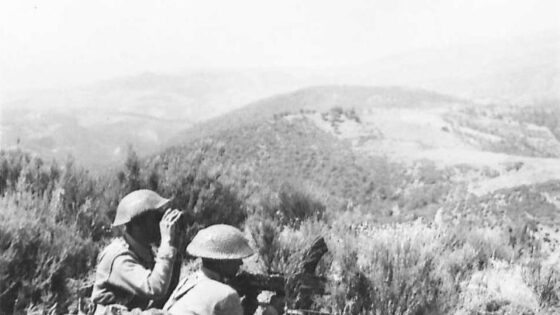
The evening of 3 August
At 9.45 p.m. on 3 August 1944 a battalion of the army of British India crossed the start line on the Sovara stream, north of Anghiari. Ahead of it was a wooded mountain rising about a thousand metres above the valley: the Alpe di Catenaia. There were no roads up it. The soldiers carried their weapons and ammunition on their backs; everything else followed on mules [1].
They were soldiers of the Indian Army, the army of British India: volunteers from present-day India, Pakistan and Nepal, with officers who were for the most part British. Leading the climb were the Marathas, from western India: 3/5 Mahrattas, the 3rd Battalion, 5th Mahratta Light Infantry. Behind them came the Nepalese Gurkhas of 2/3 Gurkhas and a British battalion, the 8th Manchesters: together they formed the 20th Brigade of the 10th Indian Division [2].
A mountain between two valleys
The Alpe di Catenaia separates the Valtiberina, the upper Tiber valley, to the east, from the Casentino, to the west, some twenty kilometres north-north-east of Arezzo. Its summit, Monte Castello (Il Castello in the military sources), reaches 1,414 metres; to the north-west rises the Sasso della Regina. For The Tiger Triumphs, the book published in 1946 for the Government of India on its divisions in Italy, it was ‘an agglomeration of ridges and peaks’, which could be taken only by climbing it head-on [3].
Beyond the summits, by way of Chitignano, the road led down into the Casentino at Bibbiena: for the official Indian history, written in 1960 from the units’ records, the natural starting point for breaking into the Gothic Line, the great German defensive line in the Apennines. The Line ran a few kilometres further north; on the massif the Germans had only delaying lines, to be held for a few days to slow down the advancing enemy, with women’s names, Karin and Lydia. The first gave its name to the ‘Quelli della Karin’ (‘Those of the Karin’) museum at Subbiano [4].
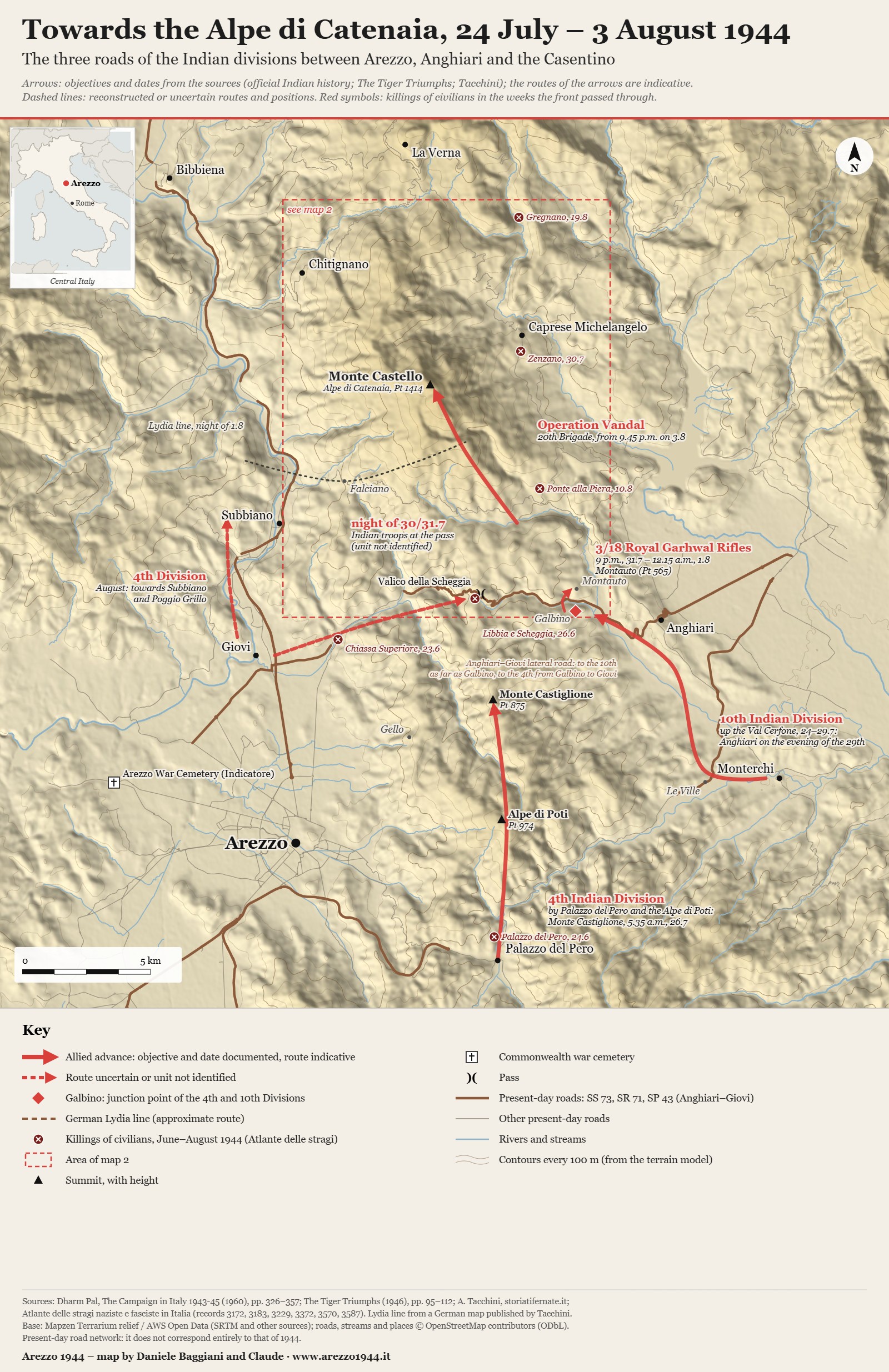
The roads by which the Indian divisions reached the foot of the Alpe di Catenaia between 24 July and 3 August 1944: by Palazzo del Pero, up the Val Cerfone as far as Anghiari, and up the Libbia valley as far as the Valico della Scheggia. Highlighted is the lateral road between Anghiari and Giovi, divided between the two divisions, which joined at Galbino. German Lydia line approximate; dark red symbols: killings of civilians. Compiled from Dharm Pal (1960), The Tiger Triumphs (1946), Tacchini and the Atlante delle stragi; Mapzen Terrarium relief, © OpenStreetMap contributors. Map by Daniele Baggiani and Claude for arezzo1944.it.
Three roads to the mountain, July 1944
At the end of July two Indian divisions, the 4th to the west and the 10th to the east, reached the foot of the massif by three roads. They were after the same thing: the lateral road between Anghiari and Giovi, which runs south of the mountain. The British plan gave the 10th the stretch as far as Galbino, and the 4th the rest [5].
The 4th Division came from the Valtiberina by way of Palazzo del Pero: in mid-July it had taken the Alpe di Poti, and on 26 July Monte Castiglione, above Gello [6].
The 10th was moving up the Val Cerfone from Monterchi. On 29 July, by midday, D Company of 3/1 Punjabis occupied Anghiari, which the Germans had left the night before; at Galbino the 25th Brigade took over the front line from the 20th, which would come forward again for the attack. At 12.15 a.m. on 1 August two companies of the Garhwalis of 3/18 Royal Garhwal Rifles, highlanders from the Indian Himalaya, took Montauto castle, on Point 764, which about a platoon of Germans had abandoned, leaving two dead behind; another company had stopped on Point 565 [7].
The third road was the lateral road itself, which climbs from Giovi up the Libbia valley and crosses the Valico della Scheggia, at 575 metres. On the night of 30/31 July, writes the Città di Castello historian Alvaro Tacchini, Indian troops established themselves on the pass [8].
So the lateral road passed into Allied hands, and the two divisions deployed along it, joined at Galbino: the 10th below the massif, between Montauto and the Sovara, the 4th further west [5].
Operation Vandal
On 2 August the British Lieutenant-General Richard McCreery, commander of X Corps, ordered the attack for the night of 3/4 August. The corps grouped several divisions, among them the two Indian ones; its Roman numeral has nothing to do with the 10th Indian Division or with the German Tenth Army, on the other side of the front. The attack had a code name, that is, the conventional name that stood for the description of the plan in the orders: Vandal. Why that name was chosen, the sources do not say [9].
Vandal was X Corps’ part in the British Eighth Army’s plan against the Gothic Line: to take the Alpe di Catenaia and Chitignano and push down towards Bibbiena ‘with all speed’, so that progress in one place would outflank the German defences in another. Further west the 4th Division was to attack towards Falciano, Subbiano and Poggio Pianale [10].
A reconnaissance had shown that no more than three battalions, that is, one brigade, could be supplied on the ridges, and only with a jeep track all the way to the top. That is why the 20th Brigade attacked alone, and work on the track began together with the attack. The plan had two phases: first the Marathas on Points 941 and 1201 and on Monte Filetto, then the Gurkhas on Monte Altuccia and on the summit [11].
Who held the mountain
The massif was held by the German 305th Infantry Division of General Friedrich-Wilhelm Hauck, the same division that had faced the Indians on the Alpe di Poti and at Campriano, with all its regiments in the front line. On the night of 1 August, according to a German map published by Tacchini, it had fallen back from the Karin line to the Lydia line, on the first heights of the massif. On the summits was the 576th Grenadier Regiment, ‘grenadiers’ being by then the name for ordinary German infantry. Among its outposts, Tacchini writes, there were many Slovaks with no experience of fighting at night [12].
On the Pratomagno, on the far side of the Casentino, and in reserve there were units of the 15th Panzer Grenadier Division, motorised infantry, and of the 114th Jäger Division, light infantry. How many men the German battalions had and who commanded them, we do not know: of the battle seen from the other side we know almost nothing beyond what Tacchini reports [13].
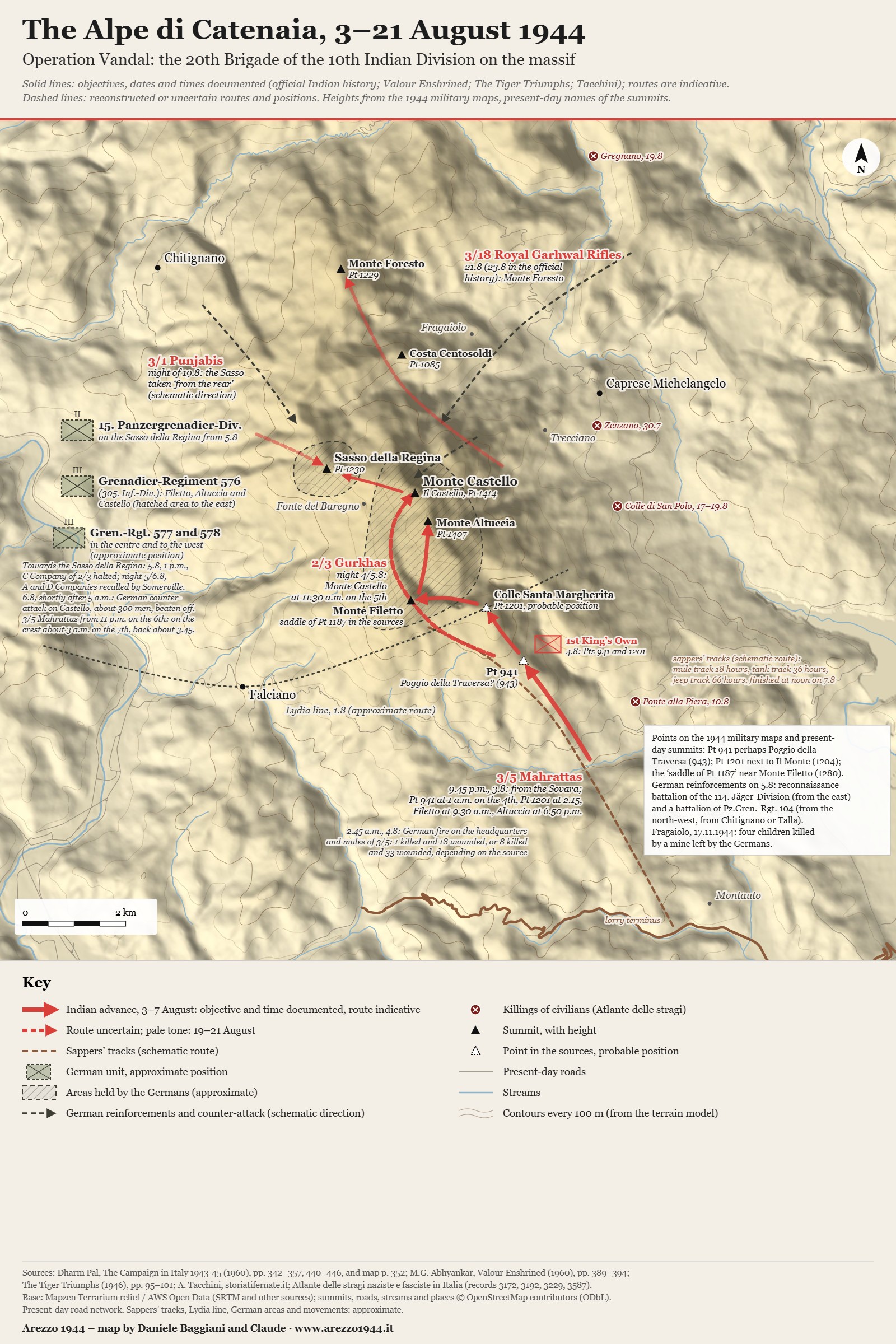
The Alpe di Catenaia from 3 to 21 August 1944: the night climb of the 20th Indian Brigade from the Sovara stream, the capture of the summits on 4 and 5 August, the German counter-attack of the 6th, the failed attack on the Sasso della Regina, and the capture of the Sasso and of Monte Foresto on the 19th and 21st. The positions of Points 941 and 1201 are probable; the sappers’ tracks are schematic. Compiled from Dharm Pal (1960), Valour Enshrined (1960), The Tiger Triumphs (1946) and Tacchini; Mapzen Terrarium relief, © OpenStreetMap contributors. Map by Daniele Baggiani and Claude for arezzo1944.it.
The summits, 3–5 August
The sources name the summits in the order in which they were attacked: Point 941, Colle Santa Margherita (Point 1201), Monte Filetto, Monte Altuccia, the summit; and beyond, to the west-north-west, the Sasso della Regina. A ‘Point’ is a height marked on military maps with its altitude in metres; not all of them can be identified with certainty today [14].
Once across the Sovara, the Marathas climbed in the dark, led by the company of Major Anandrao Kadam, an Indian officer. At 1 a.m. on 4 August they were on Point 941. At 2 a.m., writes The Tiger Triumphs, they went in with the bayonet on Colle Santa Margherita; by 2.15 it had been taken [15].
Half an hour later German fire hit the battalion headquarters and the mule columns: one killed and eighteen wounded according to the official history, eight killed and thirty-three wounded according to the regimental history; the Commonwealth War Graves Commission (CWGC), the body that cares for the memory of the Commonwealth war dead, records eight Marathas who died that day. At 9.30 a.m. another company was on Monte Filetto, taken with the bayonet after two failed attempts at a silent attack [16].
In the afternoon Major Sam Pyper’s company was driven back on Monte Altuccia, which the plan had assigned to the Gurkhas; at 6.15 p.m., after five minutes of British artillery fire, the Marathas attacked again from two sides, and by 6.50 p.m., according to Tacchini, Altuccia had been taken. The 20th Brigade war diary records the capture at 8 p.m., ‘after a fight lasting whole day’; that evening, it notes, German radio admitted that its ‘main defensive position on Monte Altuccia’ had been penetrated [17].
Meanwhile a British battalion of the 25th Brigade, the 1st King’s Own, had come up to hold the first Points, and the Gurkhas were waiting on the slopes of Point 941. The 8th Manchesters, the British battalion of the 20th Brigade, also came up in reserve during the night: at dawn on the 4th one of their companies was on Point 941; on the 5th another held Monte Filetto and two were further west, at C.S. Felicita; from the 6th the battalion dug in on Monte Altuccia. In the first twenty-four hours, The Tiger Triumphs observes, the Germans reacted little, perhaps because of surprise, mist and rain; but their artillery fired some six hundred rounds on the King’s Own and a thousand on the Gurkhas [18].
On the night of 4/5 August two Gurkha companies moved towards the summit, but lost their direction in the thick woods. At 11.30 a.m. on the 5th, ‘after a sharp engagement’, they took Monte Castello. At 1 p.m. one of the two pushed on towards the Sasso della Regina, but fire stopped it [19].
On 5 August German reinforcements were also arriving: a reconnaissance battalion of the 114th Division and a battalion of the 15th Panzer Grenadier Division. The headquarters of the 305th, Tacchini writes, ordered that there should be no further withdrawal, and that day the German artillery fired about three-quarters of its entire stock of ammunition [20].
On the night of 5/6 August two more Gurkha companies climbed towards Regina, as the sources call the Sasso. A patrol took a prisoner: up there, he said, there were about four hundred Germans. The commanding officer called off the attack [21].
The sappers’ tracks
Towards midnight on 3 August, under a full moon, the sappers had started work behind the infantry: three companies of Indian engineers, a Canadian drilling section and two companies of ‘artieri’, that is, sappers of the Italian army, which after the armistice worked alongside the Allies; with them, six bulldozers. From the lorry terminus, south-west of Montauto, the tracks ran down to the Sovara and climbed again to more than 1,100 metres: a mule track of about 8 kilometres, opened in 18 hours; a tank track, in 36; a jeep track of almost 10 kilometres, to just below Monte Filetto, in 66 hours, finished at noon on the 7th. According to Tacchini the Germans had not foreseen it. Without the tracks, the summits that had been taken could not have been held [22]. After 20 August the 10th Field Company of the Indian Engineers extended the jeep track over the Sasso della Regina to La Caspa [22].
The counter-attack and the Sasso della Regina, 6–7 August
Shortly after 5 a.m. on 6 August, before dawn, the Germans tried to retake the summit: about three hundred men of the two battalions that had just arrived, with bazookas. They overran a platoon of British machine-gunners of W Company, 1st Royal Northumberland Fusiliers: two killed, one wounded, nine missing. The Gurkhas’ commanding officer, Lieutenant-Colonel W. Somerville, recalled by wireless the companies he had sent towards Regina; they came back and took the attackers from the rear. The fighting went on for about four hours; the German losses, the official history writes, were ‘considerable’. The 20th Brigade war diary counts sixty German dead and thirty-five prisoners by 11 a.m.; later it writes of three strong companies, taken from two different divisions, which lost a hundred killed and forty prisoners. It estimates the losses of 2/3 Gurkhas that day at about fifty [23].
That dawn was depicted by Captain H.H. Sheldon, an Official War Artist. His illustration was published in Teheran to Trieste, the book on the 10th Indian Division printed in Bombay at the end of the war, with the caption: ‘With kukris flashing in the early dawn, 2/3rd Gurkha Rifles counter-attack German paratroops in the bloody glades of Castello, in the neighbourhood of Altuccia’. According to the hiking website ‘A piccoli passi’, Sheldon drew it on the spot, and the original is kept in Bombay, today Mumbai: we have not been able to verify this. The attackers, moreover, were not paratroops: the other sources speak of the two battalions that had just arrived, from the 114th Jäger Division and the 15th Panzer Grenadier Division [23].
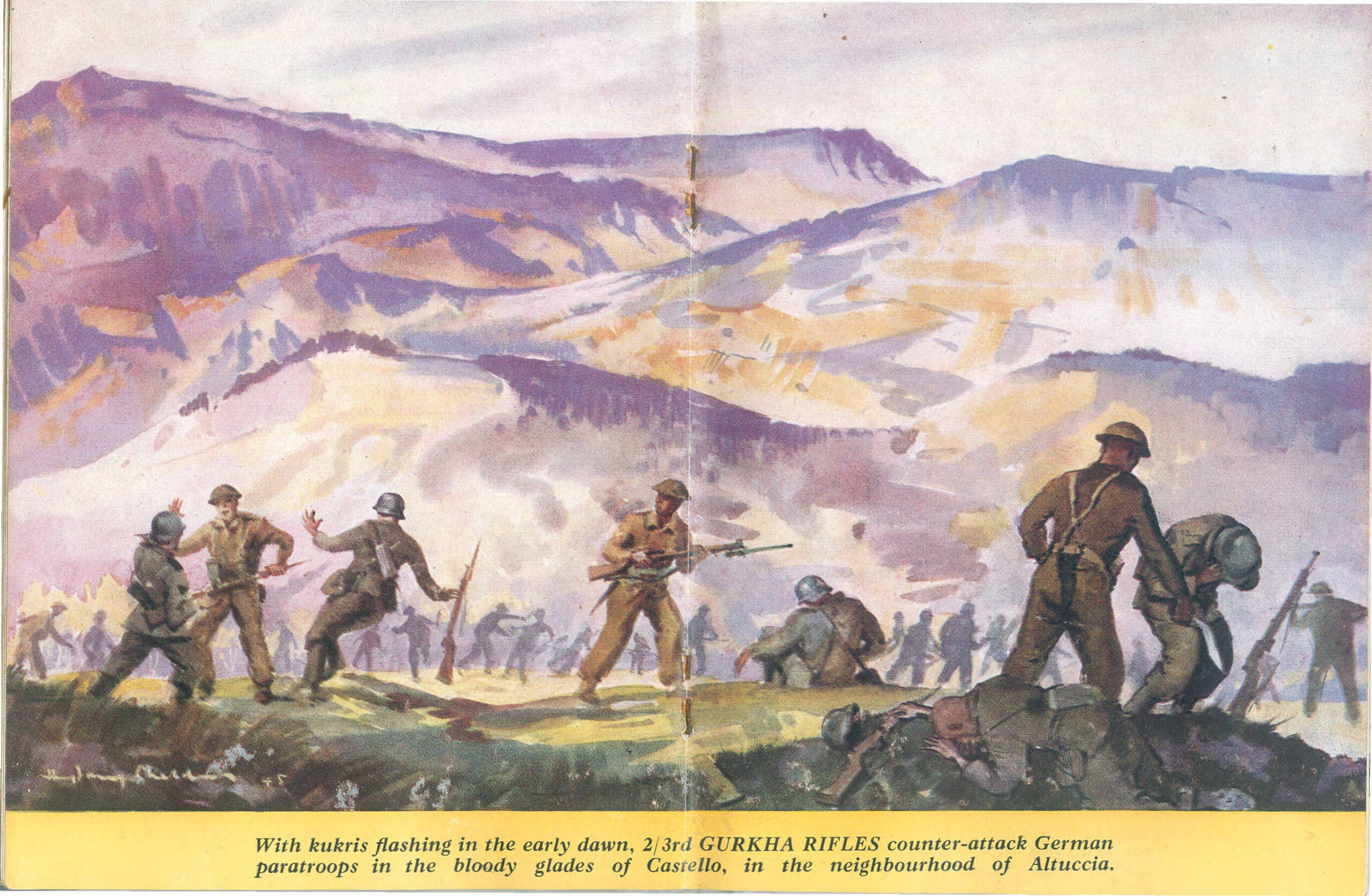
The counter-attack by the Gurkhas of 2/3 Gurkhas on Monte Castello at dawn on 6 August 1944, in the illustration by Captain H.H. Sheldon, Official War Artist. From Teheran to Trieste. The Story of the 10th Indian Division, Government of India, Bombay, n.d. Internet Archive scan, Public Domain Mark.
In the evening the Marathas took over the attack on Regina from the Gurkhas. At 11 p.m. two of their companies set off, fought their way through the machine guns and at about 3 a.m. on 7 August reached the crest. They beat off the counter-attacks for as long as their ammunition lasted, the last ones with the bayonet; at about 3.45 a.m. they fell back on Monte Castello. The brigade war diary counts 19 killed, 38 wounded and 5 missing; the next day the stretcher-bearers, collecting their own men, saw about ninety German dead on the slopes of Regina [24]. On the Sasso were two battalions of the 15th Panzer Grenadier Division, and the commander of the German Tenth Army, General Heinrich von Vietinghoff, had ordered, according to Tacchini, that it be held ‘with extreme determination’ [24].
Between 4 and 7 August the CWGC records forty-eight men of 3/5 Mahrattas killed, among them Lieutenant Alastair Thomson, aged twenty-one, who commanded a company, and seventeen of 2/3 Gurkhas. The 20th Brigade war diary counts, from 3 to 9 August, 115 casualties killed, wounded and missing in 3/5 Mahrattas and 66 in 2/3 Gurkhas. The hardest day was the 6th [25].
After Vandal: the divided mountain, 8–27 August
As early as 4 August General Harold Alexander, commander of the Allied Armies in Italy, had changed the plan: the Gothic Line would be attacked on the Adriatic side, and the forces would be moved there. On 10 August, the official Indian history writes, Vandal was ‘abruptly suspended’; why it had gone on until that day, the sources consulted do not say [26].
The 4th Division left the line for Lake Trasimene, and from there, at the end of August, for the Adriatic; the 10th was left alone on a front of about 24 kilometres, from the Tiber to Poggio Grillo. For twelve days the units of the 10th Division held Monte Castello and the Germans the Sasso della Regina. On the night of 8/9 August the 8th Manchesters took over the positions of 2/3 Gurkhas on Il Castello; on the 10th 2/3 Gurkhas came back into the line on Altuccia and at Pozza, in place of the King’s Own, and on the night of 11/12 August 4/10 Baluch relieved the Manchesters. Il Castello and Altuccia, the 20th Brigade war diary writes, were ‘a tremendous salient’ into the German positions, which could be shelled from all sides. The shelling was such that the 8th Manchesters had ‘several cases of anxiety neurosis’ and were sent to a quiet sector near Anghiari [27].
On 8 August a platoon of the German 114th Reconnaissance Battalion, which had settled overnight in the houses of Pozza, below Altuccia, attacked a British mule-borne battery, 456 Battery of 7th Mountain Regiment; two platoons of the 8th Manchesters and one of the King’s Own drove it out, taking three or four prisoners. On the morning of the 12th a concentrated air attack hit the German batteries, and from then on the shelling decreased [27].
On the night of 19 August, 3/1 Punjabis climbed the Sasso from behind the Germans and took it against little resistance. The battalion war diary describes an occupation by stages: on the 18th a patrol was driven back; on the 19th a platoon established itself in the wood south of Regina, with a section standing patrol on the summit; on the 20th B Company moved up onto the Sasso and found German and Allied dead there. At 11 p.m. on 22 August the Garhwalis took the Costa Centosoldi, and at 6 a.m. on the 23rd Monte Foresto, lower down, with thirty-six prisoners. On 25 August Chitignano was found empty; at dawn on the 27th a patrol of the 1st Durham Light Infantry, a British battalion of the 10th Indian Division, made contact with the Germans at Bibbiena station; on the evening of the 28th another patrol found the town clear. The Germans were falling back northwards, to another delaying line, in front of the Gothic Line [28].
The civilians below the mountain
For those who lived below the Catenaia the violence had begun before the front arrived. On 26 June, during a sweep against the partisans, the German military police killed Italo Tuti, a 4-year-old boy looking out of a window, and near the Valico della Scheggia hanged five partisans aged between 18 and 22, who are commemorated today by a memorial tablet. These were killings in the rear areas: the front arrived a month later [29].
On 3 August, Tacchini relates, the Germans suspected that someone was using a radio to give away the positions of their batteries to the Allied artillery, and shut thirty hostages in a cowshed to be shot, at Gricigliano, a place we have not been able to locate. They were saved by the ‘tenacity’ of a priest from Caprese, Don Tersilio Rossi, who convinced the officers that they were not spies [30].
During the weeks of the battle the Atlante delle stragi naziste e fasciste in Italia (Atlas of Nazi and Fascist Massacres in Italy), the national database of killings of civilians, records six killings of individuals around the massif, which no source links to the regiments on the summits. On 10 August, at Ponte alla Piera, Dina Primitivi, aged eighteen, was taken into the woods with her sister to be raped, and was killed. Between 15 and 19 August the Germans forcibly removed inhabitants of four villages of Caprese ‘beyond the Gothic Line’ and blew up the bridges [31].
Others died in the fighting: at Caprese, according to Tacchini, ten were killed by British artillery, five by German artillery and two by mines. On 17 November 1944, at Fragaiolo, four children aged between 9 and 11 who were playing near their home were killed by a mine left by the Germans. The intentional killings remain the responsibility of those who carried them out; those killed by artillery and by mines, of either side, were victims of the fighting [32].
Remembering the Alpe di Catenaia
Lieutenant Thomson and most of the Gurkhas of 2/3 Gurkhas lie in Arezzo War Cemetery, the Commonwealth war cemetery at Indicatore. Five Gurkhas and the other Marathas have no known grave: their names are on the memorials at Cassino and Forlì, and, with those of the other units, under ‘The fallen’ [33].
On 20 November 2025 an unnamed soldier found in a wood on the Catenaia, near Subbiano, was buried in Arezzo War Cemetery: ‘most probably’ a man of the 20th Brigade, killed in early August 1944. Whether he was British, Indian or Nepalese is not known. Gurkha soldiers of today carried him to his grave [34].
When the thaw came, Don Tersilio Rossi, the priest who had saved thirty hostages on 3 August, climbed the massif with some young men from Caprese to gather the remains of thirty-two German soldiers. They were identified and buried [35].
The mountain is still searched for traces of those days: researchers and enthusiasts walk it with metal detectors and bring down to the valley what remains of the battle. Among these finds, and we report it here for the first time, are tubes of paint and painting materials of the period, found in a position on the Alpe di Catenaia. We believe they are the ones with which, in August 1944, Captain Sheldon depicted the counter-attack on Monte Castello on the spot. This is first-hand information, gathered by those who run this website; the person who made the find prefers, for the time being, not to be named [35].
We thank our friends at the ‘Quelli della Karin’ museum at Subbiano, which collects the material found on these mountains and keeps its memory alive.
In brief
-
The Alpe di Catenaia is the massif between the Valtiberina and the Casentino, about twenty kilometres north-north-east of Arezzo; its summit, Monte Castello (Il Castello in the military sources), reaches 1,414 metres. In August 1944 it lay in front of the Gothic Line, not on it.
-
Between 24 and 31 July 1944 the 4th and 10th Indian Divisions reached the foot of the massif by three roads: by way of Palazzo del Pero (4th Division, Monte Castiglione on 26 July), up the Val Cerfone as far as Anghiari and Galbino (10th Division, 24–29 July), and up the Libbia valley as far as the Valico della Scheggia (night of 30/31 July). In this way they took the lateral road between Anghiari and Giovi, the base for the attack, divided between the two divisions and joined at Galbino. 3/18 Royal Garhwal Rifles took Montauto castle, Point 764, at 12.15 a.m. on 1 August.
-
On 2 August Lieutenant-General McCreery, commander of the British X Corps, ordered Operation Vandal, part of the Eighth Army’s plan for the attack on the Gothic Line. At 9.45 p.m. on 3 August the 20th Brigade of the 10th Indian Division crossed the start line on the Sovara.
-
On 4 August, 3/5 Mahrattas took Colle Santa Margherita (2.15 a.m.), Monte Filetto (9.30 a.m.) and Monte Altuccia (6.50 p.m.); on 5 August, 2/3 Gurkhas took Monte Castello (11.30 a.m.). Shortly after 5 a.m. on 6 August the Gurkhas beat off a counter-attack by about three hundred Germans; on the night of 6/7 August the Marathas reached the crest of the Sasso della Regina at about 3 a.m., but at about 3.45 they had to fall back.
-
Between 4 and 7 August 48 Marathas of 3/5 Mahrattas and 17 Gurkhas of 2/3 Gurkhas were killed (CWGC).
-
Behind the infantry, Indian and Canadian sappers and Italian ‘artieri’ opened, in 18, 36 and 66 hours, a mule track, a tank track and a jeep track up to the summits.
-
Facing them was the 305. Infanterie-Division, with Grenadier-Regiment 576 on the summits, and from 5 August units of the 15. Panzergrenadier-Division and the 114. Jäger-Division.
-
On 4 August General Alexander decided to attack the Gothic Line on the Adriatic side; on 10 August Vandal was suspended. The Sasso della Regina was taken by 3/1 Punjabis on the night of 19 August, Monte Foresto by 3/18 Royal Garhwal Rifles on the 23rd; on the 27th a patrol of the 1st Durham Light Infantry reached Bibbiena.
-
Around the massif, before and during the battle, German units killed civilians and partisans: at the Valico della Scheggia, on 26 June, a 4-year-old boy and five partisans. Other civilians died from the artillery of both sides and from mines.
Who’s who
Allies
-
Harold Alexander, British general, commander of the Allied Armies in Italy. On 4 August 1944 he decided to shift the weight of the offensive against the Gothic Line to the Adriatic [26].
-
Richard McCreery, British lieutenant-general, commander of X Corps. He ordered Operation Vandal on 2 August 1944 [9].
-
Denys Whitehorn Reid, British major-general, commander of the 10th Indian Division from January 1944. The Division’s watchword, writes The Tiger Triumphs, was his ‘Always lean forward’ [11].
-
A.W.W. Holworthy, British major-general, commander of the 4th Indian Division in August 1944 (official Indian history, p. 343).
-
J.B. Macdonald, brigadier, DSO, OBE, commander of the 20th Indian Brigade [2].
-
E.A. Arderne, brigadier, DSO, OBE, commander of the 25th Indian Brigade.
-
T.N. Smith, brigadier, OBE, commander of the 10th Indian Brigade, on the right flank.
-
W. Somerville, lieutenant-colonel, DSO, MC, commanding officer of 2/3 Gurkhas. On 6 August he recalled by wireless the two companies sent towards the Sasso della Regina and beat off the German counter-attack on Monte Castello [23].
-
A.E. Cocksedge, lieutenant-colonel, DSO, commanding officer of 3/5 Mahrattas until 23 July 1944, when he was wounded by an anti-personnel mine. According to The Tiger Triumphs and Teheran to Trieste command passed to Major N.J.G. James, of the 68th Field Regiment; Valour Enshrined names Lieutenant-Colonel G.A. MacMunn as Cocksedge’s successor, without a date. Who commanded the battalion on 3 August is not certain: the more likely is James.
-
Anandrao Kadam, major, an Indian officer, commanding A Company of 3/5 Mahrattas: he led the climb on the night of 3/4 August [15].
-
Sam Pyper, major, commanding D Company of 3/5 Mahrattas: Monte Altuccia, 4 August [17].
-
C.H. Pratt, captain, commanding B Company of 3/5 Mahrattas, wounded on 4 or 5 August.
-
Alastair Drummond Thomson, lieutenant, commanding C Company of 3/5 Mahrattas; died on 6 August 1944 aged 21, buried in Arezzo War Cemetery [33].
-
G.R. Grogan, lieutenant, MC, of 3/18 Royal Garhwal Rifles. On 23 August (the 21st according to The Tiger Triumphs), on Monte Foresto, he attacked a house single-handed and took twenty-nine prisoners, according to the same book, which does not say for which action he received the Military Cross [28].
Germans
-
Albert Kesselring, Generalfeldmarschall, commander of the German forces in Italy (Heeresgruppe C) [18].
-
Heinrich von Vietinghoff, Generaloberst, commander of the Tenth Army (Armeeoberkommando 10). According to Tacchini he ordered the Sasso della Regina to be held [24].
-
Friedrich-Wilhelm Hauck, Generalleutnant, commander of the 305th Infantry Division. In 1975 he wrote its history, which we have not consulted; the map of the Karin and Lydia lines published by Tacchini probably comes from it [12].
-
Eberhard Rodt, Generalleutnant, commander of the 15th Panzer Grenadier Division from November 1943 to October 1944 (Gentile).
Civilians
-
Don Tersilio Rossi, priest of Caprese, later Monsignor. On 3 August 1944, according to Tacchini, he saved thirty hostages; when the thaw came he gathered on the massif the remains of thirty-two German soldiers [30][35].
-
Italo Tuti, aged 4, and Tommaso Calabresi, Pasquale Checcaglini, Francesco Franceschi, Sabatino Mazzi, Enrico Riponi, partisans aged between 18 and 22, killed on 26 June 1944 between the Libbia valley and the Valico della Scheggia [29].
-
Dina Primitivi, aged 18, a sharecropper, killed on 10 August 1944 at Ponte alla Piera [31].
The historians and the sources
-
Dharm Pal, author of The Campaign in Italy 1943-45 (1960), the volume of the official history of the Indian armed forces devoted to Italy, edited by Bisheshwar Prasad. Written from the units’ records, it recounts Vandal with the times, the Points and the intelligence reports.
-
The Tiger Triumphs (1946): the book on the three Indian divisions in Italy, published for the Government of India; anonymous, attributed by some catalogues to G.R. Stevens. A work of official popular history, written soon after the events.
-
M.G. Abhyankar, author of Valour Enshrined (1960), the history of the Maratha regiment. For the times of the battle it draws, like the official Indian history, on the same 10th Division document: the two works are not independent witnesses.
-
Teheran to Trieste: the contemporary book on the 10th Indian Division, published by the Government of India, with drawings by Captain H.H. Sheldon, Official War Artist; his is the drawing of the counter-attack of 6 August on Monte Castello.
-
Alvaro Tacchini, historian of Città di Castello, author of Guerra e Resistenza nell’Alta Valle del Tevere 1943-1944 (2016) and of the articles on storiatifernate.it, among them two on Operation Vandal. He is our main route to the German side: his online articles do not give their German sources, and data reported only by him are attributed to him.
-
M.D. Kavanagh, author of a University of Birmingham thesis (2014) on the 10th Indian Division in Italy, which also draws on the war diaries.
Indian Army ranks. Sepoy: infantry private. Rifleman: private, in the Gurkha and Garhwal regiments. Lance naik: lance corporal. Naik: corporal. Havildar: sergeant. Jemadar, subedar: Indian or Gurkha officers commissioned by the Viceroy (Viceroy’s Commissioned Officers), between the non-commissioned officers and the British officers; they commanded platoons. The British brigadier is the officer who commands a brigade, between colonel and major-general: the rank has nothing to do with the brigadiere of the Italian Carabinieri.
German ranks. Generalfeldmarschall: field marshal. Generaloberst: colonel general (equivalent to a full general). Generalleutnant: equivalent to major-general.
Chronology
The dates on which Allied units arrived do not necessarily coincide with those that the municipalities commemorate as their day of liberation. Times are those given by the sources; where the sources diverge, see ‘Where the sources disagree’.
-
14 June – 11 July 1944: killings in the German rear areas at Chiusi della Verna, Chiassa Superiore, Palazzo del Pero, in the Libbia valley and at the Valico della Scheggia (26 June), at Poggio d’Ancona, Castelnuovo and Talla: see ‘Civilians in the area’.
-
22 July: the 10th Indian Division enters Città di Castello.
-
23 July: Lieutenant-Colonel Cocksedge, commanding officer of 3/5 Mahrattas, is wounded by a mine; Major James takes command.
-
24 July: 3/5 Mahrattas move up from Cagnano, 2/3 Gurkhas reach Lippiano.
-
25 July: the 8th Manchesters at Le Ville, where they beat off a counter-attack; the Gurkhas at Monterchi.
-
26 July, 5.35 a.m.: 1/9 Gurkhas of the 4th Division on Monte Castiglione.
-
27 July: 3/5 Mahrattas at Scoiano, the Manchesters at San Lorenzo, the Gurkhas across the Sovara.
-
Night of 28/29 July: the Germans leave Anghiari.
-
29 July: in the evening, Indian advance guards in Anghiari; 3/5 Mahrattas at Sant’Angelo and Galbino; the 25th Brigade takes over the front line from the 20th. Photographs of the Gurkhas on Monte Castiglione.
-
29–31 July: two Bailey bridges over the Sovara and in the Libbia valley.
-
30 July: killings at Zenzano (Caprese Michelangelo) and at Poggio d’Ancona (Subbiano).
-
Night of 30/31 July: Indian troops on the Valico della Scheggia.
-
31 July, 9 p.m.: 3/18 Royal Garhwal Rifles set off from the Galbino ridge. 1 August, 12.15 a.m.: B and C Companies take Montauto castle, Point 764; D Company is on Point 565.
-
Night of 1 August: the German 305th Division falls back from the Karin line to the Lydia line.
-
2 August: McCreery orders Operation Vandal for the night of 3/4 August. A killing at Casalunga (Talla).
-
3 August: thirty hostages shut in a cowshed at Gricigliano, saved by Don Tersilio Rossi. 9.45 p.m.: 3/5 Mahrattas cross the start line on the Sovara, east of Point 764, that is, of Montauto castle. Towards midnight: the sappers begin the tracks.
-
4 August, 1 a.m.: A Company of 3/5 Mahrattas on Point 941 (before midnight according to The Tiger Triumphs, Tacchini and the 20th Brigade war diary, which gives 11.30 p.m.). 2–2.15 a.m.: Point 1201, Colle Santa Margherita, taken with the bayonet. 2.45 a.m.: German fire hits the headquarters and the mule columns of 3/5 Mahrattas. 3 a.m.: the saddle of Point 1187. 6 a.m.: the jeep track crosses the Sovara; B Company moves towards Monte Filetto. 9.30 a.m.: Monte Filetto. 2–4.30 p.m.: D Company driven back on Monte Altuccia. 6.15–6.50 p.m.: Monte Altuccia taken. 7.50 p.m.: D Company on Point 1107. 8 p.m.: the first tanks at the head of the jeep track. 11 p.m.: 3/5 Mahrattas settled in; C Company on the slopes of Il Castello. Night: two companies of 2/3 Gurkhas set off from the western slopes of Point 941 towards Monte Castello.
-
4 August: General Alexander decides to attack the Gothic Line on the Adriatic side.
-
5 August: German reinforcements arrive from the 114. Jäger-Division and the 15. Panzergrenadier-Division; the 305th orders that there be no further withdrawal. 11.30 a.m.: 2/3 Gurkhas on Monte Castello. 1 p.m.: C Company of 2/3 Gurkhas, heading for the Sasso della Regina, is stopped. 4 p.m.: the jeep track reaches Point 1087. Night: A and D Companies of 2/3 Gurkhas towards Regina; a prisoner; the attack is called off.
-
6 August, 5.06–5.08 a.m.: German counter-attack on Monte Castello, beaten off in about four hours. During the day German artillery hits the headquarters of 3/5 Mahrattas (one officer killed). The CWGC dates to 6 August Lieutenant Thomson, 24 other Marathas and 11 Gurkhas: many of the Marathas were in all likelihood killed in the night attack on the Sasso della Regina. According to the 8th Manchesters’ war diary the air force destroyed 17 of the 20 lorries bringing German reinforcements. 11 p.m.: two companies of 3/5 Mahrattas attack the Sasso della Regina.
-
7 August, around 3 a.m.: the Marathas on the crest. Around 3.45 a.m.: they fall back on Monte Castello. Noon: the jeep track is finished.
-
8 August: fighting at Pozza (see above). Night of 8/9 August: the 8th Manchesters on Il Castello in place of 2/3 Gurkhas.
-
9 August: the 10th Division begins to side-step; 4/11 Sikhs, 1/4 Essex and the Lovat Scouts come under its command.
-
10 August: Operation Vandal suspended. Killing of Dina Primitivi at Ponte alla Piera. 11 p.m.: 2/3 Gurkhas relieve the 1st King’s Own on Altuccia and at Pozza. Night of 11/12 August: 4/10 Baluch relieve the 8th Manchesters; 3/5 Mahrattas take over the Baluch positions on Monte Filetto.
-
12 August: The Diagonals, the Division’s newspaper, writes that its soldiers are less than ten miles from the Gothic Line. Air attack on the German batteries.
-
14 August: the 10th Division spread over about 24 km, from the Tiber to Grillo.
-
15–19 August: inhabitants of San Casciano, Marcena, Stratino and Casalino taken away ‘beyond the Gothic Line’; the Germans blow up the bridges of Carbonchia, Cerfone, Camaiano and Singerna.
-
16–17 August: the 25th Brigade takes over the summits from the 20th: 3/18 Royal Garhwal Rifles relieve 4/10 Baluch on Altuccia and Il Castello (1.30 a.m. on the 17th), 3/1 Punjabis relieve 3/5 Mahrattas (11.30 p.m. on the 17th).
-
17 August, 11 p.m.: below the Sasso della Regina a patrol of 3/18 Royal Garhwal Rifles is fired on by mistake by a patrol of 3/5 Mahrattas: two killed and one missing.
-
17–19 August: Riccardo Severi wounded at Colle di San Polo; he dies on the 19th.
-
Night of 19 August: 3/1 Punjabis take the Sasso della Regina. Killing of Agide Pericchi at Gregnano.
-
21 August: the Germans leave Caprese.
-
22 August: a prisoner taken by the Lovat Scouts, a British scout unit, reveals the general German withdrawal. 11 p.m.: 3/18 Royal Garhwal Rifles take the Costa Centosoldi. 23 August: at 6 a.m. 3/18 Royal Garhwal Rifles take Monte Foresto, with thirty-six prisoners; the Pratomagno is clear.
-
24 August: the first Allied soldiers at Caprese Michelangelo, from Trecciano; the main body on the 26th.
-
25 August: Chitignano found empty. 5 a.m.: two platoons of A Company, 3/18 Royal Garhwal Rifles, attack a German position north of Monte Foresto: Jemadar Umrao Sing Negi and two riflemen are killed. 9 p.m.: an attack by about 35 Germans on B Company on Monte Foresto is beaten off without loss. On the Adriatic the Allied offensive against the Gothic Line begins (Operation Olive).
-
27 August, 2.30 a.m.: D Company of the 1st Durham Light Infantry in contact with the Germans at Bibbiena station.
-
28 August: a patrol of the 1st King’s Own meets five Germans at Caprese, who withdraw; a platoon establishes itself near the village. 10.10 p.m.: a patrol of A Company of the 1st Durham Light Infantry finds Bibbiena clear.
-
17 November 1944: four children killed by a mine at Fragaiolo.
-
20 November 2025: an unknown soldier, most probably of the 20th Brigade, found on the Catenaia, is buried in Arezzo War Cemetery.
Units
How a division was organised. A platoon numbered about thirty men; a company, identified by a letter (A, B, C, D), about a hundred. The battalion, a few hundred men, was the basic unit of the infantry. Three battalions formed a brigade; three brigades, with the artillery, the engineers and the services, a division; several divisions a corps; several corps an army. In the Indian brigades one British battalion served alongside two Indian or Gurkha battalions. In abbreviations, ‘3/5’ means 3rd Battalion, 5th Regiment.
Three numbers not to be confused. The 10th Indian Division is the subject of this page. The British X Corps, with the Roman numeral, was the formation to which it belonged, together with the 4th Indian Division. The German Tenth Army (Armeeoberkommando 10) was on the other side of the front. The coincidence of the numbers is pure chance.
Mahratta and Maratha. ‘Mahratta’ is the English spelling of the time, used here for the unit; the soldiers are called Marathas here. Since the war the regiment has been called the Maratha Light Infantry: so its history, Valour Enshrined.
Allied chain of command
-
British Eighth Army.
-
British X Corps, Lieutenant-General Richard McCreery, with the 4th and 10th Indian Divisions.
-
10th Indian Division, Major-General Denys W. Reid.
20th Indian Infantry Brigade, Brigadier J.B. Macdonald
-
3rd Battalion, 5th Mahratta Light Infantry: Cagnano, Scoiano, Galbino (24–29 July); Point 941, Colle Santa Margherita, Monte Filetto, Monte Altuccia (3–4 August); Sasso della Regina (6–7 August); in reserve from 7 August; back in the line between Monte Filetto and C.S. Felicita from 12 to 17 August, with one company under command of 3/18; from 25 to 29 August with the 25th Brigade, towards Rocca and Monte Fungaia.
-
2nd Battalion, 3rd Queen Alexandra’s Own Gurkha Rifles, Lieutenant-Colonel W. Somerville: Lippiano, Monterchi (24–25 July); Monte Castello (5–6 August).
-
8th Battalion, The Manchester Regiment (Ardwick), British: Le Ville, San Lorenzo (25–27 July); brigade reserve in the climb on the night of 3/4 August (one company on Point 941 at dawn on the 4th); Monte Filetto and C.S. Felicita (5 August); Monte Altuccia (from the 6th); Pozza (8 August); Monte Castello, in place of 2/3 Gurkhas (9–11 August); from 12 August in the Anghiari sector, with the 25th Brigade (Viaio, Croce, Point 519).
-
Under command of the brigade for the attack (official Indian history, p. 351): W and Z Companies of the 1st Battalion, The Royal Northumberland Fusiliers, a British machine-gun battalion (Z Company less two platoons); the 68th Field Regiment, Royal Artillery (in size, a British field regiment corresponds to an Italian artillery ‘gruppo’ rather than to a regiment); the 165th Jeep Regiment; the 100th Anti-Tank Battery. In support: the 5th, 10th and 61st Field Companies (Indian Sappers and Miners, the Indian engineers), the 4 Canadian Drilling Section, Royal Canadian Engineers, two companies of Italian artieri (‘Two companies Artieri’) and six bulldozers. Also with the Division, the 41st Field Park Company.
25th Indian Infantry Brigade, Brigadier E.A. Arderne
-
1st Battalion, The King’s Own Royal Regiment (Lancaster), British: Points 941 and 1201 from 4 August; the Monte Filetto ridge from the 6th; Altuccia and Pozza until relieved by 2/3 Gurkhas on the night of the 10th; from 21 August again on Filetto, Il Castello, Altuccia and Pozza; Trecciano and Caprese (24–28 August).
-
3rd Battalion, 18th Royal Garhwal Rifles: Galbino and Monte Sant’Angelo (30 July); Montauto castle, Point 764 (1 August); from 9 to 16 August with the 5th Brigade of the 4th Division, between Point 974 and Vogognano; from 17 August Monte Altuccia and Il Castello; Costa Centosoldi (22 August) and Monte Foresto (23 August); Chiusi della Verna (30 August).
-
3rd Battalion, 1st Punjab Regiment: Anghiari (29 July); Point 689 (1 August); Ponte alla Piera and Albiano (2–16 August); from 17 August in place of 3/5 Mahrattas below the Sasso della Regina, occupied on 19–20 August; La Caspa, Point 1204 (22 August); patrols towards Chitignano (24–25 August).
10th Indian Infantry Brigade, Brigadier T.N. Smith: 2nd Battalion, 4th Prince of Wales’s Own Gurkha Rifles, on the right flank towards Sansepolcro (29–30 July); 4th Battalion, 10th Baluch Regiment, on the massif with the 20th Brigade from 5 August, in reserve, then on Monte Filetto from the 8th and on Il Castello and Altuccia from the night of 11/12 August to 17 August; 1st Battalion, The Durham Light Infantry, British, at Bibbiena on 27–28 August.
Other units of the Division: divisional anti-tank artillery, protecting the work on the tracks. 3rd The King’s Own Hussars, a British armoured regiment, on the right flank. Skinner’s Horse and the Lovat Scouts (a British scout unit), towards the Pratomagno. From 9 August 4/11 Sikhs, 1/4 Essex and the Lovat Scouts also came under the Division.
4th Indian Division, Major-General A.W.W. Holworthy, on the left: the 5th Indian Brigade, with the 1st Battalion, 9th Gurkha Rifles, on Monte Castiglione (26 July) and then on the lower slopes of the Catenaia, ‘in touch with Tenth Indian Division on their right’ (The Tiger Triumphs); the 11th Indian Brigade on Monte Ferrato and Poggio Grillo (August).
German units
-
Heeresgruppe C (Army Group C), Generalfeldmarschall Albert Kesselring.
-
Armeeoberkommando 10 (Tenth Army), Generaloberst Heinrich von Vietinghoff.
-
LXXVI. Panzerkorps (LXXVI Panzer Corps): according to Tacchini, on 30–31 July it fell back to the Lydia line, the line of the 305th on the Catenaia. Which corps the division came under for the rest of August, the sources consulted do not allow us to establish; further east, in the upper Tiber valley, was the LI. Gebirgs-Armeekorps (LI Mountain Corps).
-
305. Infanterie-Division (305th Infantry Division), Generalleutnant Friedrich-Wilhelm Hauck, with all three regiments in the line (The Tiger Triumphs):
- Grenadier-Regiment 576 (576th Grenadier Regiment): at the end of July two battalions on Monte Castiglione and Monte Veriano; in August on Monte Filetto, Monte Altuccia and Monte Castello (Tacchini). Its II. Bataillon was surprised on the night of 3/4 August ‘a couple of kilometres east of Poggio della Traversa’.
- Grenadier-Regiment 577 (577th Grenadier Regiment): in the centre.
- Grenadier-Regiment 578 (578th Grenadier Regiment): at the end of July further to the east than the 577th according to the official Indian history (p. 339, from the 4th Division’s intelligence summaries), to the west according to Tacchini; as the attack developed it was moved from the 10th Division’s front to the 4th’s (p. 350).
- Füsilier-Bataillon 305 and Pionier-Bataillon 305: reinforcements and road works (Tacchini).
-
15. Panzergrenadier-Division (15th Panzer Grenadier Division), Generalleutnant Eberhard Rodt: at the start of Vandal in the line on the Pratomagno, with Panzergrenadier-Regiment 104 on the western slopes and Panzergrenadier-Regiment 115 on the eastern slopes, ‘covering Subbiano and Talla’ (official Indian history, p. 342); in reserve according to The Tiger Triumphs. One battalion of the 104th arrived on 5 August: II Battalion, from Chitignano, according to Tacchini; III Battalion, from the Talla area, according to the official Indian history. ‘Two battalions’ of the division were on the Sasso della Regina on 6–7 August (The Tiger Triumphs).
-
114. Jäger-Division (114th Jäger Division): its reconnaissance battalion (Aufklärungs-Abteilung) arrived from the Valtiberina on 5 August.
-
II. Bataillon of Regiment 3 ‘Brandenburg’: a reinforcement according to Tacchini.
-
Feldgendarmerie-Abteilung (mot.) 692, 1. Kompanie (1st Company of a motorised military police unit of the German army): Chiassa Superiore, Palazzo del Pero, the Libbia valley and the Valico della Scheggia, 23–26 June 1944 (Atlante).
Points and place names. The military sources use the spot heights of the maps of the time (Point, ‘Pt.’). Many of these places have not been identified with certainty on present-day maps: on our maps their positions are shown as probable. The war diaries of the 20th and 25th Brigades give the grid references of the 1944 1:50,000 maps: Point 941, MR 360470; Point 1201, square 3548; Monte Filetto, 3348; Monte Altuccia, 3449; Il Castello, Point 1415, 3350; Sasso della Regina, 3250; Point 1087, MR 350477; C.S. Felicita, MR 330488; Pozza, MR 345492; La Caspa, Point 1204, MR 320522; Costa Centosoldi, 3353; Monte Foresto, 3254. They make it possible to locate the Points on the map.
| Present-day name or name in the sources | Height | On present-day maps | What happened there |
|---|---|---|---|
| Montauto (‘Monte Montalto’ in The Tiger Triumphs, ‘Castle Montauto’ in the official Indian history) | Point 764 (Pt. 764; MR 371440 in the 3/18 war diary); Point 565 (MR 377426) lies to the south-east | Montauto castle, municipality of Anghiari | 3/18 Royal Garhwal Rifles, 12.15 a.m. on 1 August |
| Galbino, Tavernelle | – | places north of Anghiari | base for the attack |
| Sovara stream | – on the official history’s map | the stream, yes; the Point still to be located | start line east of Point 764 (Montauto castle), 9.45 p.m. on 3 August |
| Point 941 | Point 941 (Pt. 941) | not identified | A Company of 3/5 Mahrattas, 1 a.m. on 4 August |
| Colle Santa Margherita (‘C.S. Margherita’) | Point 1201 (Pt. 1201) | to be checked; a 20th Brigade message gives ‘C S MARGHERITA 3247’, about 3 km west-south-west of Point 1201 (square 3548): whether the two are the same is still to be checked | 3/5 Mahrattas, 2–2.15 a.m. on 4 August |
| Monte Filetto | Point 1187 (Pt. 1187) on the official history’s map, the ‘saddle’ of Point 1187 in its text | to be checked | 3/5 Mahrattas, 9.30 a.m. on 4 August |
| Monte Altuccia | – | to be checked | 3/5 Mahrattas, 6.50 p.m. on 4 August |
| Point 1087 | Point 1087 (Pt. 1087) | not identified | head of the mule track and of the tank track |
| Monte Castello (‘Il Castello’, ‘Monte Castello’ in the sources) | 1,414 m (4,600 feet in The Tiger Triumphs; 1407 on the official history’s map, uncertain reading) | Monte Castello, summit of the Alpe di Catenaia | 2/3 Gurkhas, 11.30 a.m. on 5 August; German counter-attack on the 6th |
| Sasso della Regina (‘Regina’, ‘Alpe della Regina’) | – | viewpoint on the ridge | attack by 3/5 Mahrattas, 6–7 August; 3/1 Punjabis, night of 19 August |
| Monte Foresto, Costa Centosoldi | – | to be checked | 3/18 Royal Garhwal Rifles, 23 August (21 in The Tiger Triumphs and Tacchini) |
| Valico della Scheggia | 575 m | pass on the road between Anghiari and Giovi (SP 43) | Indian troops, night of 30/31 July |
| Monte Castiglione | Point 745 (Pt. 745) | to be checked | 1/9 Gurkhas, 26 July |
-
The name of the summit. The military sources say ‘Il Castello’ (official Indian history) or ‘Monte Castello’ (Tacchini); komoot ‘Monte Castello’; GeoNames gives the same point the name ‘Alpe di Catenaia’. Monte Castello is used here.
-
The municipality of the summit. Caprese Michelangelo according to komoot, Subbiano according to GeoNames. The summit probably lies on the boundary between the two municipalities.
-
Soara or Sovara. ‘Sovara’ in The Tiger Triumphs, in the official history and on present-day maps; ‘Soara’ in Tacchini. Sovara is used here.
-
Gricigliano. The place where the hostages were shut in on 3 August has not been found on the maps consulted: it should not be confused with Gricignano, in the municipality of Sansepolcro, or with Gregnano, in that of Caprese.
Where the sources disagree
Where the sources diverge, the official Indian history, written from the units’ records, and the history of the Maratha regiment are as a rule followed, rather than The Tiger Triumphs, written in 1946 as a work of popular history, and Teheran to Trieste, a contemporary book of the same kind. For the times of the battle, however, the official history and the regimental history draw on the same document, the 10th Division’s narrative of operations, often in the same words: they are not two independent witnesses. Alvaro Tacchini, who has also studied the battle from the German sources, is our main route to the German side; his online articles do not give those sources, and data reported only by him are attributed to him.
-
The end of Vandal. 10 August according to the official history (p. 357), the history of the Cameron Highlanders (p. 357) and Tacchini. The decision that brought it about was taken on 4 August: that day General Alexander changed the plan of attack on the Gothic Line (official history, pp. 359–360). The Tiger Triumphs (p. 112) gives no date: it says that Vandal was ‘handed over’ to the 10th Indian Division. Alexander’s despatch (London Gazette, p. 2939) states that as early as 7 August X Corps, ‘reduced in strength to 10 Indian Division only’, went onto the defensive; the official history (p. 357) that ‘it became necessary to relax the grip’ to regroup the troops for the relief of the 4th Indian Division. The change of plan was kept hidden from the Germans (London Gazette, p. 2944). The 20th Brigade war diary, in its entry for 9–15 August, writes that higher command had decided that a further effort in this direction ‘was not likely to pay a good dividend’, and the brigade consolidated in its positions. The dates are discussed in the page on Operation Vandal.
-
The reliefs after Vandal. Valour Enshrined (pp. 392–393) writes that on 10 August 4/10 Baluch relieved 3/5 Mahrattas. In the war diaries 3/5 Mahrattas go into reserve on the evening of 7 August (20th Brigade) or are relieved on the 8th (8th Manchesters); a company of the Baluch replaces that of the King’s Own on Filetto on the 8th, and the Baluch relieve the Manchesters on Il Castello on the night of 11/12 August; then 3/5 Mahrattas return to Filetto in place of the Baluch, until they are relieved by 3/1 Punjabis on the evening of the 17th. The war diaries are followed.
-
Who took Monte Castello. Alexander’s despatch (London Gazette, p. 2939) states that ‘3/5 Mahrattas captured the summit of Monte Il Castello’; the official history (p. 354), The Tiger Triumphs and Tacchini give 2/3 Gurkhas, at 11.30 a.m. on 5 August. The despatch seems to confuse the two battalions; the official history is followed.
-
The losses on the night of 4 August. For the German fire at 2.45 a.m. the official history (p. 351) gives one killed and 18 wounded; Valour Enshrined (p. 391), in an almost identical sentence, 8 killed and 33 wounded. One of the two texts contains a misprint or a transcription error. The CWGC records eight men of 3/5 Mahrattas who died on 4 August, as in Valour Enshrined.
-
The German reinforcements of 5 August. Tacchini: II. Bataillon of Panzergrenadier-Regiment 104, from Chitignano, led by the divisional commander. Official history (pp. 350, 354): III. Bataillon, from the Talla area. That the ‘two fresh battalions’ of the counter-attack of the 6th (official history, p. 356) were those that had arrived on the 5th, the source does not say explicitly, but the definite article suggests it. On 7 August 2/3 Gurkhas took a prisoner of the 10th Company of Panzergrenadier-Regiment 104 on Il Castello, and on the 8th, at Pozza, the Manchesters and the King’s Own took four prisoners of 114th Reconnaissance Battalion (20th Brigade war diary). The 10th Company normally belonged to the III Battalion: this supports the official history.
-
The 15. Panzergrenadier-Division. The Tiger Triumphs (p. 96) places it in reserve; the official history (p. 342) in the line on the Pratomagno, with the 104th Regiment on the western slopes and the 115th on the eastern slopes, covering Subbiano and Talla. German Wikipedia states that the division left for the Western Front at the end of July: the Allied sources and Tacchini place units of it on the Catenaia from 5 August.
-
The counter-attack of 6 August. The official history (p. 356): ‘At 0506 hours there had been silence but two minutes later a full-sized action was in progress’, that is, silence at 5.06 a.m. and fighting at 5.08; about three hundred men with ‘Bazookas’, from ‘two fresh battalions’. The 20th Brigade war diary speaks of ‘3 strong companies, taken from two different divisions’. ‘Before dawn’ according to Teheran to Trieste, on the night of 5/6 August according to Tacchini; The Tiger Triumphs relates that the Gurkhas, moving silently in the dark, surrounded the attackers. Teheran to Trieste speaks of ‘a strong force of paratroopers’: no other source mentions them, and none identifies paratroops in this sector. The caption of Sheldon’s illustration, in the same book, also speaks of ‘German paratroops’. In the text they are not called paratroops.
-
The attack on the Sasso della Regina. Departure at 11 p.m. on the 6th, on the crest at about 3 a.m. on the 7th, withdrawal at about 3.45 according to the official history (p. 357), at about 3.15 according to Valour Enshrined (p. 392, uncertain reading); ‘that evening’, without a date, according to The Tiger Triumphs. English Wikipedia states that Regina was occupied on 6 August and then abandoned: the other sources say that the Marathas stayed there for less than an hour.
-
The commanding officer of 3/5 Mahrattas. Cocksedge was wounded by a mine on 23 July (Valour Enshrined, p. 356; The Tiger Triumphs, p. 95). The Tiger Triumphs (‘Major James, of 68 Field Regiment, then took command of the infantry’) and Teheran to Trieste (‘took command of the battalion’) give the command to Major N.J.G. James; Valour Enshrined (p. 394) names Lieutenant-Colonel G.A. MacMunn as Cocksedge’s successor, without a date. Who was in command on 3 August is not certain; the more likely is James.
-
The German shelling of 4 August. The Tiger Triumphs (p. 97) writes that the Gurkhas counted a thousand shells ‘with no man killed and only a few wounded’. The CWGC, however, records two men of 2/3 Gurkhas who died on 4 August, Dallu Gurung and Tek Bahadur Ghale: they may have died of wounds, at night or elsewhere; the sources consulted do not allow us to establish which. The 20th Brigade war diary, immediately after the sentence on 2/3 Gurkhas, records at 1 a.m. on 4 August two killed and one wounded by German fire during the night, without saying which unit.
-
The time and place of departure. The Tiger Triumphs (p. 96): at 9 p.m. on 3 August, 3/5 Mahrattas ‘crossed the Sovara’. The official history (p. 351) and Valour Enshrined (p. 390), in the same sentence: at 9.45 p.m. the battalion ‘crossed the start line east of Pt. 764’, that is, on the Sovara (official history map, p. 352). Tacchini: at 9.45 p.m. the units crossed the ‘Soara’. The time of 9.45 p.m. is followed here. The Tiger Triumphs (p. 111) gives 9.30 p.m. as the start time of Vandal for the 4th Division.
-
Point 941. Shortly before midnight according to The Tiger Triumphs (‘two and a half hours after crossing the river’) and Tacchini; at 1 a.m. on 4 August according to the official history and Valour Enshrined (in whose scan the Point is printed ‘911’). The 20th Brigade war diary records the capture of Point 941 at 11.30 p.m. on 3 August, ‘with only slight opposition’, and two Maratha companies on Point 1201 at 2 a.m. on the 4th: this supports The Tiger Triumphs and Tacchini.
-
Point 1201. At 2 a.m. according to The Tiger Triumphs, at 2.15 according to the official history, Valour Enshrined and Tacchini: these may be the start of the assault and the capture.
-
Monte Filetto. On 4 August, at dawn or at 9.30 a.m., according to The Tiger Triumphs, Valour Enshrined and Tacchini; on the night of the 3rd according to Teheran to Trieste. The 20th Brigade war diary already has two Maratha companies on Filetto in its 6.30 a.m. entry for the 4th.
-
Monte Altuccia. Attack at 6.15 p.m. according to Valour Enshrined, capture at 6.50 p.m. according to Tacchini.
-
Monte Castello. At 11.30 a.m. on 5 August according to the official history (p. 354) and Tacchini; ‘by the evening of August 5th’ according to The Tiger Triumphs. Valour Enshrined places C Company of the Marathas ‘on the slopes of Il Castello’ at 11 p.m. on the 4th.
-
The jeep track. 66 hours according to The Tiger Triumphs, the official history and Tacchini; ‘less than forty-eight hours’ according to Teheran to Trieste. The first three are followed.
-
Montauto. Departure at 9 p.m. on 31 July from the Galbino ridge and Point 565 at 12.15 a.m. on 1 August, then Point 764 (official history, p. 333, which does not say explicitly that Point 565 is the castle, but writes immediately afterwards ‘With the capture of Castle Montauto’); ‘31 July’, a night march of four miles (The Tiger Triumphs); from Tavernelle, on the night after that of 30/31 July (Tacchini). Galbino and Tavernelle are about a kilometre apart: the versions are compatible. The war diaries of 3/18 Royal Garhwal Rifles and of the 25th Brigade settle the point: Montauto castle is Point 764 (MR 371440), taken at 12.15 a.m. on 1 August by B and C Companies; D Company had stopped on Point 565 (MR 377426). The diaries are followed.
-
The Valico della Scheggia. Tacchini writes that on the night of 30/31 July ‘the Indian troops established themselves on the Scheggia pass’ and places the episode among the actions of the 10th Division; the official history (p. 326), by contrast, assigns to the 4th Division the stretch of the lateral road from Galbino to Giovi, in which the pass lies. Which unit reached it, the sources consulted do not say.
-
Who entered Anghiari on 29 July. According to Tacchini, ‘the advance guards of the Punjabi troops’; according to Valour Enshrined, 1/2 Punjabis; according to the official history (damaged scan), 3/1 Punjabis relieved the 8th Manchesters and 3/5 Mahrattas occupied the town. The Tiger Triumphs (p. 101) says that 1/2 Punjabis rejoined the Division only on 26 August. The 3/1 Punjab war diary: at first light on the 29th B Company occupied the area south of the town, and D Company occupied it by midday; a concentration of artillery fire on the town killed Subedar Faqir Mohd, the company’s second-in-command. The Punjabi unit was 3/1 Punjabis.
-
Monte Castiglione. First light on 26 July, Points taken at 5.35 a.m. (official history); 26 July (Tacchini); the night after the King’s visit (The Tiger Triumphs, p. 110). See the page on the Alpe di Poti.
-
Monte Foresto. On 21 August, ‘two nights’ after the 19th, according to The Tiger Triumphs and Tacchini; at 6 a.m. on 23 August according to the official history (p. 444), which provides for converging attacks between 4 and 5 a.m. on the 23rd and places the capture of the Costa Centosoldi at 11 p.m. on the previous day (the figure of the date is uncertain in the scan). The war diaries of 3/18 Royal Garhwal Rifles and of the 25th Brigade confirm the official history: Costa Centosoldi at 11 p.m. on the 22nd, Monte Foresto at 6 a.m. on the 23rd. The 23rd is followed.
-
Bibbiena. According to The Tiger Triumphs (p. 101), on 27 August ‘a patrol of 25th Brigade reached Bibbiena’. According to the official history (p. 446) it was a patrol of the 1st Durham Light Infantry, of the 10th Brigade, that found a German platoon guarding the station on the 26th or 27th; by the 29th the patrols were entering the town without contact. The 1st DLI war diary confirms the official history: contact at the station at 2.30 a.m. on the 27th, the town clear on the evening of the 28th. The text follows the war diary.
-
Caprese. According to Tacchini the Germans left Caprese on 21 August and the first Allied troops arrived from Trecciano on the 24th. In the war diaries of the 1st King’s Own and of the 25th Brigade there were still Germans at Trecciano on the 24th; on the 26th and 27th civilians reported small German parties in Caprese, which ‘the enemy enters by day’; on the 28th a patrol met five of them, and according to civilians about seventy Germans left the Caprese area that day, northwards.
-
The front on 14 August. The Tiger Triumphs (p. 99) has the Division spread over 15 miles ‘between the Tiber and Monte Grillo’: in all likelihood the Poggio Grillo where the 4th Indian Division fought at the beginning of August.
-
The Gothic Line. Italian Wikipedia, in its article ‘Alpe di Catenaia’, writes that the area was ‘affected by the passage of the Gothic Line’. The military sources place the Catenaia in front of the Line: on the massif the Germans had delaying lines (Karin, Lydia), then, at the end of August, the Brown Line, on the ridge of La Verna.
-
The Slovaks and Kesselring. The presence of many Slovaks in the outposts of II./Grenadier-Regiment 576 and Kesselring’s comment on the ‘asleep’ troops are reported only by Tacchini, who does not give the German source online.
-
Lieutenant Thomson. The CWGC gives his death as 6 August 1944. Valour Enshrined (p. 392) names him among the casualties of C Company in its account of 4 and 5 August; the scan does not allow the date to be read with certainty.
Figures
-
1,414 m: Monte Castello, the summit of the Alpe di Catenaia (4,600 feet in The Tiger Triumphs) [3].
-
575 m: the Valico della Scheggia, on the road between Anghiari and Giovi [8].
-
1 killed and 18 wounded (official history) or 8 killed and 33 wounded (Valour Enshrined) of 3/5 Mahrattas from the German fire at 2.45 a.m. on 4 August; 8 men of the battalion who died that day according to the CWGC [16].
-
About 100 men lost, killed and wounded, by the 20th Brigade in the first phase, up to 4 August (The Tiger Triumphs, ‘one hundred men’) [18].
-
About 600 German rounds on the 1st King’s Own and about 1,000 on the Gurkhas on 4 August [18].
-
18, 36 and 66 hours: the time taken to open the mule track (5 miles, about 8 km, two platoons), the tank track (5 miles, three platoons) and the jeep track (6 miles, almost 10 km, four platoons and the Italian artieri) [22].
-
65 tonnes of shells fired by the German artillery on 5 August, about three-quarters of its entire stock of ammunition, and 11 tonnes of grenades (Tacchini) [20].
-
About 400 Germans on the Sasso della Regina, according to a prisoner (6 August) [21].
-
About 300 Germans in the counter-attack of 6 August, according to the official history and Tacchini [23].
-
48 Marathas of 3/5 Mahrattas and 17 Gurkhas of 2/3 Gurkhas killed between 4 and 7 August (CWGC); 21 Gurkhas of 2/3 Gurkhas between 4 and 13 August (CWGC; Roll of Honour) [25].
-
115 casualties in 3/5 Mahrattas, 66 in 2/3 Gurkhas and 2 in the 8th Manchesters from 3 to 9 August; about 30 more afterwards, from shelling (20th Brigade war diary) [25].
-
German prisoners mentioned by the sources: 7 at the lorry terminus, 1 taken by the Gurkha patrol on 6 August, 29 on Monte Foresto according to The Tiger Triumphs, 36 according to the 3/18 war diary (35 for 3/1 Punjabis, 34 for the 25th Brigade), on 23 August. No source gives a total [21][28].
-
32: the German soldiers whose remains were recovered on the massif after the war (Tacchini) [35].
-
About 24 km (15 miles): the front of the 10th Indian Division on 14 August, from the Tiber to Grillo [27].
-
6 people killed on 26 June in the Libbia valley and at the Valico della Scheggia: a 4-year-old boy and five partisans (Atlante) [29].
-
30 hostages shut in a cowshed at Gricigliano on 3 August, all saved (Tacchini) [30].
-
6 killings of individuals recorded by the Atlante around the massif between 30 July and 19 August [31].
-
Inhabitants of Caprese who died between the end of July and 26 August: 10 from British artillery, 3 killed by the Germans; after 27 August, 5 from German artillery; in September and October, 2 from mines; on 17 November, 4 children at Fragaiolo (Tacchini) [32].
-
1,266: the Commonwealth war dead buried in Arezzo War Cemetery, 37 of them unidentified (CWGC) [34].
-
No figures in the sources consulted for the total of Allied wounded, for German dead or for the total of prisoners.
The fallen
The names come from the records of the Commonwealth War Graves Commission (CWGC), read one by one; for 2/3 Gurkhas the list by date comes from the Roll of Honour of the Gurkha regiments, derived from the CWGC, and the records checked one by one are marked with an asterisk (*). The exception is the names added on 23 November 2026 from the CWGC lists for the Cassino and Forlì memorials and the other cemeteries, whose individual records have still to be opened. The records do not say where each man fell: they are attributed to the fighting on the Catenaia by unit and by date. The ranks are explained under ‘Who’s who’. For each man: rank, name, service number in brackets, age and grave or panel. Graves are given as in the cemetery: ‘VII. K. 8.’ means plot VII, row K, grave 8. Many Indian and Gurkha soldiers appear in the registers with a single name or with a given name and a clan name. Every name can be searched on the CWGC website (https://www.cwgc.org/find-records/find-war-dead/).
Arezzo War Cemetery holds those who were buried. The Cassino Memorial, in Cassino War Cemetery, bears the names of those who died in the Italian campaign and have no known grave. The Forlì Cremation Memorial, in Forlì Indian Army War Cemetery, commemorates the Hindu and Sikh soldiers of the Indian Army who were cremated in accordance with their faith. Of the Marathas killed between 4 and 7 August, four are on the Forlì memorial and the others on the Cassino Memorial; why, the sources consulted do not say.
The list is still incomplete: it was compiled by searching name by name, because the CWGC search by unit was not accessible to our tools. Missing, among others, are the men of the 68th Field Regiment.
3/5 Mahratta Light Infantry (3rd Bn., 5th Mahratta Light Infantry): forty-eight men killed between 4 and 7 August 1944
4 August
-
Sepoy Babu More (18817), aged 28, Forlì Cremation Memorial, column 13.
-
Sepoy Narayan Mokashi (19165), 24, Cassino Memorial, panel 18.
-
Sepoy Valmik Nagawade (20096), 25, Cassino, 18.
-
Sepoy Nana Patil (18573), 23, Cassino, 18.
-
Jemadar Anna Jadhao, Cassino, 17.
-
Lance Naik Bansie Kaple, Cassino, 17.
-
Sepoy Govind Dhole, Cassino, 18.
-
Sepoy Janu Kadam, Cassino, 18.
5 August
-
Sepoy Balu Ghatge (20906), 25, Cassino, 17.
-
Sepoy Yashwant Rane (7265), 28, Cassino, 18.
-
Sepoy Kashiram Talekar (10532), 21, Cassino, 18.
-
Sepoy Dhondu Yadad, Forlì, 13.
-
Sepoy Krishna Jadhao, Forlì, 14.
-
Sepoy Mahadeo Ghorpade, Forlì, 14.
-
Sepoy Bisangir Gosani, Cassino, 18.
-
Lance Naik Govind Palande, Cassino, 17.
-
Sepoy Kashiram Bhaip, Cassino, 18.
-
Sepoy Maruti Masal, Cassino, 18.
-
Sepoy Rama Kunbi, Cassino, 18.
-
Sepoy Suryabhan Hande, Cassino, 18.
-
Sepoy Vithoba Bhosle, Cassino, 18.
6 August
-
Lieutenant Alastair Drummond Thomson (EC/9381), 21, Arezzo War Cemetery, II. C. 22. He commanded C Company. He was the grandson of the Reverend Robert J. Drummond, of Edinburgh.
-
Havildar Deoji Sakpal (7736), 27, Cassino, 17.
-
Sepoy Bhikya Adawade (23544), 20, Cassino, 17.
-
Sepoy Rajaram Bhowle (12220), 25, Cassino, 18.
-
Sepoy Prahlad Karale (32319), 25, Cassino, 18.
-
Sepoy Ganu Mahapdi (12511), 24, Cassino, 18.
-
Sepoy Dada Mane (14478), 22, Cassino, 18.
-
Sepoy Bhiwa Naik (25718), 23, Cassino, 17.
-
Sepoy Govind Patil (12471), 22, Cassino, 18.
-
Sepoy Gangaram Shellar (19219), 23, Cassino, 18.
-
Sepoy Ananda Kardile, Cassino, 17.
-
Lance Naik Anandrao Shinde, Cassino, 17.
-
Sepoy Gangaram Kadam, Cassino, 18.
-
Havildar Govind Parab, Cassino, 17.
-
Sepoy Jagan Ghule, Cassino, 18.
-
Sepoy Kalu Adarkar, Cassino, 18.
-
Sepoy Murlidhar Deshmukh, Cassino, 18.
-
Sepoy Nandu Patiskar, Cassino, 18.
-
Lance Naik Pandurang Jadhao, Cassino, 17.
-
Sepoy Rama Sawant, Cassino, 18.
-
Sepoy Ramchandra Toraskar, Cassino, 18.
-
Naik Raosahib Bhosle, Cassino, 17.
-
Sepoy Shankar Bhosle, Cassino, 18.
-
Sepoy Tuljaram Shinde, Cassino, 18.
-
Sepoy Yashwant Shaip, Cassino, 18.
7 August
- Sepoy Govind Bhojane (14019), 24, Cassino, 18.
- Sepoy Pandurang Bhuraone, Cassino, 18.
After 7 August
-
Lance Naik Govind Desai, 12 August, Cassino, 17.
2/3 Queen Alexandra’s Own Gurkha Rifles: seventeen men killed between 4 and 7 August, twenty-one up to 13 August 1944. Most lie in Arezzo War Cemetery; five are on the Cassino Memorial.
4 August
-
Lance Naik Dallu Gurung* (7765), 24, VII. K. 8.
-
Rifleman Tek Bahadur Ghale* (37301), 28, VII. K. 7.
5 August
-
Rifleman Deo Bahadur Khattri, 21, VII. F. 8.
-
Rifleman Man Raj Gurung* (8113), 21, VII. G. 6.
-
Rifleman Maha Bir Rana* (39685), 25, VII. H. 3.
6 August
-
Lance Naik Kul Bahadur Gurung, 20, VII. F. 5.
-
Havildar Man Dhoj Gurung; Riflemen Bhim Bahadur Roka, Dil Bahadur Chhetri, Pahal Man Thapa and Puran Bahadur Rana: Cassino Memorial, panel 21.
-
Rifleman Lal Bahadur Basnyat* (40210), 18, VII. F. 7.
-
Lance Naik Khazan Sing Gurung* (8101), 20, VII. F. 6.
-
Rifleman Kushmakhar Khatri* (40374), 22, VII. F. 10.
-
Rifleman Padam Bahadur Thapa* (3582), 23, VII. G. 5.
-
Rifleman Sukh Man Thapa* (40181), 21, VII. F. 9.
7 August
- Rifleman Bal Parshad Pun* (8284), 24, VII. J. 2.
After 7 August
- Rifleman Hari Bahadur Rana, 23, 11 August, VII. H. 6.; Havildar Siri Bahadur Thapa* (7237), 29, 12 August, VII. H. 5.; Rifleman Sher Bahadur Rana, 25, 13 August, VII. N. 6.; Lance Naik Ghan Bahadur Thapa* (7965), 21, 13 August, VII. N. 5.
The CWGC also records on 5 August Naik Chane Man Gurung, 22, VII. N. 7., of the 3rd Gurkha Rifles with no battalion given: he is not counted here.
Other units in the battle, 2–25 August 1944
1st Royal Northumberland Fusiliers, Arezzo War Cemetery
-
Fusilier John James Orr (4278781), 36, 3 August, III. C. 8.
-
Serjeant Eric Kent, 25, 3 August, III. C. 9.
-
Corporal William Bootland (4278184), 24, 6 August, II. B. 29.
-
Fusilier Charles Startin (5724410), 32, 6 August, II. B. 28.
-
Fusilier Robert Archibald Wallace, 6 August, II. B. 30.
-
Corporal Alexander Hammond, 8 August, Florence War Cemetery, V. F. 17.
-
Fusilier Francis Walter Blount (5118084), 24, 9 August, III. C. 11.
-
Fusilier David Baxter, 9 August, III. C. 10.
Bootland, Startin and Wallace, buried side by side, were in all likelihood from the W Company platoon overrun on Monte Castello at dawn on 6 August: the 20th Brigade war diary gives it two killed, one wounded and nine missing.
1st King’s Own Royal Regiment, Arezzo War Cemetery
-
Private John Neil (4077445), 5 August, III. C. 14. Battalion tactical headquarters (MR 359455), mortared.
-
Private James Winterbottom (4200910), 8 August, III. C. 12.
-
Corporal Joseph Barber, 9 August, III. C. 13.
-
Private Leonard Hodgson, 34, 28 August, III. B. 29. The King’s Own were then between Pozza and Caprese.
3/1 Punjab Regiment
-
On 2 August, in B Company’s raid on Ponte alla Piera, the Subadar and two men were killed; their bodies were recovered on the 3rd under the Red Cross flag:
-
Subadar Muhammad Alam Khan (220501/IO), 31, 3 August, Arezzo War Cemetery, VIII. A. 4.
-
Lance Naik Fazl Khan, 22, 3 August, VIII. A. 2.
-
Sepoy Lal Khan, 31, 3 August, VIII. A. 7.
-
Sepoy Qadir Khan (25684), 23, 8 August, Cassino Memorial, panel 17.
-
Sepoys Muhammad Zaman and Zaman Khan, 8 August, Cassino Memorial, panel 17 (D Company, night action near Albiano, on the Tiber side).
-
Lance Naik Jit Singh, 22 August, Forlì, column 9 (La Caspa, Point 1204).
3/18 Royal Garhwal Rifles
-
Lance Naik Bachan Sing Bisht (9513), 24, 2 August, Forlì Cremation Memorial, column 23 (between Montauto and Ponte alla Piera).
-
Major Stanley Henry James Whitehead (IA/419), 33, 8 August, Arezzo War Cemetery, V. C. 19. He was killed on the night of 8/9 August by a bomb from an aircraft at B Echelon, the battalion’s rear area.
-
Lance Naik Autar Sing Rawat (8328), 23, 13 August, Forlì, 23 (the battalion was with the 5th Brigade near Point 974, towards Vogognano).
-
17 August, 11 p.m.: below the Sasso della Regina a patrol of the battalion was fired on by mistake by a patrol of 3/5 Mahrattas, with two killed and one missing. The war diary gives no names; the CWGC records three Garhwalis of 3/18 Royal Garhwal Rifles on that day:
-
Naik Prem Sing Gariya (7089), 27, 17 August, Forlì, 23.
-
Rifleman Dalip Sing Negi (12878), 20, 17 August, Cassino, 20.
-
Rifleman Sadhu Sing Gosain, 17 August, Cassino, 20.
-
Rifleman Indar Singh Bisht (9501), 22, 20 August, Forlì, 24 (reported missing after the night action of the 19th at Trecciano and Point 994; confirmed killed on the 21st).
-
Rifleman Kishan Sing Bisht, 23 August, Forlì, 24 (Monte Foresto).
-
25 August, in the attack by two platoons of A Company on a German position north of Monte Foresto (the Jemadar’s body was recovered on the 26th): Jemadar Umrao Sing Negi (24862/IO), 28, Forlì, 23; Riflemen Darwan Sing Rawat (14635), 20, Forlì, 24, and Bahadur Sing Farswan (15595), 22, Forlì, 24.
8th Manchester Regiment, Arezzo War Cemetery. The battalion war diary places it on the Catenaia until 11 August (Pozza, Il Castello, Altuccia, under heavy shelling) and from the 12th in the Anghiari sector. Private Thomas Dixon, 8 August, III. C. 15.; Private Samuel Weaver, 26, 8 August, III. B. 28.; Lance Corporal Fredrick Ewart Gwilt, 25, 9 August, II. E. 11.; Private George Elvidge Thurlow, 10 August, III. C. 16.; Private Ernest Joseph Whitfield, 10 August, I. A. 25. In the Anghiari sector: Private Frederick Albert James, 36, 15 August, IV. C. 22. (that day a patrol towards Point 519 had two wounded and one missing); Lance Corporal James Reginald Smith, 17 August, Cassino Memorial, panel 10 (B Company patrol to the house below Point 519).
7th Mountain Regiment, Royal Artillery, Arezzo War Cemetery
-
Gunner Frank William Clifford, 21, 8 August, III. C. 17. His 456 Battery was attacked that day at Pozza.
Lovat Scouts, Arezzo War Cemetery (patrols and ambushes near Ponte alla Piera)
-
Trooper Allistair R. Brown, 27, 11 August, III. B. 30.
-
Trooper James Tracey, 20, 12 August, II. E. 13. Wounded on the 11th in the same ambush.
-
Trooper John Macleod, 29, 12 August, III. E. 26.
Indian Engineers (Queen Victoria’s Own Madras Sappers and Miners)
-
10th Field Company: Lance Naik Muhammad Auliya, 23, 6 August, Arezzo War Cemetery, VIII. J. 7.
-
61st Field Company: Sappers Goru Chandrapani and Subramanian, 21 August, Cassino Memorial, panels 16 and 17; Naik Krishnan, 25 August, Cassino, 16; Sapper V. Solomon, 24, 25 August, Arezzo War Cemetery, IV. C. 16.
An unknown soldier of the 20th Brigade
- Buried on 20 November 2025 in Arezzo War Cemetery. Found in a shallow trench in a wood on the Alpe di Catenaia, near Subbiano; ‘most probably’ of the 20th Indian Brigade, killed in early August 1944, according to the research of the Joint Casualty and Compassionate Centre of the British Ministry of Defence and of the National Army Museum. The condition of the remains made a DNA test pointless, and it could not be established whether he was British, Indian or Nepalese. Gurkha soldiers carried him to his grave (CWGC); the Ministry of Defence mentions the help of the Gurkha Allied Rapid Reaction Corps Support Battalion and, in the caption of a photograph, the presence of Colonel Erica Bridge, the British Defence Attaché in Rome [34].
Decorations. No decoration has been linked with certainty to the Catenaia. The Tiger Triumphs gives G.R. Grogan the Military Cross, without saying for which action. The supplement to the London Gazette no. 37091 (24 May 1945, p. 2650) lists awards to men of the 18th Royal Garhwal Rifles (Naik Sain Sing Negi, Lance Naik Ratan Sing Rana, Rifleman Gabar Sing Saund), of the 5th Mahratta Light Infantry (Lance Havildar Dyanu Bhosle, Naik Ramchandra Ghadge, Lance Naik Sitaram Jadhao) and of the 3rd Gurkha Rifles (Rifleman Chandrabahadur Chand), without the place or date of the action: to find out whether they relate to August 1944, the recommendations held at The National Archives in London (series WO 373) are needed.
The German dead of the Catenaia are not identified in the sources consulted. According to Tacchini, the remains of thirty-two German soldiers were gathered on the massif after the war, identified and buried; where, he does not say. Their names and places of burial can be sought through the Volksbund Deutsche Kriegsgräberfürsorge, the body that cares for German war graves; many of the German soldiers who died in Tuscany lie in the German military cemetery at the Futa Pass (Passo della Futa).
Civilians in the area
The records come from the Atlante delle stragi naziste e fasciste in Italia, the national database of killings of civilians, cited by record number. Intentional killings, in the rear areas or along the front, are distinguished from deaths in the fighting. No source links these killings to the units that fought on the summits of the Catenaia: they are given as context, not as an explanation. Previous partisan actions are reported as the sources report them, without presenting them as a cause: responsibility remains with those who killed.
Libbia valley and Valico della Scheggia, 26 June 1944 (Atlante, record 3570)
-
Place: municipality of Anghiari, between the Libbia valley and Montauto, and the Valico della Scheggia, on the road between Anghiari and Giovi.
-
Victims: six. Italo Tuti, aged 4, hit by a burst of fire while at a window during the round-up; five partisans aged between 18 and 22, from Monterchi and Giovi: Tommaso Calabresi, Pasquale Checcaglini, Francesco Franceschi, Sabatino Mazzi, Enrico Riponi.
-
What happened: during a sweep against the partisans in the Anghiari area the five young men were captured, tortured and hanged just beyond the pass, and their bodies were left on display.
-
Unit: 1. Kompanie / Feldgendarmerie-Abteilung (mot.) 692, the German army’s military police: the same unit that had killed seven civilians at Chiassa Superiore on 23 June and ten men at Palazzo del Pero on the 24th.
-
Type: an anti-partisan sweep in the rear areas, before the front arrived.
-
The front that day: the Allies were fighting between Lake Trasimeno and Chiusi, about 45–60 km away (our own estimate from the map). The Indian units reached the pass a month later, on the night of 30/31 July.
-
Partisan actions: for the previous day the Atlante records an exchange of fire without bloodshed; a few hours after the killings, a partisan group captured a German, von Gablenz, whom the Atlante calls a non-commissioned officer ‘in charge of the command of Koruck 594’. A Korück, the rear-area command of an army, was as a rule headed by a senior officer, and a biographical entry online gives its commander as Oberst Maximilian Freiherr von Gablenz: his rank remains to be verified.
-
After the war: the sources consulted record no legal proceedings.
-
Remembrance: at the pass, a memorial tablet with the photographs of the five partisans.
The hostages of Gricigliano, 3 August 1944 (Tacchini, ‘La liberazione di Caprese Michelangelo’)
On the day of the attack the Allied artillery hit some German batteries with precision. The Germans suspected an informer with a radio transmitter, rounded up thirty hostages and shut them in a cowshed at Gricigliano, condemned to be shot. The ‘tenacity’ of Don Tersilio Rossi convinced the officers that they were not spies, and they were released. Tacchini does not give the source of the account. Gricigliano has not been found on the maps consulted: it should not be confused with Gricignano, in the municipality of Sansepolcro, or with Gregnano, in that of Caprese.
Before the front arrived: round-ups and reprisals in the rear areas
| Date | Place (municipality) | Victims | Perpetrators according to the Atlante | Record |
|---|---|---|---|---|
| 14–15 June 1944 | Chiusi della Verna | 12: 10 civilians, the parish priest Don Raffaello Pericchi and Sister Elena Bindi; after a partisan attack in which a German commander was killed (the sources differ on the timing) | unspecified German unit | 3185 |
| 23 June | Chiassa Superiore (Arezzo) | 7 civilians, after an action by the 23rd Garibaldi Brigade on 21 June | 1./Feldgendarmerie-Abteilung (mot.) 692 | 3183 |
| 24 June | Palazzo del Pero (Arezzo) | 10 men, including two 16-year-old boys, after a clash on 23 June | 1./Feldgendarmerie-Abteilung (mot.) 692 | 3372 |
| 6 July | Poggio d’Ancona (Subbiano) | 2: Angelo and Duilio Dini, taken as ‘partisans’ and shot | unspecified SS unit | 3436 |
| 8 July | Castelnuovo (Subbiano) | 1: Marsilio Boschi, after an attempted raid | unspecified German unit | 3177 |
| 10–11 July | Talla | 3: Domenico Lucherini, Giuseppe Manni and the Carabinieri lance corporal (appuntato) Angiolo Valentini, who was hanged | Regiment 3 ‘Brandenburg’, with Fascist auxiliary police and the GNR (Fascist National Republican Guard) of Castel Focognano | 3533 |
Among the victims of the violence in the area was also the commander of the 23rd Garibaldi Brigade ‘Pio Borri’, Licio Nencetti, publicly executed by the Fascist militia at Talla on 26 May 1944 (Atlante, record 3533). The partisans of Caprese belonged to the same brigade, in the Banda Arioldi and the Distaccamento Lubiana; for July and August 1944 the sources consulted record no actions of theirs on the massif.
The Tiger Triumphs (p. 110) writes that at Talla the Germans hanged three Allied prisoners of war. The Atlante records at Talla, on 10 and 11 July, the three Italian victims in the table, among them a hanged carabiniere. These may be different episodes, or the same one wrongly reported: the sources consulted do not allow us to establish which.
Along the front: killings of individuals, 30 July – 19 August 1944
| Date | Place (municipality) | Victims | What the Atlante says | The front that day | Record |
|---|---|---|---|---|---|
| 30 July | Zenzano (Caprese Michelangelo) | Benito Innocenti, aged 21, sharecropper | killed ‘for no apparent reason’, according to local tradition by a German NCO; unit not specified | Montauto was taken on the night of 31 July/1 August | 3587 |
| 30 July | Poggio d’Ancona (Subbiano) | Vittorio Martelli, born 1901 | unspecified German unit | Subbiano was on the Karin line | 3438 |
| 2 August | Casalunga (Talla) | Natale Santini, aged about 39 | killed for no apparent reason: ‘When the front is drawing ever closer’ | the Germans on the Lydia line | 3169 |
| 10 August | Casino d’Andrea, Ponte alla Piera (Anghiari) | Dina Primitivi, aged 18, sharecropper | taken into the woods with her sister to be raped, and killed with bursts of fire; her sister survived, wounded | Ponte alla Piera contested; on the 11th the Lovat Scouts were there (Tacchini) | 3172 |
| 17–19 August | Colle di San Polo (Caprese Michelangelo) | Riccardo Severi, aged about 31, sharecropper | wounded by the Germans for leaving his house at night; died on the 19th | stalemate on the Catenaia | 3192 |
| 19 August | Gregnano (Caprese Michelangelo) | Agide Pericchi, aged 54, shopkeeper | killed by a German soldier during an attempted robbery | the night the Sasso della Regina was taken | 3229 |
The records in this group are by A. Tacchini and M. Conti (updated 14 February 2016). They are intentional killings of individuals, not mass killings; the unit is never specified. The three inhabitants of Caprese ‘killed by the Germans’ whom Tacchini counts for those weeks probably correspond to Innocenti, Severi and Pericchi, but this has not been established. The Atlante records other killings in those weeks in the municipalities of Anghiari, Pieve Santo Stefano and Bibbiena: they can be consulted on its website.
Ponte alla Piera. The war diaries of the Lovat Scouts and of the 25th Brigade, on 14 and 15 August, report the account of the wounded sister, treated by the Lovat Scouts’ medical officer: according to them the two women were shot in revenge, because they were believed to have given the Germans away. This motive differs from the one given by the Atlante.
Inhabitants taken away and bridges destroyed. Between 15 and 19 August the Germans forcibly removed inhabitants of San Casciano, Marcena, Stratino and Casalino ‘beyond the Gothic Line’ and blew up the bridges of Carbonchia, the Cerfone, Camaiano and the Singerna. From July, every morning, they rounded up men for forced labour. The sources consulted give no numbers (Tacchini, ‘La liberazione di Caprese Michelangelo’).
Deaths in the fighting. According to Tacchini, between the end of July and 26 August ten inhabitants of Caprese were killed by British artillery; after 27 August five by German artillery, two at Valboncione, two at San Polo di Caprese and one at Trecciano; in September and October two men by German mines. On 17 November 1944, near Fragaiolo, four children aged between 9 and 11, who were playing near their home, were killed by a mine left by the Germans. Their names are not given in the sources consulted online. San Polo di Caprese is not the San Polo near Arezzo of the massacre of 14 July 1944.
Places to visit today
-
Monte Castello (1,414 m), the Prati della Regina and the viewpoint of the Sasso della Regina, on the ridge of the Alpe di Catenaia: a circular walk starts from Caprese Michelangelo and passes the Fonte del Baregno and the Casetta del Vaccaio. Points 941 and 1201 and the ‘saddle’ of Point 1187, near Monte Filetto, can be located from the war diaries’ references (see ‘Points and place names’, under ‘Units’); on the map the position of the two Points is shown as probable. Traces of positions may remain in the woods, and in 2025 the remains of a soldier were found there: anyone who finds human remains or ordnance should not touch them and should inform the Carabinieri.
-
Montauto castle, near Anghiari, taken by 3/18 Royal Garhwal Rifles on the night of 31 July/1 August, and the area of Galbino and the Sovara stream, from which the attack set off.
-
The Valico della Scheggia (575 m), on the road between Anghiari and Giovi, with the memorial tablet to the five partisans killed on 26 June 1944.
-
Anghiari and Caprese Michelangelo, at the foot of the massif on the Valtiberina side; Chitignano and Subbiano, on the Casentino side. At Subbiano the ‘Quelli della Karin’ museum, presented on goticatoscana.eu, takes its name from the German defensive line and collects the material found on the mountains of the area.
-
Ponte alla Piera, Gregnano, Zenzano and Fragaiolo, where the civilians remembered under ‘Civilians in the area’ lost their lives.
-
Arezzo War Cemetery of the Commonwealth War Graves Commission, at Indicatore, near Pratantico. It holds 1,266 Commonwealth war dead; Lieutenant Thomson lies in grave II. C. 22., the Gurkhas of 2/3 Gurkhas in plot VII; since November 2025 the unknown soldier found on the Catenaia lies there too.
-
Cassino War Cemetery, with the Cassino Memorial (panels 10, 16, 17, 18, 20 and 21), and Forlì Indian Army War Cemetery, with the Forlì Cremation Memorial (columns 4, 9, 10, 13, 14, 23 and 24): they bear the names of the Marathas, Garhwalis and Punjabis who died with no known grave or were cremated.
Related pages
-
Operation Vandal. British X Corps towards Bibbiena and the Allied change of plan, 2–10 August 1944
-
The battle of the Alpe di Poti. The 4th Indian Division on the mountain east of Arezzo, July 1944
-
The battle of Campriano. The 11th Indian Brigade in the hills north of Arezzo, 24–25 July 1944
-
From Cassino to San Marino. The 4th Indian Division in Italy, 1944
-
Monte delle Gorgacce: the Indian front in the upper Tiber valley, 12–16 July 1944
-
On goticatoscana.eu: Subbiano (AR), the ‘Quelli della Karin’ museum; September 1944: The Slow Advance in the Apennines
Notes
Abbreviations: TT = [Anon.], The Tiger Triumphs, 1946; OH = Dharm Pal, The Campaign in Italy 1943-45, 1960 (the official Indian history); VE = M.G. Abhyankar, Valour Enshrined, vol. I, 1960 (the history of the Maratha Light Infantry); TtT = Teheran to Trieste. The Story of the 10th Indian Division, n.d.; RHCH = Historical Records of the Queen’s Own Cameron Highlanders, vol. V, 1952; Kavanagh = M.D. Kavanagh, The 10th Indian Division in the Italian Campaign, 1944-45, 2014; Atlante = Atlante delle stragi naziste e fasciste in Italia, with the record number; CWGC = Commonwealth War Graves Commission; RoH = Roll of Honour, ‘3rd Queen Alexandra’s Own Gurkha Rifles’; WD = war diary of the unit indicated (WD 20 Bde, WD 25 Bde, WD 8 Manch, WD 1 KO, WD 3/18 RGR, WD 3/1 Pb, WD 1 DLI, WD Lovat), cited by the date and, where there is one, the time of the entry. Alvaro Tacchini’s articles on storiatifernate.it are cited by short title: ‘Pistrino’ (La battaglia di Pistrino e la liberazione di Citerna e Monterchi), ‘Anghiari’ (La liberazione di Anghiari), ‘Filetto’ (Operazione Vandal: battaglie di Monte Filetto e Monte Altuccia), ‘Castello’ (Operazione Vandal: la battaglia di Monte Castello), ‘Caprese’ (La liberazione di Caprese Michelangelo). Page numbers are those of the printed editions; for VE and OH the quotations come from the text of the scans, and for OH pp. 350–352 and 354 have been rechecked against the page image (p. 353 is missing from the scan consulted). Times are given as the sources give them. The sources’ measurements in yards, feet and miles are given in rounded metres and kilometres (1 mile ≈ 1.6 km; 100 feet ≈ 30 m). Quotations from Italian sources are given in our translation. Online pages were accessed on 10 November 2026.
[1] OH, p. 351 (‘At 2145 hours on 3 August, 3/5 Mahratta crossed the start line east of Pt. 764 in close formation’), p. 352 (map: Point 764 on the Sovara), p. 350 (‘complete absence of any road communications’); VE, p. 390 (the same sentence on the departure); TT, p. 96 (at 9 p.m. 3/5 Mahrattas ‘crossed the Sovara’: see ‘Where the sources disagree’; the battalions ‘organized on a mule and man-pack basis and the assault troops were heavily laden’); Tacchini, ‘Filetto’ (9.45 p.m.); WD 20 Bde, 3 August, 9.45 p.m. (‘passed SL East of MONTANA 3744’). The difference in height between the Sovara and the summit is our own estimate from the map; TtT gives the massif as ‘3,000 feet above the countryside’.
[2] TT, p. 96 (‘3/5 Mahrattas followed by 2/3 Gurkhas and 8th Manchesters’); OH, pp. 343, 351; VE, p. 390 (Brigadier Macdonald). On the army of British India and the recruitment of its soldiers see From Cassino to San Marino and the page on Campriano (Related pages).
[3] TT, p. 96 (‘an agglomeration of ridges and peaks rising to 4,000 feet’; the massif could not be outflanked by either valley and could be taken only by a frontal attack), p. 97 (the summit at 4,600 feet), p. 98 (the Sasso della Regina to the north-west); OH, p. 352 (map: ‘Sasso d. Regina’ west-north-west of ‘Il Castello’); komoot, ‘Monte Castello Summit’, https://www.komoot.com/highlight/5229744 (43.62324 N, 11.94332 E); GeoNames, ‘Alpe di Catenaia’, 1,414 m. The distances from Arezzo (about 18 km) and from La Verna (about 9 km) are our own measurements on the map.
[4] Kavanagh, pp. 68–69 (the Catenaia ‘dominated the eastern approach to Florence and could not be taken by infiltration’, from TT; The Diagonals, the 10th Division’s newspaper for its soldiers, no. 2, 12 August 1944, held at The National Archives, WO 169/18814: the Division was ‘less than ten miles from the Gothic Line, the closest of any Allied troops’); OH, p. 342 (Bibbiena ‘the natural starting point for any attempt on this front to penetrate the last formidable German defences in the Apennines, the Gothic Line’), p. 440 (at the end of August the Germans on the ‘Brown line’); TT, p. 101 (the Gothic Line, seen from Bibbiena, ‘a few miles to the north’); Tacchini, ‘Filetto’ (the Karin and Lydia lines, on a map published with the caption ‘The German lines of defence on one of their own maps’); goticatoscana.eu, ‘Subbiano (AR) – Museo “Quelli della Karin”’.
[5] OH, p. 326 (the 10th Division ‘securing the road as far as Galbino and the 4th … securing the rest of the road to S. Giovi’), p. 333 (the 4th Division ‘to dominate the Anghiari lateral road from Gaibino to S. Giovi’), p. 338 (the lateral road cleared north of Gello); Tacchini, ‘Filetto’ (the plan of the 4th and 10th Divisions, with the junction point at Galbino).
[6] OH, pp. 336–337 (1/9 Gurkhas on Point 745 at 5.35 a.m. on 26 July), p. 339; TT, pp. 105–110. See the page on the Alpe di Poti.
[7] OH, pp. 327, 331–333 (24–29 July; the Germans leave Anghiari on the night of 28/29 July; the relief of the 20th Brigade by the 25th, begun the same night; 3/18 Royal Garhwal Rifles set off from the Galbino ridge at 9 p.m. on 31 July; ‘Pt. 565 was captured at 0015 hours on 1 August’, then Point 764; ‘The Germans, about a platoon in strength, withdrew’; ‘With the capture of Castle Montauto’); VE, pp. 389–390 (Cagnano, Le Ville, Scoiano, Sant’Angelo and Galbino; the handover to 3/18 Royal Garhwal Rifles); Tacchini, ‘Pistrino’ and ‘Anghiari’ (on the evening of the 29th ‘the advance guards of the Punjabi troops’ in Anghiari; Montauto from Tavernelle); TT, p. 95 (‘By July 31st, 25th Brigade were astride the lateral road at Anghiari’; the night march on Montauto); WD 3/1 Pb, 29 July (D Company in Anghiari ‘by midday’); WD 3/18 RGR, 31 July, 9 p.m., and 1 August, 12.15 a.m. (‘CASTEL DI MONTAUTO R 371440’); WD 25 Bde, July, OO No. 5 (‘Pt 764 (370440)’). The strength of a platoon is a general figure; the position of Montauto in relation to Anghiari is our own reading of the map.
[8] Tacchini, ‘Anghiari’ (the two 90-foot ‘DS’ Bailey bridges between 29 and 31 July; ‘On the night of the 30th to the 31st the Indian troops established themselves on the Scheggia pass and gained full control of the Libbia road’); OH, p. 326; GeoNames, ‘Scheggia’, 43.5502 N, 11.9675 E, 575 m; Atlante, record 3570. Which unit reached the pass: see ‘Where the sources disagree’.
[9] OH, p. 343 (‘On 2 August he issued orders for the attack to begin on the night of 3/4 August’). What a code name is is a general explanation; on the reason for the name Vandal the sources consulted are silent.
[10] OH, p. 342 (Vandal ‘with the object of securing area Chitignano—Castel Focognano—Bibbiena’), p. 343 (the 10th Division was to ‘secure Alpe di Catenaia and Chitignano’; for McCreery the attack ‘should be pushed with all speed so that an advance in one place would outflank the German defences in another’), pp. 343–344 (the 4th Division on Falciano, Subbiano and Poggio Pianale; the 11th Brigade on Monte Ferrato and Poggio del Grillo; the 25th Brigade on the right flank), p. 357 (‘a change in the Army plan for the attack on the Gothic Line’); Tacchini, ‘Filetto’ (McCreery ordered the frontal attack ‘with all possible speed’); TT, p. 111 (Vandal at 9.30 p.m. on 3 August for the 4th Division).
[11] TT, p. 96 (no more than one brigade could be maintained on the crest, and it was decided to push forward a jeep track; Reid’s motto, ‘the instruction “Always lean forward” became its watchword’); OH, p. 350 (‘This was the reason for attacking with only one brigade’), p. 351 (the two phases of the plan: first 3/5 Mahrattas on Points 941 and 1201 and on Monte Filetto, then 2/3 Gurkhas on Monte Altuccia and Il Castello); VE, p. 390; Kavanagh, p. 69 (‘Step up. Keep stepping up’, from TT).
[12] TT, p. 96 (the 305th ‘held Alpe di Catenaia with all three regiments in the forward positions’); OH, p. 342 (‘The 305th Infantry Division protected the Alpe di Catenaia massif’), p. 339 (the 576th with ‘two battalions up at M. Castiglione and M. Veriano’), p. 350 (the division, ‘guarding the position offered stiff opposition’); Tacchini, ‘Filetto’ (the withdrawal from the Karin line to the Lydia line on the night of 1 August; the Lydia line ‘on the southernmost heights of the massif (Poggio Pianale, Falciano, Colle Santa Margherita)’; the 576th on Filetto, Altuccia and Castello; II Battalion, ‘in whose outposts there were many Slovaks with no experience of night fighting’, surprised ‘a couple of kilometres east of Poggio della Traversa’). The map of the lines published by Tacchini probably comes from F.-W. Hauck’s book, Eine deutsche Division in Russland und Italien, 1975, which we have not consulted: Tacchini does not name it, and the connection can be inferred only from the file name.
[13] TT, p. 96 (elements of the 15. Panzergrenadier-Division and the 114. Jäger-Division in reserve); OH, p. 342 (the 15. Panzergrenadier-Division in the line on the Pratomagno, with the 104th and 115th Regiments, ‘covering Subbiano and Talla’). The definitions of the two German arms of service are general ones.
[14] OH, p. 352 (map ‘Alpe di Catenaia’: Point 941, ‘C.S. Margherita’ near Point 1201, ‘M. Filetto 1187’, Point 1087, ‘M. Altuccia’, ‘Il Castello’, ‘Sasso d. Regina’), p. 351; VE, p. 390; Tacchini, ‘Filetto’.
[15] VE, pp. 390–391 (the climb ‘led by A Company under Major Anandrao Kadam’; Point 941 at 1 a.m., ‘911’ in the scan; Point 1201 at 2.15 a.m.); OH, p. 351 (the same times: ‘at 0100 hours on 4 August’; ‘at 0215 hours it was established on Pt. 1201’); TT, p. 96 (‘At 0200 the assault went in with the bayonet’); Tacchini, ‘Filetto’ (‘Colle Santa Margherita (Point 1201)’); WD 20 Bde, 3 August, 11.30 p.m. (Point 941), and 4 August, 2 a.m. (Point 1201). That Kadam was an Indian officer is inferred from his name.
[16] OH, p. 351 (‘The German fire took a heavy toll of the Mahratta, killing 1 and wounding 18’, rechecked against the page image); VE, p. 391 (‘The German fire took a heavy toll of the Marathas who had eight killed and 33 wounded’; at 6 a.m. B Company towards Monte Filetto; ‘At 0930 hours, it had cleared Filetto, two platoons of German infantry withdrawing towards the crest’); CWGC, records of the men of 3/5 Mahrattas who died (see ‘The fallen’); WD 20 Bde, 4 August, 1 a.m. (two killed and one wounded during the night, unit not given) and 6.30 a.m. (Filetto taken with the bayonet); CWGC, records of 3/5 Mahrattas for 4 August (eight).
[17] VE, p. 392 (Major Sam Pyper’s D Company towards Altuccia at 2 p.m., withdrawn at 4.30 p.m.; ‘a pincer attack was mounted at 1815 hours on Altuccia’ after five minutes of fire from the 68th Field Regiment; D Company on Point 1107 at 7.50 p.m.; the battalion settled in at 11 p.m.); Tacchini, ‘Filetto’ (‘towards 6.50 p.m., they also took Monte Altuccia’); OH, p. 351 (Altuccia an objective of the second phase, assigned to 2/3 Gurkhas); WD 20 Bde, 4 August, 8 p.m. and 10.30 p.m..
[18] TT, p. 97 (‘King’s Own reported six hundred shells as their portion of a single day’s hate’; ‘The Gurkhas counted one thousand shells during the hours of daylight’; ‘For a loss of one hundred men a foothold had been gained in the heart of the German defences’; among the possible reasons for the weak German reaction in the first twenty-four hours, surprise and ‘mist and rain’); OH, p. 354 (the Gurkhas on the western slopes of Point 941); Tacchini, ‘Filetto’ (‘The troops must have fallen asleep!’; the collapse attributed to the inexperience of the 576th and to the underestimation of the attackers); WD 8 Manch, 4–6 August; WD 20 Bde, 5 and 6 August. Tacchini does not give the source of the comment online, in all likelihood the war diary of a German headquarters.
[19] OH, p. 354 (B and C Companies of 2/3 Gurkhas set off from the western slopes of Point 941; ‘the men lost direction in the dense woods’; ‘It was not till 1130 hours that they captured Il Castello after a sharp engagement’; at 1 p.m. C Company towards the Sasso della Regina: ‘Intense fire and tenacious resistance denied the crest’); TT, p. 98 (‘by the evening of August 5th the hillmen had taken over’).
[20] OH, pp. 350, 354 (‘the Reconnaissance Battalion of the 114th Jaeger Division from the Tiber valley and III Battalion from the 104 Panzer Grenadier Regiment … from area Talla’); Tacchini, ‘Filetto’ (II./Panzergrenadier-Regiment 104 from Chitignano, led by the divisional commander), ‘Castello’ (the order of the 305th of 5 August: ‘no further withdrawal was to be allowed’; ‘65 tonnes of shells, about three-quarters of the entire stock of ammunition, and 11 tonnes of grenades’).
[21] OH, p. 356 (during the night A and D Companies of 2/3 Gurkhas towards Regina; on the morning of the 6th, while they were deploying, a C Company patrol takes a prisoner, who speaks of about 400 Germans; the commanding officer halts the companies); Tacchini, ‘Castello’; TT, pp. 97–98 (the prisoners from an outpost who described the defences of the Sasso; the anti-tank gunners who drove off a German patrol that had reached the lorry terminus and took seven prisoners, without a date).
[22] TT, p. 97 (three companies of Indian Sappers and Miners, a Canadian drilling section, two companies of Italian pioneers; from the terminus the track dropped about 400 feet and climbed to 3,700 feet), p. 98 (the figures for the three tracks); OH, p. 351 (the supporting units, among them ‘Two companies Artieri’ and ‘Six Bulldozers’), p. 355 (from the lorry terminus south-west of Montauto castle, a 370-foot drop into the Sovara and a climb to 3,750 feet; ‘Mule Track … in eighteen hours to Pt. 1087’; ‘Tank Track … in thirty-six hours to Pt. 1087’; ‘Jeep Track … in sixty-six hours to south of M. Filetto’); Tacchini, ‘Filetto’ (work begun ‘towards midnight on 3 August’, by the light of the full moon; the jeep track across the stream at 6 a.m. on the 4th, 4,200 m long by 4 p.m.; the first tank unit at the head of the jeep track at 8 p.m.; the Germans had not foreseen the track, ‘which solved the enemy’s problem of supply in the mountains’), ‘Castello’ (Point 1087 at 4 p.m. on the 5th; ‘By noon on 7 August six miles had been completed in 66 hours’); WD 3/1 Pb, 23 August (the track beyond Regina, 10 Field Coy I.E.); WD 25 Bde, 22 August. The penultimate sentence of the paragraph summarises TT, p. 96 (the track as the condition for holding a brigade on the crest). Which companies worked on which track, the sources consulted do not say.
[23] OH, pp. 356–357 (‘At 0506 hours there had been silence but two minutes later a full-sized action was in progress’; the counter-attack ‘out of the damp grey mist’ in the hour before dawn; ‘about 300 Germans from the two fresh German battalions, with a detachment of troopers with “Bazookas”’; the machine-gun positions of the Royal Northumberland Fusiliers penetrated; the fighting ‘for four hours’; ‘Considerable loss was inflicted on the Germans’); TT, pp. 98–99 (‘Colonel Somerville contacted his forward companies by wireless, bade them face about’); TtT (Somerville ‘on his wireless link ordered his Regina companies to return’; illustration by H.H. Sheldon with the caption quoted in the text, image n13 of the Internet Archive scan); Tacchini, ‘Castello’ (the same illustration, ‘in a drawing by a British officer’); F. Chianucci, ‘Catenaia e l’operazione Vandal’, A piccoli passi Arezzo, 15 February 2024, https://apiccolipassiarezzo.com/posts/catenaia/ (the drawing by ‘Captain Shaldon’, ‘drawn on the spot’ and ‘today kept in Bombay’); WD 20 Bde, 6 August, 8 a.m. and 8 p.m. (three companies from two divisions; 60 dead and 35 prisoners by 11 a.m., then 100 and 40; the W Company platoon of 1 NF: 2 killed, 1 wounded, 9 missing; losses of 2/3 Gurkhas estimated at about 50), and 7 August (the prisoner of 10./PGR 104).
[24] TT, p. 99 (‘That evening two companies of Mahrattas came forward to take over the assault on Regina feature from the Gurkhas’), p. 98 (‘The ridge was held by two battalions of the Fifteenth Panzer Grenadier Division’); OH, p. 357 (B and C Companies set off at 11 p.m.; resistance on the western slope; ‘the two companies fought their way on to Sasso della Regina at about 0300 hours on 7 August’; the last counter-attacks beaten off ‘with their bayonets only’; withdrawal ‘at about 0345’); VE, p. 392 (on the top at about 3 a.m., withdrawal at about 3.15); Tacchini, ‘Castello’ (‘General Von Vietinghoff-Scheel ordered that position to be held with extreme determination’); WD 20 Bde, 7 August, 7 a.m. and 7.30 p.m. (19 killed, 38 wounded, 5 missing; about 90 German dead on Regina).
[25] CWGC, records of the men of 3/5 Mahratta Light Infantry and 2/3 Gurkha Rifles who died; for 2/3 Gurkhas also RoH; CWGC, Cassino and Forlì memorials, records of 3/5 Mahrattas and 2/3 Gurkhas; WD 20 Bde, 9–15 August (casualties from 3 to 9 August: 3/5 Mahrattas 115, 2/3 Gurkhas 66, 8 Manch 2). Names, service numbers and graves under ‘The fallen’.
[26] OH, pp. 359–360 (on 4 August Alexander ‘issued fresh instructions … drastically altering the plan’), p. 357 (‘on 10 August 1944, operation Vandal was abruptly suspended due to a change in the Army plan for the attack on the Gothic Line’); TT, p. 112 (‘Operation “Vandal” was handed over to Tenth Indian Division, which spread out across the Corps front’).
[27] OH, p. 358 (the 4th Division to the Adriatic; the 10th inherits the X Corps front), p. 440 (the 20th Brigade in reserve after the regrouping); TT, p. 99 (the side-step from 9 August; on the 14th the Division ‘dispersed over fifteen miles between the Tiber and Monte Grillo’); VE, pp. 392–393 (on 10 August, 4/10 Baluch relieve 3/5 Mahrattas); RHCH, p. 357; Tacchini, ‘Castello’ (on 17 August the 25th Brigade in place of the 20th); WD 20 Bde, 8 August (Pozza) and 9–15 August (the reliefs, the salient, the air attack of the 12th); WD 8 Manch, 8–12 August; WD 1 KO, 10 August, 11 p.m..
[28] TT, p. 100 (‘On the night of August 19th, 3/1 Punjabis stalked Regina from the rear’; ‘Two nights later, 3/18 Garhwalis cleared Monte Foresto further down the slopes’; ‘Lieutenant G. R. Grogan, M.C., in the course of this latter operation, attacked a house single-handed and captured 29 prisoners’; on 22 August the Lovat Scouts’ prisoner; ‘Next day Prato Magno was clear of the enemy’), p. 101 (on 27 August ‘a patrol of 25th Brigade reached Bibbiena’); Kavanagh, p. 70 (‘captured the position from the rear’); OH, p. 440 (the ‘Brown line’, ‘preparatory to falling back on the Gothic line’), pp. 444–446 (Monte Foresto and Costa Centosoldi; on 25 August the counter-attack by about 35 Germans dispersed and Chitignano evacuated; Bibbiena); Tacchini, ‘Caprese’ (the capture of the ‘Alpe della Regina’; on the 21st the Germans leave Caprese); WD 3/1 Pb, 17–20 August (Regina) and 22 August (La Caspa); WD 3/18 RGR, 22–26 August (Costa Centosoldi, Monte Foresto, the attack of the 25th); WD 25 Bde, 23 August; WD 1 KO, 24–28 August (Trecciano, Caprese); WD 25 Bde, 27 and 30 August (Caprese); WD 1 DLI, 27 August, 2.30 a.m., and 28 August, 10.10 p.m. (Bibbiena).
[29] Atlante, records 3570 (Libbia valley and Valico della Scheggia), 3183 (Chiassa Superiore), 3372 (Palazzo del Pero). The same killings are recounted in the pages on the Alpe di Poti and on Campriano.
[30] Tacchini, ‘Caprese’ (the hostages ‘in a cowshed at Gricigliano’; ‘If the execution did not take place, it was owing to the tenacity of Don Tersilio Rossi’). Tacchini does not give the source of the account online; in all likelihood it is T. Rossi, La valle dei castagni, 1986, which we have not been able to consult.
[31] Atlante, records 3587 (Zenzano), 3438 (Poggio d’Ancona, 30 July), 3169 (Casalunga), 3172 (Ponte alla Piera), 3192 (Colle di San Polo), 3229 (Gregnano); Tacchini, ‘Caprese’ (the inhabitants taken away ‘beyond the Gothic Line’ and the bridges blown up, 15–19 August).
[32] Tacchini, ‘Caprese’ (the deaths from British and German artillery and from German mines; the four children ‘aged from 9 to 11’, killed on 17 November 1944 near Fragaiolo by a mine left by the Germans while they were playing near their home).
[33] CWGC, record of Lieutenant Alastair Drummond Thomson (casualty 2097998: 3rd Bn. 5th Mahratta Light Infantry, died 6 August 1944, aged 21, Arezzo War Cemetery, II. C. 22.) and records of the men listed under ‘The fallen’; CWGC, pages of the Cassino Memorial and the Forlì Cremation Memorial; for the other units: CWGC, records cited under ‘The fallen’; the units’ war diaries for the places.
[34] CWGC, ‘WW2 hero laid to rest by Gurkha honour guard in Italy’, news item of 21 November 2025, https://admin.cwgc.org/our-work/news/ww2-hero-laid-to-rest-by-gurkha-honour-guard-in-italy (burial on Thursday 20 November; ‘shallow trench within a forest in Alpe di Catenaia near the town of Subbiano’; ‘most probably involved in action at the beginning of August 1944’; a DNA test judged pointless because of the condition of the remains; ‘a bearer party from the Gurkhas’); British Ministry of Defence, ‘Gurkhas lay to rest unknown war hero’, 21 November 2025 (‘most probably a soldier serving with 20th Brigade of the 10th Indian Infantry Division’; the Gurkha ARRC Support Battalion; Colonel Erica Bridge in the caption of a photograph); Gurkha Welfare Trust, 20 November 2025; CWGC, ‘Arezzo War Cemetery’ (1,266 burials, 37 unidentified).
[35] Tacchini, ‘Castello’ (‘When the thaw came’ Monsignor Tersilio Rossi climbed up with young men from Caprese; ‘The remains of 32 German soldiers were gathered, identified and buried’), ‘Caprese’ (the hostages of 3 August). The find of the painting materials: first-hand information gathered by the editors of the website, Daniele and Leonardo Maria Baggiani (November 2026). The ‘Quelli della Karin’ museum: Chianucci, cit.
Bibliography
In November 2026 the page was revised against the July and August 1944 war diaries of the 20th and 25th Indian Brigades, the 8th Manchesters, the 1st King’s Own, 3/18 Royal Garhwal Rifles, 3/1 Punjabis, the 1st Durham Light Infantry and, for August, the Lovat Scouts (The National Archives, Kew; see ‘Archival sources’). The war diaries of 3/5 Mahrattas, 2/3 Gurkhas, 4/10 Baluch and the 10th Division have not been consulted.
Archival sources
-
The National Archives, Kew, War Diary HQ 20th Indian Infantry Brigade, July and August 1944 (diary and appendices D-1…D-19, D-1…D-10) [reference to be verified: WO 169/18875?].
-
The National Archives, Kew, War Diary HQ 25th Indian Infantry Brigade, July and August 1944 (diary and appendices A, D, G) [reference to be verified: WO 169/18890?].
-
The National Archives, Kew, War Diary 8th Bn The Manchester Regiment, July and August 1944 [reference to be verified: WO 170/1437?].
-
The National Archives, Kew, War Diary 1st Bn The King’s Own Royal Regiment (Lancaster), July and August 1944 [reference to be verified: WO 170/1417?].
-
The National Archives, Kew, War Diary 3rd Bn 18th Royal Garhwal Rifles, July and August 1944 (with O.O. No. 1 of 22 August) [reference to be verified: WO 169/18995?].
-
The National Archives, Kew, War Diary 3rd Bn 1st Punjab Regiment, July and August 1944 [reference to be verified: WO 169/18960?].
-
The National Archives, Kew, War Diary 1st Bn The Durham Light Infantry, July and August 1944 [reference to be found].
-
The National Archives, Kew, War Diary The Lovat Scouts, August 1944 [reference to be found].
Sources
-
Commonwealth War Graves Commission, records of the dead cited under ‘The fallen’ (https://www.cwgc.org/find-records/find-war-dead/); cemetery record ‘Arezzo War Cemetery’, https://www.cwgc.org/find-a-cemetery/cemetery/2008200/arezzo-war-cemetery/; news item ‘WW2 hero laid to rest by Gurkha honour guard in Italy’, 21 November 2025.
-
Roll of Honour, ‘3rd Queen Alexandra’s Own Gurkha Rifles’, https://www.roll-of-honour.org.uk/Regiments/Gurkha_Regiments/html/3rd_queen_alexandra_s_own_gurk.htm (list of the dead by date, derived from the CWGC).
-
The London Gazette, supplement no. 37091, 24 May 1945, p. 2650.
-
British Ministry of Defence, ‘Gurkhas lay to rest unknown war hero’, 21 November 2025, https://www.gov.uk/government/news/gurkhas-lay-to-rest-unknown-war-hero.
-
Documents cited by the sources and not consulted: The National Archives, Kew, WO 169/18814 (10 Indian Division, General Staff, August 1944, with The Diagonals, no. 2, 12 August 1944, cited by Kavanagh); war diaries of the battalions not yet consulted (WO 169/18964, 19000, cited by Kavanagh); German map of the Karin, Lydia and Irmgard lines published by Tacchini.
Official and unit histories
-
[Anon.], The Tiger Triumphs. The Story of Three Great Divisions in Italy, HMSO for the Government of India, 1946, ch. 9, pp. 95–101, and ch. 10, pp. 105–112 (attributed by some catalogues to G.R. Stevens); text online: https://ibiblio.org/britishraj/Tiger3/chapter09.html and chapter10.html; scan: https://archive.org/details/tigertriumphsitaly.
-
Dharm Pal, The Campaign in Italy 1943-45, ed. Bisheshwar Prasad, Official History of the Indian Armed Forces in the Second World War 1939-45, Combined Inter-Services Historical Section (India & Pakistan), 1960, pp. 325–361, 439–447, with the map ‘Alpe di Catenaia’, p. 352; scan: https://archive.org/details/in.ernet.dli.2015.111423.
-
Abhyankar, M.G., Valour Enshrined. A History of the Maratha Light Infantry 1768-1947, vol. I, Orient Longmans, 1960, ch. 28, ‘Mightier than the Mighty: Arno to Senio’, pp. 389–394, with maps 52 (‘Advance to Bibbiena’, p. 389) and 53 (‘Capture of Alpe di Catenaia’, p. 391); scan: https://archive.org/details/in.ernet.dli.2015.136498.
-
Teheran to Trieste. The Story of the 10th Indian Division, Director of Public Relations, War Department, Government of India, Bombay, n.d., illustrations by H.H. Sheldon (the counter-attack on Monte Castello is image n13 of the scan); scan: https://archive.org/details/TeheranToTrieste-TheStoryOfThe10thIndianDivision.
-
Historical Records of the Queen’s Own Cameron Highlanders, vol. V, 1952, p. 357; scan: https://archive.org/details/cameronhighlandersvol5.
-
Not consulted: Barclay, C.N. (ed.), The Regimental History of the 3rd Queen Alexandra’s Own Gurkha Rifles, vol. II, 1953; Barr, J.S., A Brief History of the Mahratta Light Infantry, 1945; Jackson, W.G.F., and Gleave, T.P., The Mediterranean and Middle East, vol. VI, part II, HMSO, London 1987; Alexander, H.R.L.G., ‘The Allied Armies in Italy from 3rd September, 1943, to 12th December, 1944’, supplement to the London Gazette, no. 38937, 12 June 1950.
Studies
-
Fulvetti, Gianluca, Uccidere i civili. Le stragi naziste in Toscana (1943-1945), Carocci, 2009 (cited via the Atlante).
-
Gentile, Carlo, I crimini di guerra tedeschi in Italia 1943-1945, Einaudi, 2015.
-
Hauck, Friedrich-Wilhelm, Eine deutsche Division in Russland und Italien. 305. Infanterie-Division 1941–1945, Podzun, Dorheim 1975 (not consulted).
-
Kavanagh, M.D., The 10th Indian Division in the Italian Campaign, 1944-45: Training, Manpower and the Soldier’s Experience, MA by Research thesis, University of Birmingham, 2014, pp. 68–70, https://etheses.bham.ac.uk/5632.
Local studies
-
Curina, Antonio, Fuochi sui monti dell’Appennino toscano, Badiali, Arezzo 1957 (the Atlante cites a 1959 edition; not consulted).
-
Galli, Domenico, Catenaia! Una banda partigiana, ITEA, 1994 (not consulted).
-
Rossi, Tersilio, La valle dei castagni, ILA Palma, 1986 (not consulted).
-
Tacchini, Alvaro, Guerra e Resistenza nell’Alta Valle del Tevere 1943-1944, Petruzzi Editore, Città di Castello 2016.
-
Tacchini, Alvaro, articles on storiatifernate.it: ‘Lo schieramento tedesco’, https://www.storiatifernate.it/id/lo-schieramento-tedesco/; ‘Lo schieramento degli Alleati’, https://www.storiatifernate.it/id/lo-schieramento-degli-alleati/; ‘La battaglia di Pistrino e la liberazione di Citerna e Monterchi’, https://www.storiatifernate.it/id/la-battaglia-di-pistrino-e-la-liberazione-di-citerna-e-monterchi/; ‘La liberazione di Anghiari’, https://www.storiatifernate.it/id/la-liberazione-di-anghiari/; ‘Operazione Vandal: battaglie di Monte Filetto e Monte Altuccia’, https://www.storiatifernate.it/id/operazione-vandal-battaglie-di-monte-filetto-e-monte-altuccia/; ‘Operazione Vandal: la battaglia di Monte Castello’, https://www.storiatifernate.it/id/operazione-vandal-la-battaglia-di-monte-castello/; ‘La liberazione di Caprese Michelangelo’, https://www.storiatifernate.it/id/la-liberazione-di-caprese-michelangelo/; ‘Le truppe indiane nell’Alta Valle del Tevere nei ricordi di un militare britannico’, https://www.storiatifernate.it/id/le-truppe-indiane-nellalta-valle-del-tevere-nei-ricordi-di-un-militare-britannico/; ‘Partigiani di Caprese Michelangelo’ (PDF), https://www.storiatifernate.it/wp-content/uploads/2023/01/Partigiani-di-Caprese-Michelangelo.pdf.
Online resources
-
Atlante delle stragi naziste e fasciste in Italia, records 3169, 3172, 3177, 3183, 3185, 3192, 3229, 3372, 3436, 3438, 3533, 3570, 3587, https://www.straginazifasciste.it/?page_id=38&id_strage=3570 (and the other numbers).
-
Gentile, Carlo, ‘NS-Täter in Italien’, entry ‘15th Panzer-Grenadier-Division’, https://www.ns-taeter-italien.org/en/perpetrators/15th-panzer-grenadier-division.
-
British Military History, order of battle of 10 Indian Division 1944 (for the engineer units), https://www.britishmilitaryhistory.co.uk.
-
Chianucci, Francesco, ‘Catenaia e l’operazione Vandal’, A piccoli passi Arezzo, 15 February 2024, https://apiccolipassiarezzo.com/posts/catenaia/ (CC BY 4.0 licence).
-
GeoNames (https://www.geonames.org) and komoot (https://www.komoot.com) for coordinates and heights.
-
goticatoscana.eu, ‘Subbiano (AR) – Museo “Quelli della Karin”’, https://www.goticatoscana.eu/en/portfolio/subbiano-ar-museo-quelli-della-karin/; ‘September 1944: The Slow Advance in the Apennines’, https://www.goticatoscana.eu/en/portfolio/september-1944-the-slow-advance-in-the-apennines/.
-
Wikipedia (Italian), article ‘Alpe di Catenaia’; (English), articles ‘Richard McCreery’, ‘10th Infantry Division (India)’; (German), articles ‘305. Infanterie-Division (Wehrmacht)’, ‘15. Panzergrenadier-Division’.
An invitation to readers
Are you descended from a Maratha, Gurkha, Garhwali, Punjabi, British or German soldier who fought on the Alpe di Catenaia? Do you have photographs, letters, diaries or documents, or do you have access to F.-W. Hauck’s history of the 305. Infanterie-Division, to the battalions’ war diaries or to other German sources? Do you live in Anghiari, Caprese Michelangelo, Subbiano, Chitignano or the villages below the massif, and do you have family memories of the front passing through in the summer of 1944? Do you know where Gricigliano was, the place where the Germans shut in thirty hostages on 3 August? Do you know Colle Santa Margherita, Monte Filetto, Monte Altuccia, Points 941 and 1201 on the massif, or the routes of the tracks opened by the sappers? Do you know where the thirty-two German soldiers gathered by Don Tersilio Rossi were buried, or the names of the four children of Fragaiolo? Which day does your municipality commemorate as its day of liberation? Walking on the Catenaia, have you seen remains of trenches or positions? Let us know, without touching anything. Have you found a mistake or a date that needs correcting? Write to us through our Contact page (www.arezzo1944.it/contatti/). Every contribution helps us to correct and enrich this page.