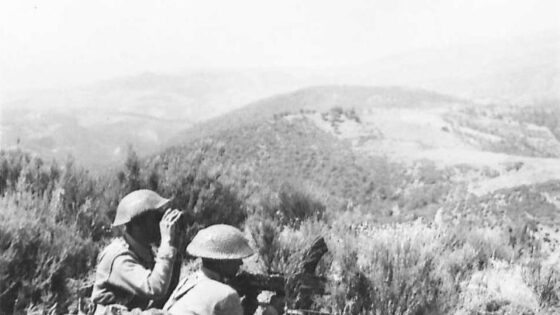
- 1Under Lignano11–14 July
- 2The capture of Monte Lignano14–15 July
- 3Camurcina, Poggio Altoviti e la vittoria che la BBC non raccontò15–20 July
One in the morning, 15 July
At one in the morning on 15 July 1944 the guns of three New Zealand artillery regiments, deployed on the plain of Castiglion Fiorentino, opened fire on the summit of Monte Lignano. A thunderstorm had passed over around midnight; the rain had stopped, but the sky was overcast and in the dark one could see about fifty metres [1]. Forty minutes later C Company of the 25th New Zealand Battalion began to climb, in single file, along the narrow ridge that leads to the summit. At five past three it reported to Battalion Headquarters that it had taken the summit [2].
It was a successful attack, and the Germans defending the mountain held out less than had been feared. The gravest danger of that night, in the New Zealanders’ accounts, came from the shells that for an hour kept falling on the summit after it had been taken, and which the battalion attributed to its own guns [3]. A few hours later, on the telephone, the chief of staff of the German Tenth Army was saying: ‘We must accept the loss of M. Lignano’ [4].
This is the second of three pages on the battle of Monte Lignano. The first, Under Lignano, tells of the three days before the attack; the third will tell of the capture of Camurcina and Poggio Altoviti and of the silence that covered the New Zealand victory.

Castiglion Fiorentino and, on the left, Monte Lignano seen from the headquarters of the 6th New Zealand Infantry Brigade, about 16 July 1944. Photo George Kaye. Credit requested by the archive: Kaye, George Frederick, 1914-2004. View from 6 NZ Infantry Brigade HQ showing Castiglione and Lignano, Italy, World War II – Photograph taken by George Kaye. New Zealand. Department of Internal Affairs. War History Branch: Photographs relating to World War 1914-1918, World War 1939-1945, occupation of Japan, Korean War, and Malayan Emergency. Ref: DA-06367-F. Alexander Turnbull Library, Wellington, New Zealand. https://natlib.govt.nz/records/22734352
The summit that looked out over Arezzo
Monte Lignano (838 metres) is the highest peak of the range that closes the Val di Chiana to the south-east, between Rigutino and Arezzo. From the summit one can see the whole valley, State Road 71 and the railway, and to the north the city. In July 1944 it was the main strongpoint of the German defence of Arezzo: the New Zealand official history calls it ‘the dominant peak in the Arezzo defence system’, and the commander of the German Tenth Army gave the same reason in simpler words: from Lignano the enemy could see right to Arezzo [5].
The Germans held the ridge with units of the 15th Panzergrenadier-Division and the 94th Infanterie-Division. By day they stayed on the slope facing Arezzo, which the Allied observers could not see, and they came up onto the ridge at night; a house on the summit, the ‘red house’ of the sources, served them as an observation post [6]. The 25th Battalion had arrived below the mountain on the night of 12–13 July, taking over from the British riflemen of the King’s Royal Rifle Corps, and for the next two days it had been under mortar and artillery fire. Before the attack it had already lost seven killed and fourteen wounded [7]. Those days are told in the first page of this series, Under Lignano.
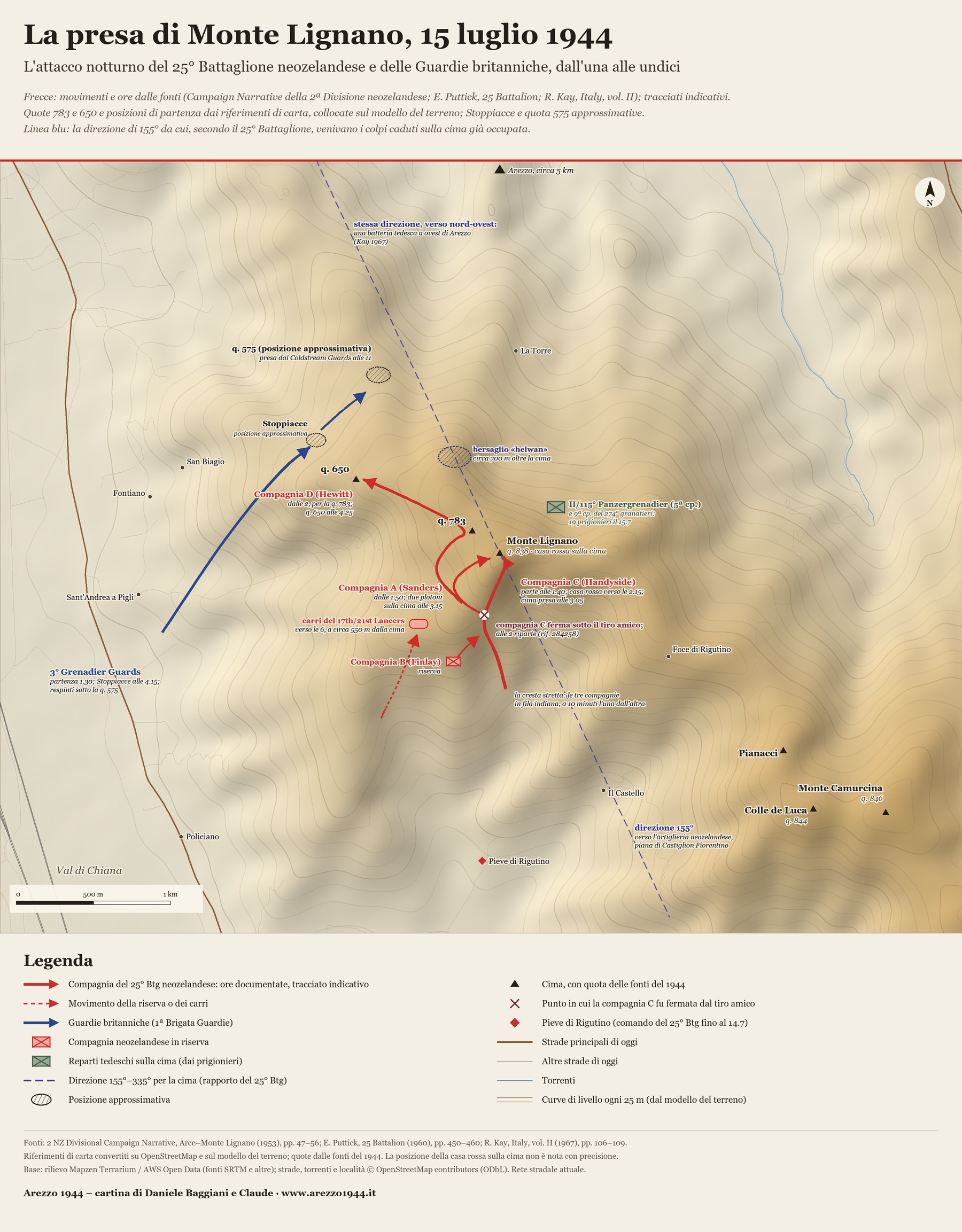
The capture of Monte Lignano, 15 July 1944: A, C and D Companies of the 25th New Zealand Battalion climb the same ridge and divide below the summit; on the left, the Grenadier Guards head for Stoppiacce and Point 575. The blue line is the bearing of 155° from which, according to the battalion, came the shells that fell on the summit after it had been taken: in one direction the plain of Castiglion Fiorentino, with the New Zealand artillery, in the other, beyond Arezzo, a German battery. The line of the arrows is indicative; the positions are derived from the map references in the sources and placed on the terrain model, and those of Stoppiacce and Point 575 are approximate. Compiled by arezzo1944.it from the Campaign Narrative of the 2nd New Zealand Division (1953) and the New Zealand official histories (Puttick 1960; Kay 1967); base © OpenStreetMap contributors, relief Mapzen Terrarium. Map by Daniele Baggiani and Claude.
The plan
On the morning of 14 July, at the headquarters of the British 6th Armoured Division, the attack on Arezzo was decided. The 1st Guards Brigade, with the tanks of the 17th/21st Lancers, was to take the heights at the head of the Val di Chiana, south-west of the city; then the 26th Armoured Brigade would pass through into the Arezzo plain to reach the bridges over the Arno. At the same time Brigadier J. T. Burrows’s 6th New Zealand Infantry Brigade was to take Monte Lignano and cover the right flank of the Guards [8].
The Guards were to attack along the lower slopes of Lignano, west of the mountain. The 3rd Battalion Grenadier Guards was to take the house at Stoppiacce and Point 575; the 2nd Battalion Coldstream Guards Point 501, the Val di Romana and the Paradiso; the 3rd Battalion Welsh Guards the height of Point 422 [9].
The task of Lieutenant-Colonel E. K. Norman’s 25th Battalion, reinforced by a machine-gun platoon and two troops of tanks of the 17th/21st Lancers, was to take the summit of Lignano, Point 838, and then Point 650, a good kilometre further north-west. The final orders, given by Norman on the afternoon of the 14th, entrusted the summit to A Company (Major N. K. Sanders) and C Company (Major M. Handyside). D Company (Major Hewitt) was to go round the summit on the west side, a little lower down, take Point 783, about 450 metres to the north-west, and from there follow the ridge westwards as far as Point 650. B Company (Major Finlay) would occupy the positions left by C Company. Once the battle was over, the 24th Battalion would relieve the 25th [10]. Before evening Norman took the company commanders to a point from which the ground of the attack could be seen [11].
The fire plan was a heavy one. Two batteries each of the 4th and 5th Field Regiments were to engage the summit for an hour, first rapidly and then more and more slowly, searching an area of about 45 by 90 metres; the other batteries were to hit the eastern slope, Point 650 and a series of targets beyond the summit, up to a kilometre away. The brigade’s 4.2-inch mortars and a British medium battery also took part. Zero hour was one o’clock on 15 July. The 24th Battalion was to provide ammunition carriers, help the signallers to lay the telephone lines, add stretcher-bearers and set up a collecting point for prisoners [12].
The gunners knew that theirs was the hardest task. Lignano is steep, and the targets on the summit were only a few dozen metres from the points the infantry would pass through: a shell on a slightly too low trajectory would fall on the slope the battalion was climbing. All batteries were ordered to compute with care the angle of sight of each individual gun [13]. The forecast was for fine weather and excellent visibility, with no rain [14].
On the afternoon of the 14th the area where the battalion was waiting for zero hour was shelled twice by the German artillery, and the mortars bombarded it again at 9.15 p.m. and 11.40 p.m. The Germans seemed to suspect something: perhaps they had heard the noise of vehicles, perhaps they had seen movement, perhaps they had intercepted communications [15].
The thunderstorm
The forecast was wrong. Around midnight a thunderstorm broke. ‘Just before the barrage commenced a terrific thunderstorm broke, after threatening to do so for several hours’, Private J. M. Shinnick, of 15 Platoon, C Company, recalled two months later; fortunately it was over before the infantry moved [16]. Major Sanders, commanding A Company, wrote in his report that the sky was very cloudy and that visibility was about fifty metres [17].
At one o’clock the artillery opened fire along the whole front, also in support of the Guards’ attack on the left [18]. According to Shinnick the first shells fell on the New Zealand positions, killing and wounding some men; his platoon was down to twenty-one men, and the others were not much better off [19].
At 1.40 a.m. C Company moved off, with two platoons forward and the sections in single file. A and D Companies followed, ten minutes apart [20]. All three had to take the same route, a fairly narrow ridge, and there was no room to deploy until they reached the slopes of the summit. ‘The terrain was such that the start line could only be reached by scrambling almost on hands and knees in single file’, Shinnick said. In the dark, so as not to get lost, the men called out to one another, and Sanders noted that in this way they must have revealed to the Germans where they were [21].
At two o’clock a German wireless station began transmitting on the battalion’s frequency, with such interference that at Battalion Headquarters all the sets had to be re-netted and the frequency changed [22]. Meanwhile the German artillery was shelling the jeep track and the small gully where Battalion Headquarters had been until the day before; but the battalion had moved forward on the morning of the 14th, and that fire fell on empty ground [23].
Up the ridge
C Company advanced for ten minutes and then had to stop: ahead of it the shells of its own artillery, which was shelling the lower slopes of Lignano, were still falling. While it waited, one man was killed by a short round. At two o’clock the fire lifted, the company deployed and climbed quickly. It met the first opposition about 350 metres from the red house, but this did not slow it down. 14 Platoon, on the right, found no one; Lieutenant Trevor Collins’s 15 Platoon, on the left, killed about six Germans short of the house, took prisoners there, occupied the summit and drove the Germans back down the far side [24].
Shinnick’s account is that of a soldier in the leading platoon. After crossing a minefield and going round the spur on the far side, the platoon deployed and began to climb the face of the summit: ‘It was terribly rocky and often it was a case of helping one another over the obstacles.’ A first German weapon pit was silenced, then a second strongpoint; on the crest stood ‘a very badly shattered building’, the red house, and the platoon occupied it. Shortly afterwards a group of Germans arrived to strengthen the position around the house and found it already in New Zealand hands [25].
Further to the left, A Company reached the foot of the summit and deployed: Lieutenant R. S. Liddell’s 8 Platoon turned left for about 270 metres and then climbed; Lieutenant K. J. S. Bourke’s 9 Platoon did the same on the right; Lieutenant N. Lawson’s 7 Platoon stayed in reserve and was not needed. Resistance was slight: two or three machine-gun posts were quickly silenced [26]. Liddell noted in his report some Teller anti-tank mines with trip wires, badly laid: the wires were too slack to set them off. The German machine guns were still firing tracer, which gave away their positions, and flares were sent up only when the platoon was already on the objective; the defences were ‘shallow but well sited’. Bourke wrote that when they moved the pace became a little too fast, with some confusion and a few errors of direction [27].
At 3.05 a.m. C Company reported that it had taken its objective; ten minutes later A Company had two platoons on the summit. A little later nine prisoners captured by C Company reached Battalion Headquarters [28].
Under their own guns
At 2.27 a.m., when 15 Platoon was already at the red house, C Company reported shells around the house, and shortly afterwards confirmed that they were coming from the New Zealand artillery. According to the plan, the fire on the summit was to end at two o’clock. Stopping it proved difficult. The artillery forward observation officers accompanying the infantry had no radio, at the forward position of Battalion Headquarters, with which to speak directly to their regiments: the only way was through the battalion’s sets and the telephone line to Brigade Headquarters. Norman tried three times to have the fire lifted, without result. He then asked for it to be moved about 270 metres to the north and then, at about 2.50, a further 180 [29]. A Company, which had just arrived below the summit, also asked for it to be moved 450 metres [30].
‘We wirelessed back that the position had been taken and to lift the barrage, but it continued to whittle away at what poor protection we had, and for 20 minutes we had to endure our own concentrated shellfire’, Shinnick recalled. The two sections of his platoon that had pushed on beyond the house were caught in the shelling and reduced to two and four men. From the crest, he said, the flashes of the New Zealand guns could be seen, and from that moment one had about ten seconds to get under cover: in his view half the shells failed to clear the crest [31].
Major Handyside wrote that the summit was shelled by the New Zealand guns until three o’clock and that at this stage casualties were ‘considerable’. His company’s toll for 15 July was thirteen men: one killed and eight wounded by the fire of its own artillery, two killed and two wounded by enemy fire [32]. At 3.25 a.m. shells were still falling on the leading platoon, and two and a half hours later the same happened to D Company [33]. The narrator of the New Zealand divisional history called the short rounds of the artillery ‘a most disconcerting feature of the whole attack’ [34].
Whose guns were they? The battalion’s report lists fourteen incidents of friendly fire during 15 July, with sixteen casualties; six of them, between 2.25 and 3.25 a.m., on the summit of Lignano, where after two o’clock nothing was supposed to fall. The guns held responsible were, according to the battalion, on a bearing of 155 degrees, that is towards the south-south-east, which passed through the area where the New Zealand artillery was deployed. The same bearing, extended beyond the summit, crossed one of the targets of the fire plan, about 700 metres north-west of the summit. The history of the 25th Battalion concludes that either the guns that were to engage the summit did not lift at two o’clock, or those that were to hit the target beyond the summit hit the summit instead [35]. Robin Kay’s official history, written a few years later, observes that the same bearing, extended in the opposite direction, passed through a German battery just west of Arezzo, and that the German artillery had surveyed the ground well: at least some of that fire, if not all of it, may have been German [36]. The sources consulted do not allow a decision.
Point 650 and Stoppiacce
D Company had set off last and had the longest way to go. At about 2.50 it was on the western slope of the summit; at 3.30 it passed A Company, then was held up until 4.20. At 4.25 one of its platoons was on Point 650 and fifteen minutes later the second was there too. There the Germans defended themselves more stubbornly than on Lignano [37].
On the left the Guards had set off at 1.30. The Grenadier Guards took the house at Stoppiacce, less than 400 metres north-west of Point 650, at 4.15, after a short fight; but the company sent towards Point 575, north-east of Stoppiacce, was counter-attacked and pushed back about 270 metres, and the squadron of the 17th/21st Lancers that went to its help at dawn came under fire from anti-tank guns. Point 575 was taken by the Coldstream Guards at 11 a.m. Point 501, reached in the afternoon, was lost to a counter-attack and retaken at 6.45 p.m., under an artillery smoke screen [38]. Fighting with the Coldstream was S Company of the Scots Guards under Captain Andrew Shennan Neilson, who was wounded by an anti-personnel mine during the assault and died of his wounds: his story is told on the page Capitano Andrew Shennan Neilson, DSO. Scots Guards caduto a Stoppiacce.
At dawn
Norman feared the counter-attack that the Germans usually launched after losing a position. At 4.45 a.m. he asked for the tanks to come up in support of the forward companies. The tanks climbed from the south-west the ridge leading to Lignano and at about six o’clock stopped about 550 metres from the summit: higher up the ground did not allow it. From there they could still stop an attack from the west, and their presence so high up made a strong impression on the infantry [39]. A telephone line reached A and C Companies, and an artillery forward observation officer reached C Company within half an hour [40].
An hour before sunrise, which that day was at 5.42, all the companies and Battalion Headquarters came under heavy mortar fire. The German guns firing on the battalion could be seen, but the link between the observation post and the artillery broke down, and at 8.30 a.m. Norman asked that the dive-bombers, already at work on the Guards’ front, should attack those guns [41].
At first light the 25th Battalion was firmly established on the mountain: A Company on the summit, C Company a little to the south-east, D Company on the ridge between Point 783 and Point 650, B Company in reserve on the southern slope [42]. At seven o’clock the battalion counted forty casualties in the previous twenty-four hours: five killed, one officer and thirty-three other ranks wounded, one missing. About twenty Germans were killed; nineteen were taken prisoner, thirteen from 5th Company, II Battalion, Panzergrenadier-Regiment 115 and six from 9th Company, Grenadier-Regiment 274 [43].
The prisoners of the 115th were the most reticent under interrogation: according to the division’s intelligence report, the regiment had not altogether lost its ‘traditional desert security’. The report nonetheless stated that they had been ordered to hold on to the last man, and that shortly afterwards they had heard an officer say that there would probably be a withdrawal that night or the next: ‘They were spared the unwanted mental exercise of resolving this contradiction’, the writer concluded, ‘by the arrival of our barrage and our troops’ [44].
15 July on the summit
The counter-attack did not come. Throughout 15 July the battalion’s positions on Lignano were hit at intervals by German mortars and artillery, and again by its own: between 1 p.m. and 9.40 p.m. the battalion reported six times that the New Zealand artillery was firing on the forward companies, one gun in particular that would not stop. ‘Despite contact with Div Arty one gun continued to offend’, the battalion war diary noted at 1.45 p.m. Two men were killed [45].
After dark a patrol from D Company made contact with the Guards on the left and returned with five prisoners captured near Point 650 [46]. The jeeps managed to bring the rations, the greatcoats and a blanket per man as far as Battalion Headquarters, saving the carriers a great deal of effort; but from there to the summit, as Private W. P. T. Peters of C Company put it, rations and ammunition went up ‘by the blood, sweat, and tears method’ [47]. B Company of the 24th Battalion was placed at the battalion’s disposal as a reserve, in case of a German attack. The night was quiet [48].
On the right, meanwhile, the 24th Battalion was still held up below Colle de Luca, the western summit of Camurcina, and the Germans held Camurcina and Poggio Altoviti. On the afternoon of the 15th Brigadier Burrows ordered them to be attacked at two o’clock the following night [49].
On the telephone, on the other side
Why did the Germans not counter-attack? The answer lies in the telephone conversations between the German headquarters, transcribed in the war diary of the Tenth Army and fallen into Allied hands at the end of the war [50]. The New Zealand intelligence officers, on the morning of the 15th, knew only that the enemy had not launched the immediate counter-attack called for by his doctrine, and wrote that he would have to succeed in a counter-attack ‘or accept the consequences’, that is, put the whole Arezzo position at risk [51].
At 9.05 a.m. General Fritz Wentzell, chief of staff of the Tenth Army, telephoned Oberst H. W. Runkel, chief of staff of LXXVI Panzer Corps: ‘We must accept the loss of M. Lignano… The withdrawal to the next line will take two days. A strong rearguard immediately north of Arezzo will hold on for a day…’ [52]. Within the hour the army commander, General Heinrich von Vietinghoff, explained the situation to the headquarters of Army Group C: the penetration on the left flank of the 15th Panzergrenadier-Division, which had led to the loss of Lignano, had been caused by a strong attack with a limited objective. ‘I don’t like it because the enemy shelling is so heavy down there that I don’t want to mount a counter-attack, which would be very costly. On the other hand, from Lignano the enemy can see right to Arezzo’ [53].
At 11.10 a.m. Wentzell spoke to Oberst Dietrich Beelitz, head of the operations section of Army Group C: ‘Firstly we have lost M. Lignano. From there the enemy has a view of Arezzo. Therefore we can not remain there much longer. The whole artillery of the enemy is ranging on M. Lignano. A counter attack would be very costly and is out of the question.’ Beelitz replied that Generalfeldmarschall Kesselring agreed with him: with Monte Lignano in enemy hands they had to withdraw [54]. At 11.25 a.m. LXXVI Corps was authorised to make a two-day delaying withdrawal towards the Arno, to a new line through Gaiole, Levanella, Ponte a Buriano, three kilometres north of Arezzo, and Molino Nuovo, not to be reached before the morning of the 17th [55].
At 1.40 p.m., in another telephone call between the two headquarters, to the question whether the line of the 305th Division still ran over Monte Lignano, the answer was: ‘The enemy is on the feature.’ The heights east and south-east of Arezzo, it was said that evening, had to stay in German hands as long as possible, because from there one could see the country south-west of the city [56].
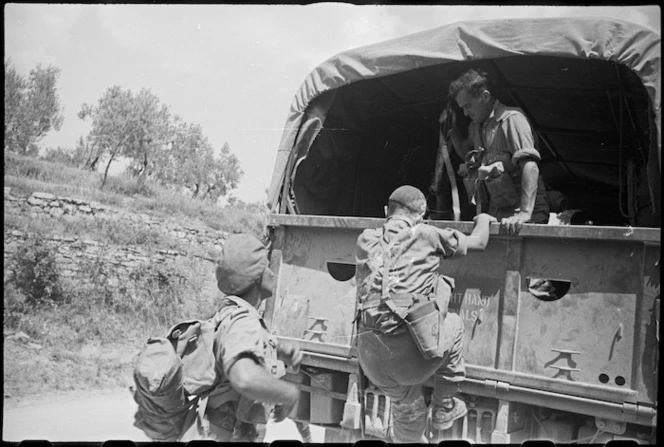
New Zealand infantrymen climb onto a truck to return to the rear after the attack on Monte Lignano, about 16 July 1944: the 25th Battalion left the mountain at midday on the 16th. Photo George Kaye. Credit requested by the archive: Kaye, George Frederick, 1914-2004. World War II New Zealand Infantry troops climbing onto truck for transport to rear after assault on Lignano, Italy – Photograph taken by George Kaye. New Zealand. Department of Internal Affairs. War History Branch: Photographs relating to World War 1914-1918, World War 1939-1945, occupation of Japan, Korean War, and Malayan Emergency. Ref: DA-06392-F. Alexander Turnbull Library, Wellington, New Zealand. https://natlib.govt.nz/records/22663651

Men of the 26th New Zealand Battalion leave the front line, about 16 July 1944. The archive record speaks of an ‘assault on Mt Lignano’: the 26th fought in the same battle, on Poggio Spino and Poggio Altoviti; Lignano was taken by the 25th Battalion. Photo George Kaye. Credit requested by the archive: Kaye, George Frederick, 1914-2004. Members of 26 New Zealand Battalion on way out from front line after assault on Mt Lignano, Italy – Photograph taken by George Kaye. New Zealand. Department of Internal Affairs. War History Branch: Photographs relating to World War 1914-1918, World War 1939-1945, occupation of Japan, Korean War, and Malayan Emergency. Ref: DA-06380-F. Alexander Turnbull Library, Wellington, New Zealand. https://natlib.govt.nz/records/22733713
The day after
At two o’clock on the night of 15–16 July the 24th and 26th Battalions attacked Camurcina and Poggio Altoviti and found them abandoned. After first light a patrol of the 24th reached A Company of the 25th on Lignano [57]. That morning the British 26th Armoured Brigade broke through at the head of the Val di Chiana, and at 9.45 a.m. the tanks of the 16th/5th Lancers entered Arezzo [58].
The 25th Battalion left Lignano at midday on 16 July, without further casualties, and was taken back to the rear area of the 6th Brigade [59]. Its losses in the Lignano days were 17 other ranks killed and 4 died of wounds, 3 officers and 41 other ranks wounded [60]. That same day, at a divisional conference, General Bernard Freyberg congratulated the 6th Brigade: ‘I do think that the attack by 25 Battalion was a very admirable one and a very tidy one. It was a very difficult operation’ [61].
Lieutenant-Colonel Norman was awarded the Distinguished Service Order for the close and hazardous forward reconnaissance he had made and for planning and leadership to which the success was largely due; Major Handyside also received it, Brigadier Burrows received a second, and Sergeant W. R. Leslie and Private T. J. Schultz were awarded the Military Medal [62]. The division passed into corps reserve, and the battalion had eight days’ rest before being sent towards Florence [63].

Men of the 26th New Zealand Battalion who had taken part in the battle of Lignano wait for transport to the rear for a period of rest, about 16 July 1944. Photo George Kaye. Credit requested by the archive: Kaye, George Frederick, 1914-2004. Members of 26 New Zealand Battalion who took part in attack on Lignano, Italy, awaiting transport to rear – Photograph taken by George Kaye. New Zealand. Department of Internal Affairs. War History Branch: Photographs relating to World War 1914-1918, World War 1939-1945, occupation of Japan, Korean War, and Malayan Emergency. Ref: DA-06378-F. Alexander Turnbull Library, Wellington, New Zealand. https://natlib.govt.nz/records/22772901
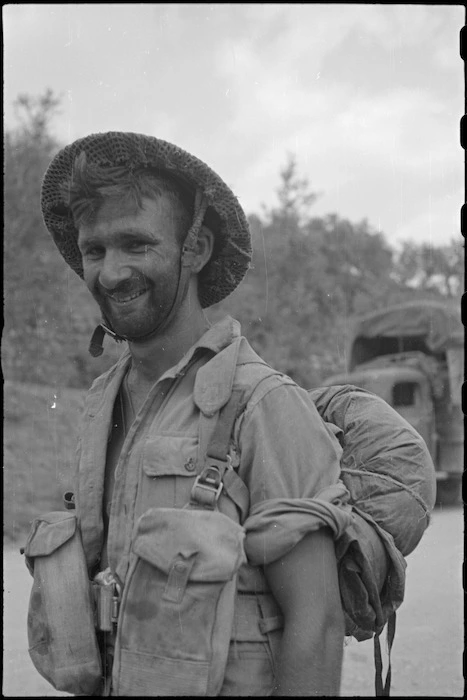
The New Zealand soldier L. B. Quinn waits for transport to the rear after the attack on Monte Lignano, about 16 July 1944. The original caption does not give his unit. Photo George Kaye. Credit requested by the archive: Kaye, George Frederick, 1914-2004. L B Quinn waits for transport to rear after assault on Mt Lignano, Italy, World War II – Photograph taken by George Kaye. New Zealand. Department of Internal Affairs. War History Branch: Photographs relating to World War 1914-1918, World War 1939-1945, occupation of Japan, Korean War, and Malayan Emergency. Ref: DA-06377-F. Alexander Turnbull Library, Wellington, New Zealand. https://natlib.govt.nz/records/23159615
Remembering the fallen of Lignano
Between 15 and 20 July 1944 fourteen soldiers of the 25th Battalion died: eleven on 15 July, on the summit or of wounds received in the attack, and three in the following days, of their wounds. The names are those of the Roll of Honour in the battalion history [64].
- Killed on 15 July: Corporal Trevor Conwell; Corporal E. W. Cameron; Privates P. E. Chisholm, K. Gibb, A. G. Lowe, Ernest McKinley, Clement George Nicholls, Joseph Paul Stratford, John Alan Mark Woods.
- Died of wounds on 15 July: Privates William Denis O’Keeffe and K. N. Williams.
- Died of wounds in the following days: Privates Conrad Walter Jury (17 July), Oswald William Mickell (18 July), Alexander Walker Whyte (20 July).
The nine who fell on 15 July lie at Indicatore, in Arezzo War Cemetery, in the same row as those who fell in the preceding days, Row A of Plot III. The five who died of wounds are buried in Assisi War Cemetery. The youngest, McKinley, was 21, as was Cameron; the oldest, Nicholls, 38 [64]. With the eight men of the 25th Battalion who fell on 13 and 14 July, remembered in the first page of this series, they number twenty-two.
With them we should remember the British Guardsmen who fell on the slopes of the same mountain, the twenty or so German soldiers killed on the summit, whose names the sources consulted do not give, and the civilians of the houses on Lignano.
This page was rewritten in November 2026 from the sources listed in the bibliography. The previous Italian version contained some errors, corrected here: the attack began at one in the morning and not at dawn; the division came from Arce and not from Avezzano; the British tanks entered Arezzo on the morning of 16 July and not in the evening; Freyberg’s judgement is the one quoted above; the information on the German decision to withdraw comes from the transcripts of the telephone calls of the German headquarters and not from ‘intercepted radio reports’.
In brief
- Monte Lignano (838 metres), between Rigutino and Arezzo, was in July 1944 the main strongpoint of the German defence of Arezzo. From the summit the Val di Chiana and the city could be seen.
- On 14 July the Allied commanders fixed the attack for one o’clock on the 15th: the British Guards on the lower slopes to the west, Lieutenant-Colonel Norman’s 25th New Zealand Battalion on the summit and on Point 650.
- Around midnight a thunderstorm reduced visibility to about fifty metres. At one o’clock three New Zealand artillery regiments opened fire; at 1.40 a.m. C, A and D Companies climbed in single file along the same narrow ridge.
- German resistance was slight. Lieutenant Collins’s 15 Platoon took the red house on the summit; at 3.05 a.m. C Company reported that it had taken its objective, and at 4.25 a.m. D Company was on Point 650.
- For an hour shells kept falling on the summit after it had been taken. The battalion attributed them to its own artillery; Kay’s official history points out that they may also have been German.
- At dawn the battalion had five killed and thirty-four wounded, had killed about twenty Germans and taken nineteen prisoners. The Guards took Stoppiacce and, after hard fighting, Points 575 and 501.
- On the morning of the 15th the German Tenth Army, with Kesselring’s agreement, gave up any counter-attack and at 11.25 a.m. authorised the withdrawal towards the Arno. On the 16th, at 9.45 a.m., British tanks entered Arezzo.
- Between 15 and 20 July fourteen men of the 25th Battalion died; nine lie in Arezzo War Cemetery, at Indicatore, and five in Assisi War Cemetery.
Notes
Abbreviations: CN = 2 NZ Divisional Campaign Narrative, ‘From the Arce Rest Area to Monte Lignano (Arezzo)’, 1953; KAY = R. Kay, Italy Volume II: From Cassino to Trieste, 1967; P25 = E. Puttick, 25 Battalion, 1960.
The yards and feet of the sources are given in rounded metres (100 yards ≈ 90 m). Times are those of the Allied sources; those of the German conversations are those of the Tenth Army war diary, as cited by the New Zealand sources. The six-figure map references (100-metre grid) have been compared with OpenStreetMap and with a terrain model. Web pages were consulted on 16 November 2026.
[1] P25, p. 453 (‘At 1 a.m. on 15 July the artillery concentrations opened as planned’); KAY, p. 106 on the position of the regiments (‘which were located in the Castiglion Fiorentino area’); KAY, p. 107 (‘There was a thunderstorm about midnight’); Major Sanders’s report in P25, p. 456 (‘rain had fallen round midnight. Visibility was only about 50 yards’).
[2] P25, p. 453 (‘Forty minutes later C Company moved along the ridge leading up the slopes of Monte Lignano’); P25, p. 454 (‘At five minutes past three C Company reported the capture of its objective on Monte Lignano’).
[3] P25, p. 459 (‘The only serious trouble encountered in the attack by 25 Battalion was the shellfire reported on many occasions, and from several sources, as coming from the supporting artillery’). See the section ‘Under their own guns’.
[4] P25, p. 458; CN, p. 62 (‘We must accept the loss of M. Lignano…’). See note 52.
[5] KAY, p. 109 (‘The loss of Monte Lignano, the dominant peak in the Arezzo defence system, meant that the Germans would have to withdraw’), an expression already found in CN, p. 57; von Vietinghoff’s words in P25, p. 459 (‘from Lignano the enemy can see right to Arezzo’). Height: CN, p. 47 (point 838, reference 285262); KAY, p. 106.
[6] Units: CN, p. 54 (prisoners from Panzergrenadier-Regiment 115 of the 15th Panzergrenadier-Division and from Grenadier-Regiment 274); the 274th belonged to the 94th Infanterie-Division. Ridge held at night: CN, p. 23 (KRRC patrol of 11 July); see the first page of the series. Red house used as an observation post: CN, p. 51; P25, p. 453 (‘a red house reported by Collins to have mines around it’).
[7] P25, p. 452 (‘The casualties reported prior to the attack were seven killed and one officer (Second-Lieutenant de Lautour) and thirteen other ranks wounded’). On the number of dead before the attack (seven or eight) see note 64.
[8] KAY, p. 106 (‘Concurrently with the first phase of this attack, 6 NZ Infantry Brigade was to clear Monte Lignano and protect the right flank of the Guards Brigade’); CN, p. 47 (conference on the morning of the 14th at the headquarters of the 6th Armoured Division; heights of Agazzi, reference R2430). Burrows’s initials: P25, biographical note 3 to ch. 14.
[9] CN, p. 47. The sources write ‘Stoppiace’; we use the spelling ‘Stoppiacce’ already adopted on this site. The place does not appear in OpenStreetMap; according to P25, p. 451, it was ‘400 yards north-west of D Company’s objective’.
[10] P25, pp. 450–452; KAY, pp. 106–107 (‘Point 650, about 1200 yards north-west of the summit of Lignano’; ‘D Company to take Point 783, 500 yards to the north-west, and then clear the ridge running 700 yards westward to Point 650’). Order of the 13th on the relief by the 24th: P25, p. 451. Time of the final orders: CN, p. 48 (3 p.m.). Norman’s initials: KAY, biographical note to ch. 3; those of Sanders and Handyside: CN, p. 51.
[11] P25, p. 452 (‘Colonel Norman then took the company commanders forward to a point where the ground to be covered by the attack could be seen’).
[12] P25, p. 451 (‘Two batteries from each of 4 and 5 Field Regiments were to engage the peak of Monte Lignano for an hour, first rapidly, then very slowly, and finally slowly, and at the same time search an area of fifty yards by a hundred yards at the peak’; ‘Zero hour was to be 1 a.m., 15 July’); CN, p. 48 (nine targets, a programme of two and a half hours; British battery 20/21 Medium Battery RA).
[13] P25, p. 451 (‘It was recognised that the precipitous nature of the country made the task of the artillery very difficult and instructions were issued to all batteries that “care will be taken in computing correct Angle of Sight for individual guns during fire plan”’). The explanation of the risk is ours.
[14] CN, p. 49.
[15] P25, p. 452 (‘It seemed as if the Germans had some inkling of the impending attack, probably from the noise of vehicles, from observation, and from interceptions of telephone or wireless messages’).
[16] Interview with Private J. M. Shinnick, September 1944, in P25, p. 454 (‘Just before the barrage commenced a terrific thunderstorm broke, after threatening to do so for several hours. Fortunately it finished before we started the attack’); KAY, p. 107, note 2.
[17] P25, p. 456 (‘The sky on the night 14/15 was very cloudy’).
[18] KAY, p. 107 (‘The artillery bombardment on the New Zealand front and in support of the Guards Brigade’s attack on the left opened at 1 a.m. on the 15th’).
[19] P25, p. 454 (‘the first few shells landed in our positions killing several and wounding others’; ‘Our platoon strength was now 21, and the other platoons were little better’). Shinnick places the start of the barrage at 11 p.m. and the forming up for the attack at midnight; the editor of the battalion history marks the times as doubtful (‘[? 1 a.m.]’). His statement that there was a gap of only ‘10 feet’ (3 metres) between the fire and the infantry is also judged by the editor to be ‘surmise or rumour’.
[20] Major Handyside’s report in P25, p. 455 (‘C Company left the start line at 0140 hours with two platoons forward and sections in single file’); P25, p. 453 (‘each company keeping ten minutes’ interval from the company in front’); CN, p. 50 (A at 1.50 a.m., D at 2 a.m.).
[21] P25, p. 454 (‘The terrain was such that the start line could only be reached by scrambling almost on hands and knees in single file’); Sanders’s report, P25, p. 456 (‘The approach to the objective was a fairly narrow ridge and this approach had to be used by all three companies’; ‘This was done by shouting to each other which must also have disclosed our whereabouts to the enemy’); KAY, p. 107.
[22] P25, p. 452 (‘an enemy wireless station, operating on the same frequency at 2 a.m. during the attack, caused such interference that it was necessary to re-net all sets at Battalion Headquarters and change the frequency’); CN, p. 50.
[23] P25, p. 453 (‘the forward concentration of the battalion in the early morning of the 14th—a wise move—therefore avoided this fire’).
[24] Handyside’s report, P25, pp. 455–456 (‘While waiting for the barrage to lift off the lower slopes of Lignano, one man was killed by shorts from our own guns. When the barrage lifted at 0200 the Company deployed and advanced quickly up the hill. First opposition was met 400 yards from the red house’; ‘15 Platoon on the left killed about 6 Germans short of the red house and took prisoners at the red house, then secured the peak, and drove the enemy down the other side’).
[25] P25, p. 455 (‘It was terribly rocky and often it was a case of helping one another over the obstacles’; ‘We made the crest on which was a very badly shattered building [the red house] and we occupied it’; ‘a group of Jerries came in to consolidate their positions on the house but found us already in occupation’); KAY, p. 107.
[26] P25, p. 453 (deployment of the platoons); Sanders’s report, P25, p. 456 (‘Very little opposition was encountered. The 2 or 3 Spandau posts were quickly silenced, and the reserve platoon (No. 7) was not committed’). Liddell’s initials: P25, biographical note 5.
[27] Liddell’s report, P25, p. 457 (‘Several badly-laid Teller mines encountered, trip wires attached. No casualties as wires were too slack. Spandaus still fire tracer giving away location of M.G. posts. Contrary to usual, enemy did not use flares until Pl was on objective. Enemy defences shallow but well sited’); Bourke’s report, ibid. (‘the pace became a little fast with some resultant confusion and loss of direction’).
[28] P25, p. 454 (‘nine prisoners of war from C Company arrived at Battalion Headquarters’).
[29] P25, p. 453 (‘Twelve minutes later C Company reported that shells were falling in the vicinity of the red house and then confirmed that they were from the supporting artillery’; ‘direct communication between the FOOs accompanying the infantry and their respective artillery regiments could not be established because of their lack of R/T equipment in the forward position occupied by Battalion Headquarters’; ‘Three unsuccessful attempts to have the fire lifted were made by Colonel Norman’). The time of 2.27 a.m. is deduced from the text (‘At 2.15 a.m.… Twelve minutes later’). P25 places Norman’s second request ‘thirteen minutes later, at 2.15 a.m.’, a time that does not fit the sequence; CN, p. 53 puts it at 2.50 a.m.: we follow CN.
[30] P25, p. 454 (‘A Company made a similar complaint, asking that the fire be lifted 500 yards to the north’); CN, p. 53.
[31] P25, p. 455 (‘We wirelessed back that the position had been taken and to lift the barrage, but it continued to whittle away at what poor protection we had, and for 20 minutes we had to endure our own concentrated shellfire’; ‘they were caught in our own barrage and shortly reduced to the numbers of two and four’; ‘50 per cent of the shells failed to clear the crest. From the crest our own artillery flashes could be seen and you then had about 10 seconds to get under cover’).
[32] Handyside’s report, P25, p. 456 (‘The peak was shelled by our own guns until 0300 hours and casualties were considerable at this stage’; ‘Casualties on 15 July 13. Own artillery 1 killed 8 wounded. Enemy action 2 killed 2 wounded’).
[33] P25, p. 454 (‘shells which at 3.25 a.m. were reported still to be falling short, and as much as two and a half hours later D Company was to have a similar experience’).
[34] CN, p. 52 (‘a most disconcerting feature of the whole attack’).
[35] P25, pp. 459–460 (‘In six of the incidents—from 2.25 a.m. to 3.25 a.m. on the 15th—the shells fell near the summit of Lignano, which was the target for concentrations—code name helmieh—timed to end at 2 a.m.’; ‘The guns deemed responsible were reported to be on a bearing of 155 degrees, which passed through the area occupied by the supporting artillery’; ‘either the guns firing the helmieh concentrations failed to lift at 2 a.m. in accordance with the plan, or those firing the helwan concentrations on targets 750 yards beyond Lignano were responsible’); KAY, p. 108 (fourteen incidents, sixteen casualties).
[36] KAY, p. 108 (‘the bearing cited by 25 Battalion as the source of the shelling, if extended in the opposite direction, passed through the site of a German battery just west of Arezzo. It is quite possible, therefore, that this battery or some other German long-range guns were responsible for at least some if not all of the damaging fire’), who cites W. E. Murphy, 2nd New Zealand Divisional Artillery, p. 612 (‘The German artillery had the area well surveyed’). Murphy’s volume has not been consulted directly.
[37] CN, p. 53; P25, p. 457 (‘reported a platoon on the objective at 4.25 a.m. and a second platoon there fifteen minutes later’); KAY, p. 107 (‘where it overcame a more stubborn resistance than the enemy had offered on Lignano’).
[38] CN, pp. 55–56; KAY, pp. 108–109 (‘A battalion of the Grenadier Guards captured Stoppiace, less than half a mile from Point 650, after a short fight, but a company directed to Point 575 (north-east of Stoppiace) was counter-attacked and forced back 300 yards from the crest’); P25, p. 458 (Stoppiace at 4.15 a.m.). Kay does not give the number of the height retaken in the afternoon; Point 501 and the time of 6.45 p.m. are in CN, p. 56.
[39] P25, p. 457 (‘Enemy counter-attack after the loss of a position was regarded as automatic and standard procedure’; ‘about 6 a.m. took up a position about 500 yards west of B Company, with one tank a little closer, and within 600 yards of the summit, the rough ground preventing further progress’; ‘the moral effect of their presence well forward was considerable’).
[40] P25, p. 457 (‘a line being run forward to A and C Companies and an artillery FOO reaching C Company within half an hour’).
[41] P25, pp. 457–458 (‘As day was dawning, about an hour before sunrise, which was at 5.42 a.m., all companies and Battalion Headquarters were under heavy mortar fire’; ‘at 8.30 a.m. Colonel Norman asked that dive-bombers, which were active on the Guards’ front, should attack the guns’).
[42] KAY, p. 108; CN, p. 54.
[43] CN, p. 54 (the 7 a.m. return). The figures in the sources do not coincide because they refer to different periods: P25, p. 457 gives for the attack ‘nine killed, two died of wounds, and twenty-seven wounded’; KAY, p. 108 for the whole of 15 July ‘12 dead and 27 wounded’; on the prisoners all agree (‘About twenty of the enemy were killed and nineteen taken prisoner’, P25, p. 457).
[44] CN, p. 54, quoting the division’s intelligence summary no. 292 (‘the Regiment… has not altogether lost its traditional desert security’; ‘They had been told that they must hold on to the last man, but their German minds were somewhat confused when, shortly after this order was given, an officer had been overheard to comment that a withdrawal would probably take place last night or tonight. They were spared the unwanted mental exercise of resolving this contradiction by the arrival of our barrage and our troops’).
[45] P25, p. 458 (‘between 1 p.m. and 9.40 p.m. there were no fewer than six reports of the supporting artillery shelling the forward companies, one gun in particular continuing to offend. Two men were killed’); CN, p. 55 (battalion war diary, 1.45 p.m.: ‘Despite contact with Div Arty one gun continued to offend’); Sanders’s report, P25, p. 456, on the German fire from 10 a.m.
[46] P25, p. 458 (‘After dark a patrol from D Company established touch with the Guards on the left and returned with five prisoners, captured in the vicinity of Point 650’).
[47] P25, p. 458 (‘rations and ammo were brought up by the blood, sweat, and tears method—right up to the top of the hill from below’). Peters’s initials: P25, biographical note 6.
[48] P25, p. 458 (‘Although it was expecting a counter-attack and B Company 24 Battalion had been ordered up to come under command as a reserve, 25 Battalion had a quiet night’).
[49] KAY, pp. 109–110; CN, p. 65 (the 4 p.m. conference).
[50] P25, p. 458 (‘is explained in conversations between enemy commanders, available from documents captured after the war’); KAY, p. 109, note 1 (‘War diary, Tenth Army’); CN, pp. 62–63, which quotes them from W. D. Dawson, German Army Documents, and from Canadian Report no. 24.
[51] CN, p. 62 (‘he must produce a successful counterattack, or accept the consequences… the jeopardising of the whole AREZZO position’).
[52] P25, p. 458 (‘“We must accept the loss of M. Lignano…,” said the Chief of Staff Tenth Army in a telephone conversation with the Chief of Staff 76 Panzer Corps at 9.5 a.m. on the 15th. “The withdrawal to the next line will take two days. A strong rearguard immediately north of Arezzo will hold on for a day….”’); the names of Wentzell and Runkel are in CN, p. 62.
[53] P25, pp. 458–459 (‘This penetration on 15 Pz Gren Div’s left, which has led to the loss of Lignano, was caused by a strong attack with a purely limited objective. I don’t like it because the enemy shelling is so heavy down there that I don’t want to mount a counter-attack, which would be very costly. On the other hand, from Lignano the enemy can see right to Arezzo’); CN, p. 62. Von Vietinghoff went on to say that this was an argument in favour of the withdrawal plan of General Lemelsen, commander of the Fourteenth Army (CN, p. 62).
[54] CN, p. 63 (‘Firstly we have lost M. Lignano. From there the enemy has a view of Arezzo. Therefore we can not remain there much longer. The whole artillery of the enemy is ranging on M. Lignano. A counter attack would be very costly and is out of the question’; ‘The Field Marshal agrees with me, with M. Lignano in the hands of the enemy we must withdraw’); KAY, p. 109.
[55] CN, p. 63; KAY, p. 109 (‘Permission was given for 76 Panzer Corps to make a delaying withdrawal, lasting two days, to the Arno River’).
[56] CN, p. 64 (‘The enemy is on the feature. But I learnt today from Corps that they have not pushed on any farther’); P25, p. 459 (‘The high ground east and south-east of Arezzo must stay in our hands as long as possible as from there we can see the country SW from Arezzo’).
[57] P25, p. 459; KAY, p. 110; CN, pp. 66–67.
[58] CN, p. 67.
[59] P25, p. 460 (‘Twenty-fifth Battalion concluded its task in the Monte Lignano sector at noon on 16 July, when without further casualties it withdrew to 6 Brigade’s B Echelon area’); CN, p. 69 (Brolio area, west of State Road 71).
[60] P25, p. 460 (‘its losses in the operations were 17 other ranks killed, 4 died of wounds, and 3 officers (Lieutenant Cameron, and Second-Lieutenants P. A. de Lautour and E. Cardale) and 41 other ranks wounded’). The casualty table in CN, p. 69, gives for the 25th Battalion 66 casualties between 12 and 19 July, of whom 22 dead: the same number as the names in the Roll of Honour (see note 64).
[61] P25, p. 460 (‘I do think that the attack by 25 Battalion was a very admirable one and a very tidy one. It was a very difficult operation’); CN, p. 69 (diary of the divisional commander, 16 July).
[62] P25, p. 460 (‘he had made a close and hazardous forward reconnaissance and his planning and sound leadership were largely responsible for the success of this important operation’; ‘For skilful and courageous leadership in this action, Sergeant Leslie was awarded the Military Medal’); CN, p. 56 (Burrows, Handyside, Schultz). The awards to Burrows and Handyside also recognised other actions.
[63] P25, p. 460.
[64] Roll of Honour of 25 Battalion (P25), NZETC. In the Roll of Honour O’Keeffe and K. N. Williams are shown as died of wounds on 15 July; with the nine killed on the same day they make up the eleven dead given by P25, p. 457 for the attack (note 43). With the eight killed on 13 and 14 July (see note 68 of the first page of the series) the Roll of Honour gives 22 dead of the battalion between 13 and 20 July, as does the table in CN, p. 69; P25, p. 460 gives 21. Burials and ages: Commonwealth War Graves Commission, Find War Dead (cwgc.org, consulted on 16 November 2026). Arezzo War Cemetery, Plot III, Row A: Stratford (aged 28) grave 10; Cameron (21) 12; Conwell (24) 13; McKinley (21) 14; Lowe (32) 15; Woods (26) 16; Chisholm (22) 17; Gibb (22) 23; Nicholls (38) 24. Assisi War Cemetery: Jury (22), VI. G. 2; O’Keeffe (25), VI. G. 3; Williams (23), VI. H. 2; Mickell (23), VI. H. 3; Whyte (24), VI. H. 7. For Williams the CWGC record (Kernick Norman Mounteagle Williams, died 15 July 1944) matches in initials, date and unit, but the search did not give an exact match of the name. Graves 8 and 9 of Row A have not been checked.
Bibliography and sources
Archival sources
- 2 NZ Divisional Campaign Narrative, ch. I, ‘From the Arce Rest Area to Monte Lignano (Arezzo), 13 June – 20 July 1944’, War History Branch, Department of Internal Affairs, Wellington, compiled in May–June 1953 (narrator A. G. Protheroe), typescript, copy no. 2, pp. 47–69; photographed by the editors. It contains, in quotation, the diary of the divisional commander, the reports of the company commanders, the division’s intelligence summaries and the transcripts of the telephone conversations of the German headquarters taken from Dawson, German Army Documents, and from Canadian Report no. 24. Cited as CN.
Official and unit histories
- Puttick, Sir Edward, 25 Battalion, War History Branch, Wellington 1960, ch. 14, pp. 450–461 and Roll of Honour; text: NZETC, http://nzetc.victoria.ac.nz/tm/scholarly/tei-WH2-25Ba-c14.html. Cited as P25. It contains the interview with Private J. M. Shinnick (September 1944) and the reports of Majors Handyside and Sanders and of Lieutenants Liddell and Bourke.
- Kay, Robin, Italy Volume II: From Cassino to Trieste, Official History of New Zealand in the Second World War 1939–1945, Historical Publications Branch, Wellington 1967, ch. 3, pp. 106–110; text: NZETC, http://nzetc.victoria.ac.nz/tm/scholarly/tei-WH2-2Ita-c3-3.html (web.archive.org copy). Cited as KAY.
- Not consulted directly: Murphy, W. E., 2nd New Zealand Divisional Artillery, Historical Publications Branch, Wellington 1966 (cited through KAY); Howard, Michael, and Sparrow, John, The Coldstream Guards 1920–1946, London 1951; Dawson, W. D., German Army Documents (cited through CN).
Online resources
- Commonwealth War Graves Commission, Find War Dead, records of the fallen, https://www.cwgc.org/find-records/find-war-dead/.
- National Library of New Zealand, Alexander Turnbull Library, photographs by George Kaye DA-06367-F, DA-06377-F, DA-06378-F, DA-06380-F and DA-06392-F, https://natlib.govt.nz/.
- New Zealand Electronic Text Collection (NZETC), Victoria University of Wellington, copies on web.archive.org.
- OpenStreetMap, data consulted with Nominatim, https://nominatim.openstreetmap.org/; Mapzen Terrarium / AWS Open Data, terrain model.
An invitation to readers
Do you live in Rigutino, Pieve di Rigutino, Sant’Andrea a Pigli, Fontiano, San Biagio or Policiano? Do you know where the ‘red house’ stood on the summit of Lignano, which the Germans used as an observation post and which the New Zealanders of 15 Platoon took on the night of 15 July 1944? Do you know where the house at Stoppiacce, the Palazzo, Case Lignano and Casa Vecchia were, and what Point 650 and Point 575 are called today? Have you heard stories of the night of the thunderstorm, of the shelling on the mountain, of the soldiers who came down from Lignano on 16 July? Do you have family memories, photographs, letters, documents? Are you descended from a New Zealand, British or German soldier who was here? Have you found a mistake? Write to us through our Contact page (www.arezzo1944.it/contatti/). Every contribution helps us to correct and enrich this page.